Important discussion of moral harm, moral repair and what can be done

Occupational health and safety (OHS) needs to talk more about failure, in a similar way that other business processes are dissected and reported. But the challenge to this, and I think the main reasons failure is not discussed, is that OHS failures result in serious injuries, life-altering conditions and deaths. OHS shares something with the medical profession which “buries its mistakes”. There appears to be something shameful in talking about these failures in public, although the OHS profession is full of chatty anecdotes in private.

One of the ways for OHS to discuss these uncomfortable experiences is to focus on Harm rather than legalities and the chase for compliance.

The first paragraph in Derek Brookes‘ new book, “Beyond Harm“, seems to speak to the OHS profession:

Subscribe to SafetyAtWorkBlog to continue reading.
Subscribe Help
Already a member? Log in here

Aim for prevention, to affect real change

The Minerals Council of Australia (MCA) has released its submission (not yet online) to the Safe Work Australia’s (SWA) review of the Regulatory Impact Statement on the recommendations from the Boland review of the Model Work Health and Safety laws. It is comprehensive but contains little that is new. An interesting interpretation of the submission comes from considering how the MCA’s recommendations prevent harm, for prevention is the challenge.

Subscribe to SafetyAtWorkBlog to continue reading.
Subscribe Help
Already a member? Log in here

Asia, maturity, grief, zero and data-collecting mouthguards – the SafetyConnect conference

Zero Harm is hardly ever mentioned in Australia’s academic occupational health and safety (OHS) conferences, except maybe with a little snigger. But it was prominent at the NSCAV Foundation’s SafetyConnect conference in late August 2019. This was partly because this conference has more of a commercial bent compared to other conferences but also because several international speakers from Asia were able to clarify what was meant by the term.

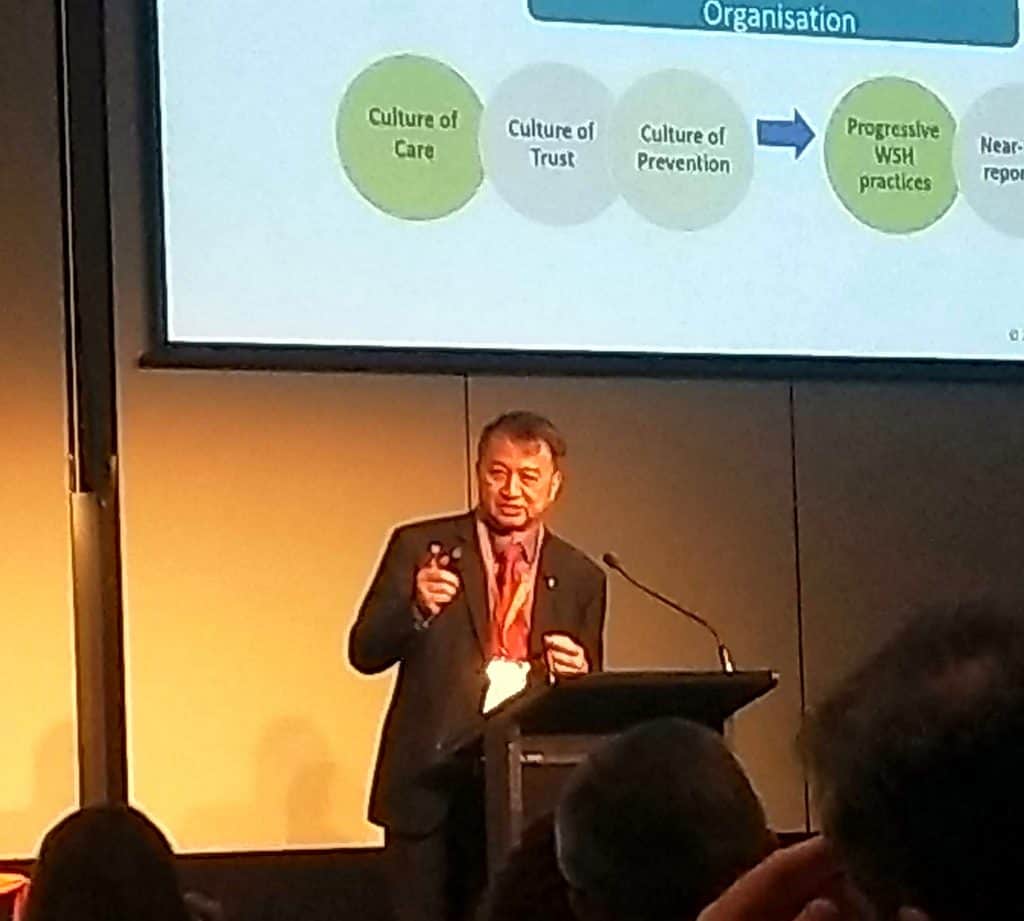
This conference had an enviable number of prominent Asian OHS professionals and engineers. One of them Ho Siong Hin (pictured above) explained the application of Vision Zero by the Singaporean government and business community.

Subscribe to SafetyAtWorkBlog to continue reading.
Subscribe Help
Already a member? Log in here

“no one wants to call out the real issue” says Tooma

In August 2019, lawyer and author Michael Tooma (pictured right) was the keynote speaker at the 2019 National Work Health and Safety Colloquium ostensibly talking about his May 2019 presentation to the United Nations Industrial Development Organization (UNIDO). It was an important presentation of the paper he wrote is important. However, it was in the questions afterwards, on Industrial Manslaughter laws and accountability, where Tooma was most passionate and personal.

Subscribe to SafetyAtWorkBlog to continue reading.
Subscribe Help
Already a member? Log in here

Time to ban synthetic stone

Professor Malcolm Sim of Monash University spoke at the 2019 National Work Health and Safety Colloquium on an issue that he never imagined he would be speaking of, at his age, silicosis.

As it is in several countries, the emergence of silicosis related to synthetic stone is gradually getting the attention of governments as more, and younger, workers are starting to die from this aggressive occupational disease. Professor Sim outlined the risk of handling this new type of stone by asking:

Subscribe to SafetyAtWorkBlog to continue reading.
Subscribe Help
Already a member? Log in here

The Interconnectedness Challenge

The solutions to most occupational health and safety (OHS) issues are multidisciplinary meaning that solutions are rarely simple and rarely come from a single source of information or knowledge. Recently I have been challenging my colleagues to spread their voices and experience beyond their own disciplines to illustrate how a worker’s health and safety is affected by a broad range of hazards and environments. I extend that challenge to all organisations including employer and industry groups like the Business Council of Australia (BCA) which has recently released a report on “The state of enterprise bargaining in Australia”.

Many organisations undertake research into different elements of work but rarely take an overall perspective, or one that analyses the interconnection of societal and occupational conditions and pressures. The latest BCA report is one example

Subscribe to SafetyAtWorkBlog to continue reading.
Subscribe Help
Already a member? Log in here

Long commute times need to be factored into OHS structures

The mainstream media reported on the release of new demographic statistics from the latest HILDA survey (Household, Income and Labour Dynamics in Australia). Most of the attention is on the increasing commuting times to and from work in the urban centres. Traffic is not usually an occupational health and safety (OHS) issue but traffic congestion reduces the effectiveness of our social recuperation and recovery structures and work/life balance initiatives.

Subscribe to SafetyAtWorkBlog to continue reading.
Subscribe Help
Already a member? Log in here
Concatenate Web Development
© Designed and developed by Concatenate Aust Pty Ltd