Fels sets the scene for inquiries into workplace mental health

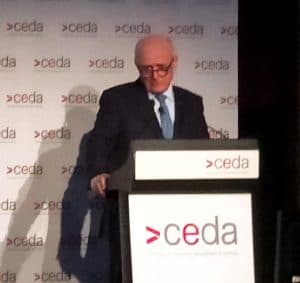
Earlier this week former chair of the Australian Government’s National Mental Health Commission, Allan Fels (pictured right) addressed a lunch hosted by the Committee for Economic Development of Australia.  The topicality of his presentation stemmed from two major inquiries into mental health – one by the Federal Government and undertaken by the Productivity Commission (PC), the other is a Royal Commission from the Victorian Government.  The breadth of the Terms of Reference (ToR) of the PC inquiry has generated a very broad level of interest across the social spectrum.  The Royal Commission ToR are yet to be released.
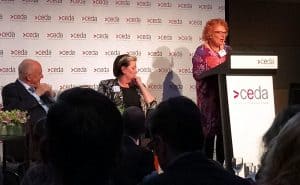
Fels acknowledged the role that workplaces have in addressing mental health

Subscribe to SafetyAtWorkBlog to continue reading.
Subscribe Help
Already a member? Log in here

Timeline for PC Mental Health Inquiry

One of the Commissioners of Australia’s Productivity Commission (PC), Julie Abramson, spoke briefly at a lunchtime seminar on Mental Health and the Economy, hosted by the Committee for Economic Development of Australia.  It is very early in the PC’s inquiry into the role of improving mental health but Abramson was able to provide some draft timelines.

Abramson told the audience that the Presiding Commissioner on this inquiry

Subscribe to SafetyAtWorkBlog to continue reading.
Subscribe Help
Already a member? Log in here

What is the “All Victorians Infrastructure Fund”?

ON 22 November 2018, two days before the State Election, the Secretary of the Department of Treasury and Finance released a document called the “Release of costing of election commitment“.  Most of the media attention was on the removal of a self-imposed “debt cap” by Treasurer, Tim Pallas, but there is an interesting footnote that seems to involve using some of WorkSafe Victoria’s premium income as a dividend to fund infrastructure.

Attachment A – “Summary of Labor’s 2018 Election Commitments” – lists the following table (figures are in millions):

Footnote 3 says:

Subscribe to SafetyAtWorkBlog to continue reading.
Subscribe Help
Already a member? Log in here

Productivity Commission sets stage for inquiry into mental health

The Australian Government has released the terms of reference into its Productivity Commission inquiry into mental health.  The inquiry has broad aims that clearly include occupational health and safety (OHS) and may set some evidence challenges for some of those in the workplace wellbeing sector:

“It will look at how governments across Australia, employers, professional and community groups in healthcare, education, employment, social services, housing and justice can contribute to improving mental health for people of all ages and cultural backgrounds.” (emphasis added)

The Treasurer Josh Frydenberg MP has written that

“the Commission should consider the role of mental health in supporting economic participation, enhancing productivity and economic growth.”

Subscribe to SafetyAtWorkBlog to continue reading.
Subscribe Help
Already a member? Log in here

OHS needs to accept the influence of neoliberalism and rebuild

Many have been claiming that the era of neoliberal economics and the associated politics is over or, at least, coughing up blood.  However, occupational health and safety (OHS) is rarely discussed in terms of the neoliberal impacts, and vice versa, yet many of the business frustrations with red tape, regulatory enforcement strategies, reporting mechanisms and requirements and others have changed how OHS has been managed and interpreted.

One of the most readable analyses of neoliberalism in Australia comes from

Subscribe to SafetyAtWorkBlog to continue reading.
Subscribe Help
Already a member? Log in here

The banks are having their culture changed for them and OHS needs to watch and learn

Occupational health and safety (OHS) is easy.  Change is hard.  OHS can identify  workplace hazards and risks but it is the employer or business owner or Person Conducting Business or Undertaking (PCBU) who needs to make the decision to change. All of this activity occurs within, and due to, the culture of each workplace and work location.  OHS lives within, and affects, each company’s organisational culture but a safety subculture is almost invisible, so it is worth looking at the broader organisational culture and there is no better show, at the moment in Australia, than The Royal Commission into Misconduct in the Banking, Superannuation and Financial Services Industry (the Banking Royal Commission).

Public submissions are littered with references to culture but it is worth looking more closely at what one of the corporate financial regulators said in a submission in April 2018.  The Australian Securities and Investment Commission (ASIC) wrote:

Subscribe to SafetyAtWorkBlog to continue reading.
Subscribe Help
Already a member? Log in here
Concatenate Web Development
© Designed and developed by Concatenate Aust Pty Ltd