Professor Sidney Dekker has a new book out called “The Safety Anarchist –
Relying on human expertise and innovation, reducing bureaucracy and compliance“. Last month Sidney spoke exclusively with SafetyAtWorkBlog about the issues of governance, risk assessment, the safety profession, bureaucracy, centralisation and the cost of compliance. The full conversation is available at the Safety At Work Talks podcasts and below.
Category: ethics
Action on insurance for OHS penalties slows down
In all of the discussion about the new industrial manslaughter laws in Queensland, the topic of directors and officers liability insurance has been overlooked. As mentioned in an earlier article
“….the Queensland Government has promised to ban insurance products that pay occupational health and safety (OHS) penalties imposed against employers.”
Industrial Manslaughter arguments cover old ground
The Queensland Government is in the middle of a debate in Parliament and the media about the introduction of industrial manslaughter as an offence related to serious occupational health and safety (OHS) breaches. It is both a good and a bad time for this debate. The laws are likely to pass but the debate is showing old arguments, weak arguments, political expediency and union-bashing but not a lot about improvement in workplace safety.
Timeline
Following two major fatal workplace incidents, in April 2017 the Government established an
Near Kill – Jim Ward speaks
Jim Ward is hardly known outside the Australian trade union movement but many people over the age of thirty, or in the occupational health and safety (OHS) profession, may remember the person Esso blamed for the Esso Longford explosion in 1998. Just after the nineteenth anniversary of the incident that killed two workers and injured eight other, SafetyAtWorkBlog interviewed Ward about the incident but, more significantly, also about how that incident changed his world view.
For some time now Jim Ward has been the National OHS Director for the Australian Workers’ Union. Here is a long interview with Ward that provides a useful perspective on OHS while Australia conducts its National Safe Work Month.
[Note: any links in the text have been applied by SafetyAtWorkBlog]
SAWB: Jim, what happened at Longford, and what did it mean for you.
JW: So, on 25 September 1998, I got up out of bed and went to work, just as I’d done for the previous 18 years of my working life, at the Esso gas plant facility at Longford in Victoria.
There was nothing unforeseen or untoward about that particular day. But due to, as one judge elegantly described it, “a confluence of events”, it turned out to be the most significant day of my life.
Leadership conference was hit and miss
The Future of Leadership roadshow was only partly about its topic. Much of it felt like a professional development day with interesting speakers and storytellers. By providing stories of failure, reconciliation, and unlearning the organisers could argue that they were also creating future leaders.
A previous article briefly discussed Dan Gregory’s presentation. One additional element was the catalyst for his Directorship of White Ribbon – a poster which reframed the issue of violence against women as an issue that men can affect. Gregory was advocating being open to alternative perspectives of your reality, your lived experiences, career, communication and profession. He challenged the audience, as Daniel Hummerdal does his safety audience, to look differently, to look creatively and to analyse our personal and organisational motivations.
Like all good conference speakers, Dan Gregory does not tell you what to think but how to think, and treats the audience like adults who are in charge of their own decisions.
Financial targets preferred over OHS
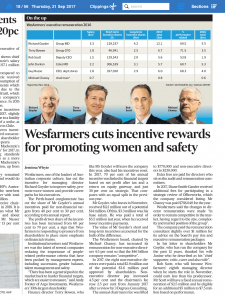
Today’s issue of the Australian Financial Review (AFR) contained an article that shows that the trend for companies and boards embracing their occupational health and safety (OHS) obligations is not uniform. The article “Wesfarmers cuts incentive rewards for promoting women and safety” reports that the Managing Director’s share of annual incentives paid for non-financial targets, which includes OHS, has been reduced from 40% to 30%. Continue reading “Financial targets preferred over OHS”
People Centred Prevention should not be a new concept
The World Congress on Safety and Health is physically and mentally exhausting. Physically, simply because of its size. Mentally because there is so much information. Some that confirms your occupational health and safety (OHS) approach and others that conflict with what you know. Some information that seems incredibly dated and anachronistic but you look around and this seems new and wonderful to other delegates.
A major theme of the Congress was “People Centred Prevention” (PCP). This is one of the anachronisms. Wasn’t OHS always about keeping people safe? If this theme had originated in the United Kingdom, it could have been contextualised as redressing the red tape attack on OHS regulation by previous governments – bringing the humanity back to OHS – but it is being proposed in this Congress as a significant change of focus and perspective.