

To truly understand occupational health and safety (OHS) issues, it is necessary to examine OHS concerns beyond one’s own industry. Recently, this blog has reported on some parliamentary debates on OHS in the horse racing industry. The November edition of The Monthly includes an exposé of the OHS of Australia’s horse racing industry by freelance writer, Madison Griffiths, with lessons for all of us on morality, Godliness, accountability and leadership. The article is paywalled but well worth the purchase.
Category: ethics

Another Step on the Long Road to Protecting Gig Workers
On October 21, 2025, the Australian Capital Territory’s Parliament debated (page P3249) expanding workers’ compensation to gig workers. Impediments to change were similar to those mentioned in various parliamentary inquires and debates ever since gig work developed into an industry sector and gig workers started to die at work. But the amendment passed so progress was made.
What We Lose When NDAs Win
Non-disclosure agreements (NDAs) are a contentious device used by lawyers, often as part of the settlement of a legal dispute. These came to the fore in the context of sexual harassment several years ago. The Victorian government has proposed a bill to Parliament that, according to the Australian Financial Review (AFR), will increase transparency. This should assist in determining changes to work processes that are as low as is reasonably practicable.
NDAs have been an insidious tool, especially in relation to sexual harassment at work.
Why do we need a “positive duty” to prevent harm?
In 2023, a Royal Commission into Violence, Abuse, Neglect and Exploitation of People with Disability recommended that the Commonwealth Disability Discrimination Act 1992 be amended to introduce a positive duty on all duty-holders to eliminate disability discrimination, harassment and victimisation. This echoes the imposition in 2022 of a positive duty to prevent sexual harassment. Occupational health and safety (OHS) legislation has had its positive duty to prevent work-related harm since 1985. So why this current push for positive duties?

OHS Lessons from the Antoinette Lattouf Case
Just before Christmas in 2023, Antoinette Lattouf was taken off-air by the Australian Broadcasting Corporation halfway through her five-day contract as a radio fill-in. It sparked an acrimonious unfair dismissal dispute. Last week the Australian Labour Law Association held a webinar on the case which touched on the occupational health and safety (OHS) perspective.

More OHS voices needed
A new discussion paper from Safe Work Australia (SWA) is interesting in a curious way. Its purpose is confusing, and its final report will not be presented until mid-2026. SWA offers no definition of “best practice” but suggests that consideration should start from the objective of the Model Work Health and Safety Act:
“….to ensure the model WHS laws continue to provide a balanced and nationally consistent framework to secure the health and safety of workers and workplaces.”
Audio summary on reasonably practicable
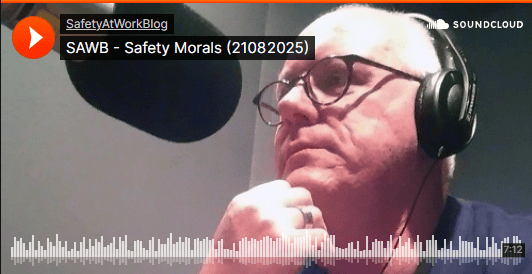
In the next short audio episode, I discuss the myth of “reasonably practicable” within occupational health and safety (OHS) and the moral implications it carries. Safety is not just about adhering to laws but about upholding values and a moral code in the workplace. Legislation should be viewed as a tool, not a destination, and we must go beyond mere compliance to effectively protect workers from harm.
This thought-provoking discussion is based on an article from SafetyAtWorkBlog, published on August 21, 2025.