HondaMPE sends lawyer’s letter to Australian manufacturer of safety devices

Just over a week after Australia’s national safety authority, Safe Work Australia, slammed the quad bike and all terrain vehicle manufacturers over shortsightedness on safety, Honda MPE has sent legal correspondence to an Australian manufacturer of crush protection devices (CPD), Quadbar Industries, over the wording of a sticker.

Norton Rose Letter to QuadbarIn the letter Peter Cash of Norton Rose Australia says that his client HondaMPE believes that a sticker on each Quadbar identified as a “compliance plate” may misled or deceive “members of the public and, in particular, prospective purchasers of your device”, and potential purchasers of Honda quad bikes.

The wording of the sticker is:

“COMPLIANCE PLATE

Certification/ fitment contact

Manufacturer 118 Industries

www.quadbar.com

7 Margaret St Clifton, Qld Aust. Continue reading “HondaMPE sends lawyer’s letter to Australian manufacturer of safety devices”

Is safety leadership the panacea for unsafe workplaces?

National Safety Cover May 2013The May 2013 National Safety magazine has an article on safety leadership by Australia lawyer, Michael Tooma.  It is a terrific article but it also highlights the lack of case studies of the practical reality of safety leadership in Australia and the great distance still required to improve safety. Tooma starts the article with

“It is widely recognised that strong safety leadership is integral to work, health and safety performance in any organisation.” [emphasis added]

Later he writes

“There is little doubt that safety leadership is a prerequisite to a positive safety culture in any organisation.”

These equivocations may indicate authorial caution on the part of Michael Tooma but  they could illustrate that the role of safety leadership still remains open to question. Continue reading “Is safety leadership the panacea for unsafe workplaces?”

Safe Work Australia vs Quad Bike Manufacturers

The chair of Safe Work Australia, Rex Hoy, makes an extraordinary challenge to the manufacturers of quad bikes.  In a media statement released on 26 April 2013, he

“…has called on the designers and manufacturers of quad bikes to urgently reconsider improving the design of quad bikes so they are not prone to roll over.”

Quad bike Say Safety_v151_04_10This sounds a sensible and safe suggestion but independent Australian research is still to be completed on whether these work vehicles are prone to roll over as a result of their design, and not simply driver (mis)behaviour.

Hoy notes that people continue to die whilst riding quad bikes and is quoted saying:

“We cannot sit by and watch people being killed and seriously injured by these vehicles. Everyone has a responsibility for quad bike safety but it must involve a safer product. We need to ask ourselves how much a life is worth opposed to the cost of a crush protection device.”

Quad bike designers and manufacturers have been emphatic in their position that rollovers are, primarily, the fault of driver behaviour and that crush protection devices are likely to contribute to rollovers or exacerbate worker injuries from rollovers. Continue reading “Safe Work Australia vs Quad Bike Manufacturers”

An OHS look at the Liberal Party’s policy document

Following on from a look at the workplace safety-related elements of the current policy document of the Australian Labor Party, it is the Liberal Party of Australia‘s turn.

PressPhoto tony abbott
Liberal Opposition Leader Tony Abbott

The Liberals, currently lead by Tony Abbott, are the Australian equivalent of the Conservative Party in the United Kingdom and the Republicans in the United States and follow many of the free market principles that support capitalism. In terms of workplace safety, commitments are less obvious than those from the Left side of politics.  Often workplace safety is wrapped in other concepts and there is an expectation that benefits to workers will somehow flow on from those benefits granted to employers and business, benefits frequently termed as part of productivity.

The Liberal’s policy document entitled: Our Plan, Real Solutions for All Australians lists the following productivity improvements: Continue reading “An OHS look at the Liberal Party’s policy document”

OHS would benefit from a historical perspective on workplace bullying

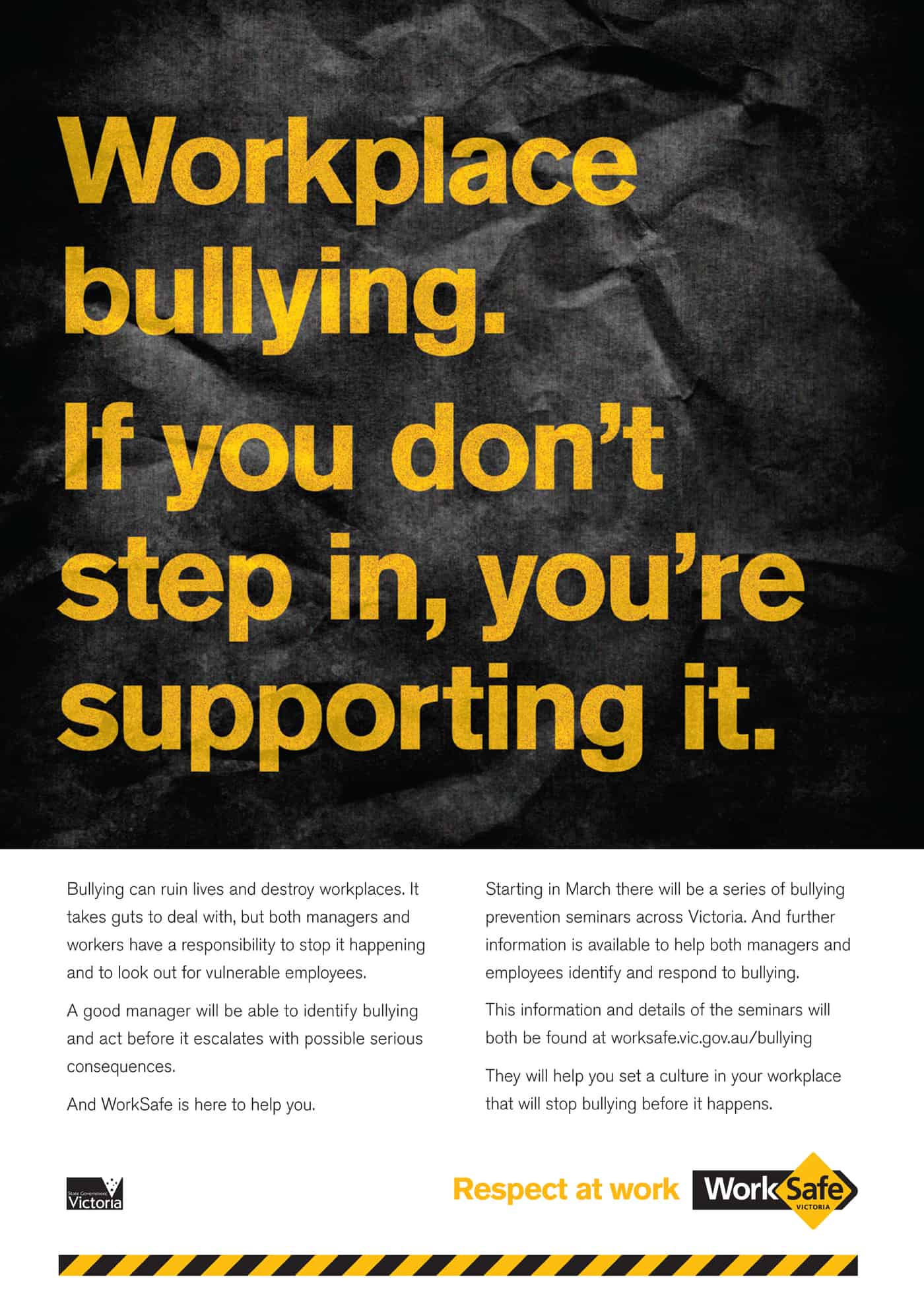
Every year, around this time, the mainstream media reports on the findings of employee surveys of the Victorian public service. Each year the statistics on workplace bullying are featured.  (The Age newspaper reported on the latest survey on 31 March 2013.)  But the approach to an understanding of workplace bullying has changed over the last fifteen years or so.  A brief look at the March 2001 Issues Paper on workplace bullying, released by the Victorian Workcover Authority (VWA), is useful to illustrate the degree of  change but also the origin of some of the contemporary hazard control themes.

Cover of Bullying Issues PaperThe VWA Issues Paper was always intended to lead to a formal Code of Practice but due to belligerence from various industry bodies, no code eventuated and Victoria had to make do with a guidance note.  This effectively banished workplace bullying to a nice-to-manage rather than an essential element of modern management.  Significantly, Safe Work Australia intends to release a model Code of Practice on workplace bullying shortly. Perhaps the employer associations’ attitudes have mellowed.  Perhaps it is the decline of trade union influence since 2001.

The Issues Paper roughly defines workplace bullying as:

“…aggressive behaviour that intimidates, humiliates and/or undermines a person or group.” Continue reading “OHS would benefit from a historical perspective on workplace bullying”

Quad bike fatalities cost an average of at least $2.3 million

Australian research has provided an important additional element to discussions on the safety of using quad bikes as work vehicles on Australian farms.  According to a media release to be published on 3 April 2013 from the Australian Centre for Agricultural Health and Safety (ACAHS):

Two new papers released today in the Australian and New Zealand Journal of Public Health ….indicate that the costs for fatal [quad bike] incidents between 2001-2010 were $288 million.” [links added, articles only available for purchase or by subscription]
caution ATV signDr Tony Lower, ACAHS Director, says that
 ““This conservative estimate draws on deaths data from the National Coroners Information System and includes projected losses in future earnings, impacts on household contributions, insurance payments, investigation and hospital costs”…. The average cost was $A2.3 million, with the highest average being in those aged 25-34 years at $A4.2 million””.
This estimation is shocking but refreshing.  Shocking in that the cost is so high but refreshing because the data is not based, as so much OHS data is, only on workers compensation claims data Continue reading “Quad bike fatalities cost an average of at least $2.3 million”

Latest review into workers compensation provides OHS clues

Cover of src_act_review_reportThe Australian Government has released its report into a review of its national workers’ compensation scheme, Comcare, and the Safety, Rehabilitation and Compensation (SRC) Act.  Some of the media (and politicians), as it often does, has focused on the seemingly absurd compensation claims.  Few cases have gained the same degree of national and international attention as the sex case for instance, and although most workers’ compensation reports focus on post-incident treatments, there is a glimmer of  hope on occupational health and safety (OHS) in this latest review.

The report, the latest undertaken by Peter Hanks QC, states that one of the guiding principles of the SRC Act should be an acknowledgement that

“The benefit and premium structure should promote incident prevention and reduce risk of loss.” (page 25)

This would be a wonderful benchmark to apply but is likely to be overshadowed by the compensation and rehabilitation issues of the review, unless OHS professionals and practitioners continue to remind regulators that prevention is better than cure.

Peter Hanks admits in a 2012 video interview on his review that injury prevention is not part of the terms of reference but there are elements of his report that require serious consideration by OHS professionals in consultation with their Human Resources (HR) colleagues. Continue reading “Latest review into workers compensation provides OHS clues”

Concatenate Web Development
© Designed and developed by Concatenate Aust Pty Ltd