
The 23rd World Congress on Safety and Health at Work has been a remarkable achievement, with 3000 delegates, at least two-thirds of whom are from outside of Australia. The most valuable elements of this Congress have been the opportunities to network, talk to people you’ve never met, and get new perspectives. What has been a little peculiar was the presentations or, rather, the format of the sessions.
Category: evidence
New international and local workplace data should cause a reassessment of national OHS strategies
Earlier this week, the International Labour Organisation (ILO) released new data showing that in 2019:
“According to the latest estimates developed by the ILO and covering the year 2019, over 395 million workers worldwide sustained a non-fatal work injury.”
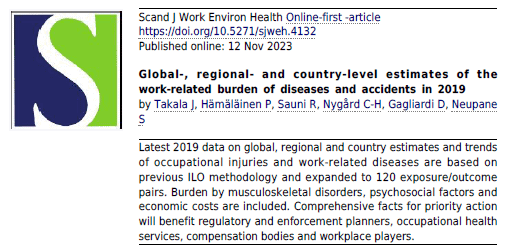
More research on global work-related deaths has been released. This time, it was through the Scandinavian Journal of Work, Environment, and Health and with regional data breakdowns. This latest report includes some important statistical data about psychosocial exposures at work.
ILO sets the OHS picture at the 23rd World Congress
This afternoon, the 23rd World Congress on Safety and Health at Work commences in Sydney. Already important information is being released, with the International Labour Organisation (ILO) being first out of the block, setting the broader occupational health and safety (OHS) context.
In a media release dated November 27 2023, the ILO says:

How to determine the usefulness of what you read
Many employers are continuing to pimp up their well-being programs and employer benefits with the intention of managing mental health pressures. This is often based on advice from multinational business advisory and consulting firms in the form of trend surveys and reports about business attitudes, fears and concerns. A recent report from Mercer was the basis for an article in the Australian Financial Review (AFR, paywalled) written by Euan Black. It is instructive to subject the article and the Mercer report to a little scrutiny to determine their usefulness.
Industrial Manslaughter distracts from what really works
South Australia’s Industrial Manslaughter Bill is being negotiated in its Parliament. New South Wales’ version is in development, and Tasmania has said it does not want to be left out, so the government has flagged its intention to have Industrial Manslaughter (IM) laws. Each politician stresses the importance of these laws to deter employers from doing the wrong thing and causing the death of a worker. However, there are serious concerns about the intended deterrent effect when other occupational health and safety (OHS) measures have been shown to be more effective.
Engineered stone reveals the reality behind OHS decisions
Caesarstone Asia Pacific managing director David Cullen told the Australian Financial Review (AFR – paywalled) on October 27, 2023, that:
“A full ban on the use of engineered stone would double the cost of benchtops..”
So? That seems to be enough of a reason to continue to allow the use of a product that is causing a large number of preventable deaths in Australia and elsewhere??!!
A stronger argument may be that the occupational health and safety (OHS) management of the cutting of engineered stone has failed.
Engineered stone is unsafe at any level
Safe Work Australia has recommended:
“a prohibition on the use of all engineered stone, irrespective of crystalline silica content, to protect the health and safety of workers.”
So that should be it. No more engineered stone products for use in Australia. Apparently, that decision is difficult to make even though the top occupational health and safety (OHS) advisory body in Australia recommends prohibition. OHS has always had an uncomfortable mix of morality, law and politics. Engineered stone and its inherent silicosis risks are a good illustration of the tensions between these three elements.