Recently a reader brought to our attention a research report from Edith Cowan University that used SafetyAtWorkBlog as an important source of occupational health and safety (OHS) dialogue. “A ‘Once in a Generation Opportunity’? Narratives about the Potential Impact of OHS Harmonisation on Smaller Firms in Australia” by Rowena Barrett, Susanne Bahn, and Susan Mayson,…
Category: government
SWMS – the infectious safety weed
Australian occupational health and safety (OHS) professional, Paul Breslin, is continuing his research into the use and application of the Safe Work Method Statement (SWMS) in the construction industry. His latest paper, recently published in the Journal of Health, Safety and Environment (subscription only) asks an important question:
“If administrative controls are one of the lowest levels of control measures under the hierarchy of control, why has the Safe Work Method Statement become a central element in ensuring safety in the Australian construction industry?”
Breslin’s article title summarises the frustration of many OHS professionals where safety relies on lower order controls of the
Inexactitudes could lead to OHS myths
Consulting firm Deloittes recently announced the merging of its occupational health and safety (OHS) and sustainability sectors in order to provide better customer services. In the article Deloittes says about the importance of workplace mental health:
“Given that one in six working age Australians live with mental illness including depression, that is costing Australian businesses at least $11 billion dollars each year, this is a growing area“.
But the source of this statement is unclear and this lack of clarity may be contributing to some of the inexactitudes in the mental health/wellbeing debate. Continue reading “Inexactitudes could lead to OHS myths”
Enforceable Undertakings on OHS – Good and Bad
In 2010 Queensland’s former Attorney-General Cameron Dick said of enforceable undertakings that:
“Enforceable undertakings promote the introduction of long-lasting and more wide-ranging safety changes that would not have occurred under the prosecutorial system that imposes fines after the event.”
Enforceable Undertakings can be a powerful force for improving occupational health and safety (OHS) but they could also be used by employers to forestall investment in OHS and minimise the financial penalties should an incident occur.
Continue reading “Enforceable Undertakings on OHS – Good and Bad”
Is methamphetamine a significant workplace hazard?
The Australian Industry Group (AIGroup) submission to the Australian Government’s Parliamentary Joint Committee on Law Enforcement inquiry into crystal methamphetamine, commonly known as Ice, has been made publicly available. The submission focuses on the risks to all workplaces, primarily, by imposing non-work statistics onto the workplace, lumping Ice in with other illicit drugs, and relying on anecdotal evidence. This approach is not unique to AiGroup and can also be seen regularly in the mainstream media but such an important Inquiry requires a much higher quality of evidence than anecdotes.
The submission references a recent Australian Crime Commission (ACC) report into Ice saying it:
“… paints a bleak picture for the community and Australian workplaces. This combined with greater ease of access, including in regional areas, places Australian workplaces at risk.
A key requirement for employers seeking to manage safety risks arising from persons attending work affected by Ice is the ability to conduct workplace drug and alcohol testing.” (page 3)
The ACC report refers almost exclusively to the hazards presented to hospital and emergency staff, not by Ice use by staff, and yet is able to link Ice-affected public to the drug testing of workers. Continue reading “Is methamphetamine a significant workplace hazard?”
Agricultural safety case study from Australia
In early June 20915, the Rural Industries Research and Development Corporation (RIRDC) provided a case study of agricultural safety and the importance of safety culture – Raby Stud, part of Hassad Australia. The study shows great potential but the promotion of this case study would be more convincing if more OHS detail was available and if there was better coordination of its media.
RIRDC emphasised that:
“The injury rate is now close to zero at ‘Raby Stud’, near Warren in New South Wales, thanks to the attitude that ‘it won’t happen to me’ is simply not good enough to ensure everyone gets home safely to their families every night.”
Continue reading “Agricultural safety case study from Australia”
Mixed messages on OHS and productivity
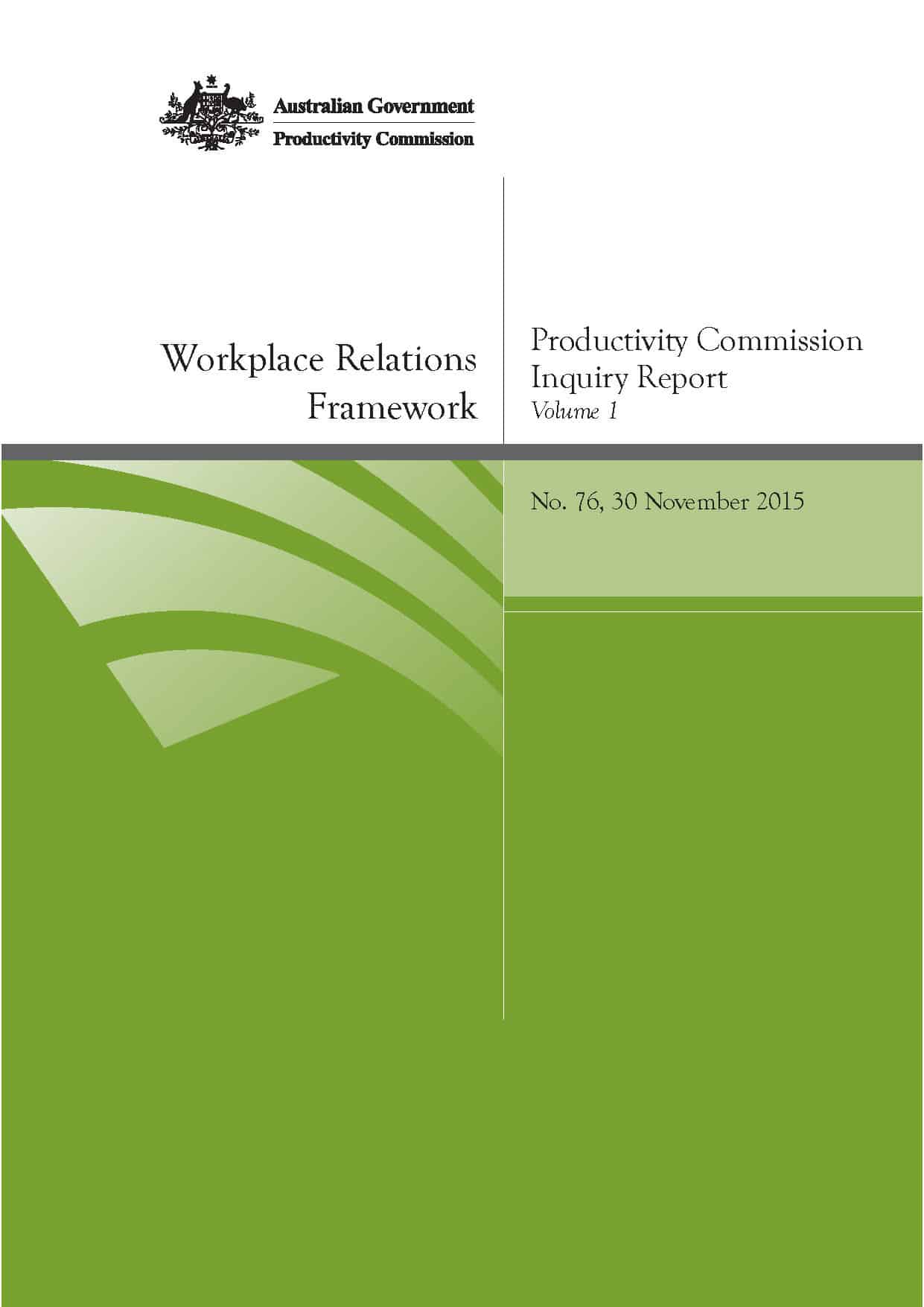
There is a clear link between the modern take on occupational health and safety (which includes psychosocial health) and productivity. However, there are seriously mixed messages coming from the Productivity Commission (PC) in its current inquiry into Australia’s Workplace Relations Framework.
In Senate Estimates on 3 June 2014 (draft Hansard), the Chair of the Productivity Commission, Peter Harris, and Assistant Commissioner, Ralph Lattimore, briefly discussed OHS. Harris acknowledged that some of the submissions to the current inquiry discussed OHS matters (page 65) but Lattimore stated:
“….we did say that we would quarantine the inquiry away from workforce health and safety issues unless they were directly related to, say, enterprise bargaining or some feature of the relationship between employers and employees. We were aware of the large amount of regulation in that area, and we were not planning to revisit that.”