Tory leader calls for a “forensic examination” of health and safety culture

David Cameron, the leader of England’s Conservative Party, has spoken about the health and safety culture that he says is restricting personal and business options in England.

In the full speech, Cameron clearly outlines an ideological agenda but it is a mistake to see this as an attack on the OHS regulator.  Below is an edited summary of the most relevant bits of his speech:

“In almost every area, the Conservative Party aims to remove the obstacles that prevent people from making their own decisions.

That’s why we plan a radical redistribution of power, giving control over education, housing and policing to local people.

…there is a growing sense that too many areas of our life are governed by petty rules, regulations and tick box bureaucracy that flies in the face of common sense, undermines discretion and prevents us from getting on with our lives.

We see it in our police force,… our prisons, …our schools, [and] our hospitals

[the the over-the-top health and safety culture] is… infuriating. It … stifles judgement and discretion……is a straitjacket on personal initiative and responsibility……and is a big barrier to the creation of the big society.

…something has gone seriously wrong with the spirit of health and safety in the past decade.

…it is clear that what began as a noble intention to protect people from harm has mutated into a stultifying blanket of bureaucracy, suspicion and fear that has saturated our country…

How has this over-the-top health and safety culture become embedded in our national way of life? [emphasis added]

  • [European] bureaucratic rules
  • The Labour Government

But the biggest cause of this excessive health and safety culture is the way these rules have been interpreted and used.

What is more the problem is the perception we have allowed to develop that in Britain today, behind every accident there is someone who is personally culpable……someone who must pay.

[It is encouraged by]

  • adverts on television
  • the commercialising of lawyers’ incentives to generate litigation
  • the rising premiums and concerns of the insurance industry.
  • high-profile claims and pay-outs.

This has all helped to create a legal hypersensitivity to risk, accident and injury. And this has had a direct knock-on effect on the health and safety culture.

So it is not just the regulations from Brussels, or even the distrustful, interfering government that has created this culture, or the insurance industry, ……it is that everyone’s so worried about being sued that they invent lots of their own rules on top of the regulations that already exist.

… perhaps the most damaging consequences of this excessive health and safety culture have occurred in our society.

… the health and safety culture actively undermines responsibility.

CONSERVATIVE APPROACH

First, establish clear and specific principles about when health and safety legislation is appropriate, and when it is not, so we can evaluate whether existing or future legislation is necessary.

Second, we will propose practical changes in the law to both help bring an end to the culture of excessive litigation while at the same time giving legal safeguards to those who need them most.

HEALTH AND SAFETY CHANGES

there are three particular scenarios where this is the case.

The first is when consumers have a lack of information, or are unable to understand technical information, about a product or a service they are purchasing.

The second situation in which official action on health and safety is appropriate is where there is an imbalance of power.

The third situation in which there is a case for health and safety oversight is when someone might have a clear motive – normally profit – to put someone else in danger.

That’s because keeping people safe is often more expensive than exposing them to risk.

[REVIEW]

I have asked Lord Young to lead an extensive review on this subject for the Conservative Party. He has a track record of deregulation and cutting bureaucracy. He also has experience in the legal profession and will judge these issues with the care and attention they deserve. And he will look at everything from the working of the Health and Safety Executive, to the nature of our health and safety laws, litigation and the insurance industry.

There are some specific questions I have asked David Young to investigate urgently.

The first question is: how can we best protect what are effectively ‘Good Samaritans’?

In Australia, concern about the effect of increasing payouts for medical negligence led to a full review of civil liability.  Its final report concluded that when an individual is acting in good faith – as a Good Samaritan – and takes reasonable actions to help someone, then they should not be found negligent.

Second, can we help alleviate some of health and safety oversight that currently burdens small, local and voluntary organisations?

Third, do we need a Civil Liability Act?

I know the over-the-top health and safety culture that has grown in our country in recent years provokes a lot of understandable anger.  But anger itself is not solution.  Instead we need a forensic examination of what has gone wrong and the steps we need to take to put it right.”

Cameron’s speech has some valid points even if the ideological path that he has followed to get here may be unpalatable.

What separates this from a Jeremy Clarkson rant is that he is not targeting any one particular bureaucracy or social group.  He acknowledges that there are a range of social factors that have, over time, created what he believes is an “over-the-top health and safety culture”.   Cameron may have chosen extremes to illustrate his points but most OHS professionals would not be averse to a review of OHS laws particularly if such a review included other social structures that make their lives difficult but over which they have no influence.

Along the way, the chance for the political boot up the jaxy of the regulators and the unions, and those dreadful Europeans, will be irresistable for the Conservatives, but if planned for occupational health and safety may salvage some useful tools.

It must be remembered that the Conservatives are not in power in England but even from here in Australia, the Prime Minister Gordon Brown looks like a dead man walking.

Some commentators have already responded to the “outrageous” suggestions in Cameron’s speech.  More union response similar to this from Grahame Smith, General Secretary of the Scottish Trades Union Congress, can be expected.

“The families of the tens of thousands of workers who have been killed and maimed at work will find these comments deeply offensive. David Cameron has sent a chilling message to the working people in the UK that any future Conservative Government will attack the health and safety laws that trade unions have spent decades fighting for.

“This is not about draconian legislation. This is about the failure, or unwillingness, of employers, community groups and others to grasp the very basics of our health and safety system.

“We have witnessed what poor regulation has done for our finance sector and the economy. We do not want to see this attack on health and safety legislation having a similar catastrophic effect on human lives. Our economy will recover. Individuals killed at work and their families never recover from the consequence of poor health and safety regulation.

“We would say to David Cameron if you want to learn about the true consequences of health and safety failures read Hazards Magazine and come to Scotland and meet families who have lost loved ones due to health and safety failures by employers. Don’t subscribe to the trivial nonsense which is churned out by sections of the media.”

Smith is correct to remind Cameron to not rely on the media from which to develop policies, particularly the English print media.  Smith comparison of OHS legislation to financial market regulation is also valid.  Legislation should never be used as a blanket control mechanism but requires targeting.

Another union, Prospect, had this to say

On behalf of 1,650 HSE inspectors, scientists and other specialists, Prospect negotiator Mike Macdonald said: “There is a world of difference between petty bureaucracy enacted under the label of health and safety and HSE regulation designed to prevent deaths in the workplace.

“Measures aimed at preventing death and injury at work run the risk of being overshadowed by inappropriate obsessions by local authorities with minor issues that are often an excuse for withdrawing services on the grounds of cost. Given the importance of health and safety to the British economy and UK businesses we would welcome any changes that boost workers’ safety as well as business competitiveness.

“But confusing the two continues to perpetuate a negative image of health and safety regulation and masks the bigger picture: as the figures for 2007/08 show 32,810 employees were exposed to fatal and major injuries at work.”

If (when) the Conservatives come to power in England, Cameron and Lord Young will need to structure an inquiry that is inclusive and designed to be constructive.  Many people will approach such an inquiry with decades of suspicion and many memories of despair and disappointment. In many ways the laws require a rationalisation, not a revolution and this is what Cameron needs to “sell” as he gets ready for the next election, due in the first half of 2010.

Kevin Jones

The OHS “fun vampires” hit the theatre

Several weeks ago, I took my family to the filming of a TV program.  As with most of this things there is a person who “warms up” the audience and which seems to involve the throwing of lots of lollies and sweets.  (If only weddings used sweets instead of bouquets there might be more takers) The warm up act will always make one of two references to “having someone’s eye out with that one” as they throw the sweets.

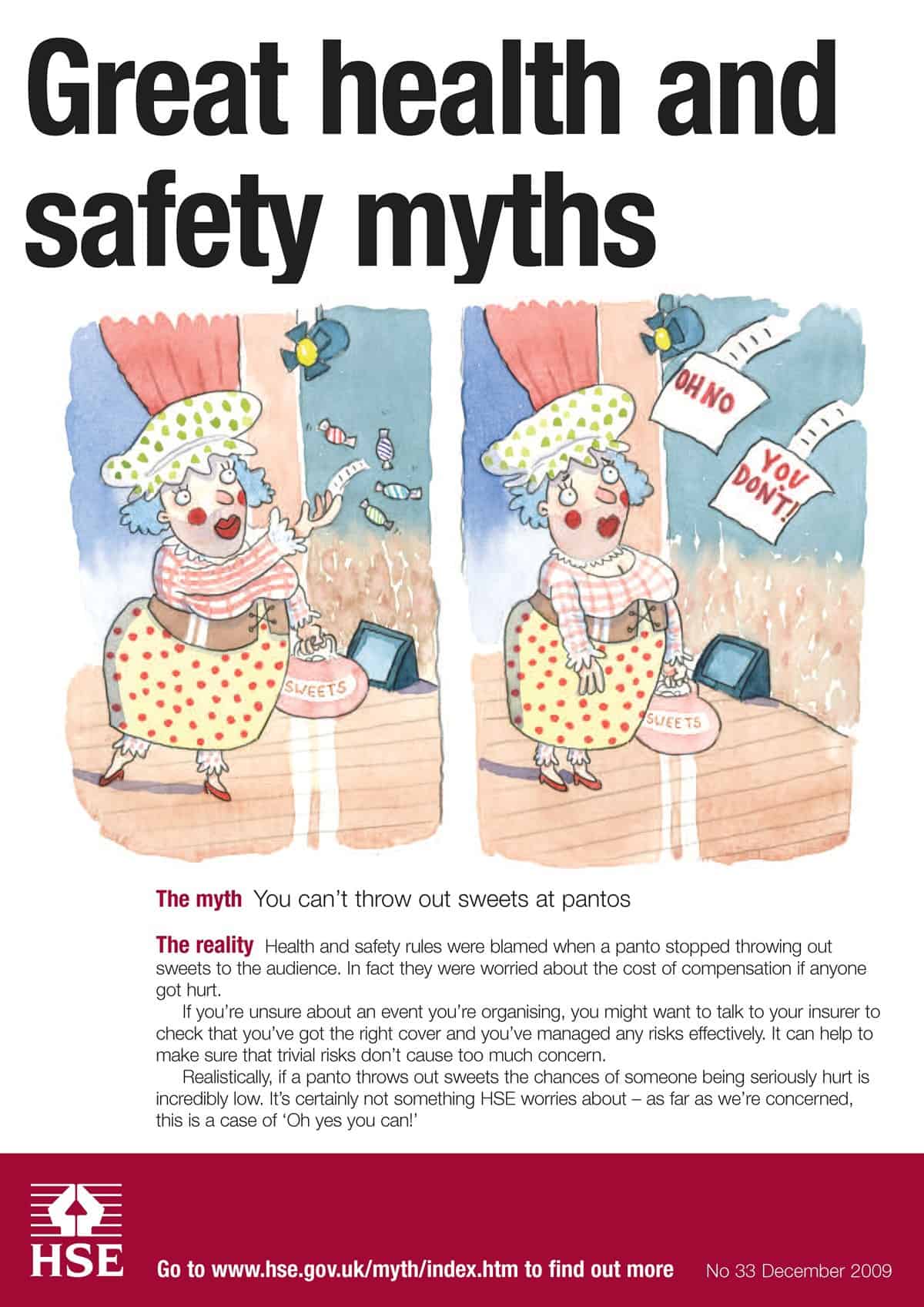
England’s Health and Safety Executive have chosen this “hazard” as their December OHS myth.  It’s particularly important for the English as the pantomime season begins.  The HSE says

“Health and safety rules were blamed when a panto stopped throwing out sweets to the audience. In fact they were worried about the cost of compensation if anyone got hurt….

Realistically, if a panto throws out sweets the chances of someone being seriously hurt is incredibly low. It’s certainly not something HSE worries about …”

The hazard of being injured from stage projectiles is real and it was only 2000 when a law suit was settled between Dame Edna Everage and a man who was hit in the eye with a gladioli thrown from stage.

Whether being injured by a projectile from the stage is an OHS matter or a public liability situation is debatable.  My risk management lecturer used to say that one should always sue the deepest pockets.

It is not OHS which is generating the safety rules.  OHS regulators are reacting to the increased litigation that is being touted by lawyers, bled into the Western culture through US television programs and being seen as a “nice little earner” by some in the community.  Most of the critics are facing the wrong target but are doing so because the OHS regulator is an easier target.

As an OHS professional, I would have to say do not throw anything into an audience or crowd unless it is an essential element of the performance.  There are other ways of distributing treats.

Kevin Jones

HSE executive talks about OHS Leadership

At the launch of a new guidance for higher education students in late November 2009, Judith Hackett CBE, chair of the Health & Safety Executive spoke at length on a range of interesting matters but one section on leadership was particularly interesting:

“Strong leadership, engagement and a common sense approach are key to effective health and safety in any and every organisation.  Leadership is fundamental because it sets the tone for whether health and safety happens or not, and how it happens.  The type of health and safety culture that exists in organisations will be decided by how leaders manage it.

If they see that it makes good business sense this will lead to openness and involvement.  Leaders will be seen to care about the people they employ and manage.  But if, on the other hand leaders see health and safety as being all about bureaucracy, paperwork and procedures, this is likely to lead to health and safety being seen as a chore, a burden and therefore not properly and appropriately addressed.”

Kevin Jones

Union continues pressure on asbestos as an urgent public health issue

Following on from Asbestos Awareness Week, an ABC media report on 3 December 2009 says that the Australian Workers Union is continuing to apply pressure to the Tasmanian Government and Cement Australia for testing of former employees  and local residents for exposure to asbestos.

An epidemiological study of former employees has been agreed to by the company and is being conducted by Monash University.  Dr Yossi Berger of the AWU wants the study to be expanded to residents.

The logic is sound, particularly in Railton where the entire community has been exposed to asbestos production and products over decades.   Asbestos should be considered as more than a work-related hazard.

The union position on this pernicious substance received recent support from Matt Peacock’s book “Killer Company” that brought to the public’s attention the issue of asbestos bags being used in carpet underlay over many years.  Peacock says that cases of mesothelioma that just appear without any direct link to asbestos-handling , use or manufacture could come from unsuspecting exposure to asbestos in seemingly innocuous sources, such as underlay.

The union must be fairly confident that the results of any study will provide incontrovertible proof of the spread of the asbestos hazard, so that there can be some “oomph” behind a broader public campaign.  As mentioned at a recent Asbestos seminar, the evidence may exist but it needs to be translated into a format that the national decision-makers will accept and cannot contest.  Then large-scale improvements are possible.

Kevin Jones

Shoemaking in South East Asia – book review

Some of the best OHS writing comes from the personal.  In a couple of days time a new book will go on sale that illustrates big issues from a niche context and brings to the research a degree of truth from the personal experiences of the author.

Pia Markkanen has written “Shoes, glues and homework – dangerous world in the global footwear industry” which packs in a range of issues into one book.  The best summary of the book comes from the Preface written by the series editors.

“Pia Markkanen’s extraordinary first hand investigation of the dangers of home work in the shoe industry in the Philippines and Indonesia is an important contribution to our understanding of work, health and the global economy. She also carefully documents the intersection of gender relations and hierarchy with the social relations of “globalised” economic development and reveal as the important implications for the health of women, men and children as toxic work enters the home.”

As one reads this book, local equivalents keep popping into the reader’s head.  For instance, Markkanen’s discussion of the home as workplace raises the definition of a “workplace” that is currently being worked through in Australia.  She briefly discusses the definition in her chapter “Informal Sector, Informal Economy” where she refers to an ILO Home Work Convention, and usefully distinguishes between the homeworker and the self-employed, a distinction that Australian OHS professionals and regulators should note.

Markkanen does not impose a Western perspective on her observations and acknowledges that regardless of the global economic issues and social paradigms, “shoemakers felt pride for their work”.  This pride goes some way to explaining why workers will tolerate hazards that others in other countries would not.  In many OHS books this element is often overlooked by OHS professionals and writers who are puzzled about workers tolerating exposure and who look to economic reasons predominantly.

In South East Asia, limited knowledge can be gleaned from literature reviews as the research data is sparse.  Markkanen interviewed participants first hand and, as mentioned earlier, this provides truth and reality.  She describes the shoe makers’ workshops in Indonesia:

“Shoe workshops are filled with hazardous exposures to glues, primers, and cleaning agents, unguarded tools, and dust.  Work positions are often awkward, cuts and burns are common, as are respiratory disorders.  Asthma and breathing difficulties are widespread when primers were in use.  Workers were reluctant to visit doctors because of the expense.”

She then reports on the interviews with Mr. Salet, a shoe manufacturer, Ms. Dessy, the business manager, Mr Iman, the business owner, Mr Ari, a skilled shoemaker, and many others.

Markkanen also illustrates the shame that the minority world and chemical manufacturers should feel about the outsourcing of lethal hazards to our fellows.  In the chapter, “Shoemaking and its hazards”, she writes:

“Shoe manufacturing will remain a hazardous occupation as long as organic solvents are applied in the production.  It is notable that in 1912, the Massachusetts Health Inspection report declared that naphtha cement, then in use for footwear manufacturing, was considered hazardous work.  The 1912 report also referred to a law which required the exclusion of minors from occupations hazardous to health – the naphtha cement use was considered such hazardous work unless a mechanical means of ventilation was provided and the cement containers were covered…. minors were prohibited from using the cement.  Almost a century later, hazardous footwear chemicals are still applied – even by children – in the global footwear industry.”

There is little attention given to the OHS requirements of majority world governments by OHS professionals in the West, partly because the outsourcing of manufacturing to those regions has led to the reporting of OHS infringements and human rights issues more than information about the legislative structures.

Markkanen provides a great section where she describes the OHS inspectorate resources of the Indonesian Government and the fact that Indonesian OHS law requires an occupational safety and health management system.  Granted this requirement is only for high-risk industries or business with more than 100 employees but there are many other countries that have nothing like this.  Markkanen quotes Article 87 of the Manpower Act 2003:

“Every enterprise is under an obligation to apply an occupational safety and health management system that shall be integrated into the enterprise’s management system.”

It is acknowledged that this section of legislation is hardly followed by business due to attitude and the lack of enforcement resources but we should note that safety management is not ignored by majority world governments.

Lastly, Markkanen provides a chapter on the gender issues associated with the shoemaking industry.  She makes a strong case for the further research into the area but it is a shame that to achieve improvements in women’s health the reality is  that

“women’s health needs female organizers and female women trade union leaders who understand women’s concerns”.

Some male OHS professionals may be trying to be “enlightened” but this seems to not be enough to work successfully in some Asian cultures.

Overall this book provides insight by looking at a small business activity that illustrates big issues.  The book is a slim volume of around 100 pages and it never becomes a difficult read because it is concise and has a personal presence that other “academic” books eschew.  As with many Baywood Books, the bibliographies are important sources of further reading.

At times it was necessary to put the book aside to digest the significance of some of the information.  Occasionally the reality depicted was confronting.  Baywood Books could do well by encouraging more writers to contribute to it Work, Health & Environment Series.

Kevin Jones

[SafetyAtWorkBlog received a review copy of this book at no charge.  We also noted that, according to the Baywood Books website, the book is available for another couple of weeks at a reduced price.]

Big fine for Queensland Rail – big risks in rail

Almost two years ago, two rail workers died in Queensland.  According to the official report into the  incident:

“At approximately 1056 on Friday 7 December 2007, two QR [Queensland Rail] Infrastructure Services Group (ISG) track workers were fatally injured as a consequence of being struck by a track machine (train) at Mindi, approximately 130 kilometres south-west of Mackay.

The collision occurred when Track Machine MMA59, in the process of conducting track resurfacing work on the Down line at Mindi, commenced a routine reversing movement.

During the process, two QR Systems Maintenance personnel, working on the same track and behind the track machine, were struck and fatally injured by this track machine.

Analysis of evidence and conditions surrounding the accident revealed:

  • An overall lack of compliance with elements of the QR SMS at the Mindi site; and
  • Inadequate communication and coordination between workgroups at the Mindi site.”

On 26 November 2009, Queensland Rail was fined $A650,000 over the deaths.  The fine is only $A100,000 below the maximum fine applicable.  According to a media release about the fine:

“The Workplace Health and Safety Queensland investigation found that QR’s safety management systems were inadequate for managing the separation of workers and plant, particularly when both were within the same section of track between signals.

It also found that QR knew the systems were inadequate and not working because it had been highlighted to management in a series of audits.”

Not only were Queensland Rail’s safety management systems inadequate, Queensland Rail knew they were inadequate because a series of audits had told it so.

Railway in Australia and elsewhere is one of the most regulated industries.  It is also one of the industries with the most prescriptive set of rules.  It is a complicated business but one where hazards are known and systems are in place to control these hazards.

The extent of QR’s failure to operate safely can be illustrated by some of the many recommendations made in 2008 by Queensland Transport:

  • The necessity for consistent and effective Worksite Safety Briefings by ISG personnel;
  • Preconditions to the reversal of vehicles in accordance with QR safeworking requirements;
  • Responsibilities and training syllabi for ISG Resurfacing personnel;
  • The necessity for pre-departure safety checks on ISG trains;
  • Provision of safe separation and segregation between ISG track workers and trains;
  • ISG SMS compliance monitoring, at the local level;
  • Fatigue management within QR, and in particular ISG rostering;
  • Management of the perceived relationship between ISG and Network Control;
  • Awareness of the priority of safety over commercial pressures by remote ISG staff;
  • Distribution of safety communications and documents within QR;
  • Representation for relevant stakeholders in operational change management processes;
  • Risk and change management training for ISG operational personnel;
  • Safety risks presented to ISG through the permanent coupling of track machines;
  • The safety value to QR of an enhanced and transparent reporting system;
  • The management of ISG district staff relationship issues; and
  • ISG and Network Access radio protocol compliance monitoring.

Many elements are familiar to other investigations in rail and other industries – fatigue, on-site communication, training, segregation, document control and distribution, local compliance enforcement, transparency in reporting…..

On 10 September 2008, the QR CEO Lance Hockridge said:

“When I arrived in November 2007, I found an organisation with a safety record that was improving but not what it should be.  Only three weeks later we had a very tragic reminder of this when work colleagues Jamie Adams and Gary Watkins were killed at Mindi.

“Organisations hoping to achieve meaningful change must firstly be honest with themselves – we need to confront this reality and make the changes required.”

Queensland Rail did not face the reality of problems identified by safety auditors and two workers died.

The news of the record fine came at a time when the ownership of  Victoria’s metropolitan rail network has changed from Connex to Metro.  Victoria has a stressed rail service but has managed to avoid the controversy of  Queensland Rail and RailCorp in New South Wales but this has been through luck rather than good management.  The Victorian Government, and particularly the Transport Minister, Lynne Kosky, needs to read the Waterfall Inquiry report and the Queensland Mindi report to understand the personal, economic and political cost of not having a tightly managed, functional rail safety regime.  Having been in power for just over 10 years, this government now owns all the Victorian problems and must account to the electorate for not fixing them.

The political risk was summarized in an editorial in The Age on 30 November 2009

“In September, a Senate report into federal funding of public transport found Melbourne’s network was badly managed in comparison with Perth’s government-operated system.  A key problem was lack of accountability: it was unclear who was in charge.  The consequences of the lack of an overarching transit authority to oversee the whole system are clear…..

New operators of trains and trams in new livery will struggle to deliver acceptable service unless the Government makes good its past neglect of infrastructure.”

The fact that the Victorian rail system is being privately operated will not be an acceptable shield when the first passenger train crashes with a jam-packed peak hour cargo.

Kevin Jones

Asbestos Awareness Week calls for action

During Asbestos Awareness Week 2009 in Melbourne Australia the trade union movement pledged to begin a national strategy to control and remove asbestos from Australia.  This would have been a very tall ask any time in the last two decades but Asbestos needs to compete now with Climate Change for the attention of the media, the decision makers and the heartstrings of the community.

It is accepted that in the near future more people will be touched directly and indirectly by asbestos-related diseases but, at the moment, the issue is concentrated in low-income industrial suburbs and, as such, is still dismissed by some (often in suburbs with large trees and no pubs) as a disease that only strikes the blue-collar smokers.  The social inequity of asbestos-related diseases should be studied in some depth as it is likely to shame governments into action on this hazard.

Jim Ward - Australian Workers Union

At a seminar in late November 2009, a small audience in the Victorian Trades Hall was told of the success of the Tasmanian campaign in gaining government support for the removal of all asbestos by 2030.  Jim Ward of the Australian Workers Union spoke of the approaches to Goliath Cement (“The James Hardie of Tasmania”). Ward told how the CEO of Goliath did not blink at the request to remove asbestos.  Ward said this type of response has been repeated throughout Tasmania.

The audience also heard from several who are at the frontlines of dealing with asbestos-related diseases.  Vicki Hamilton and Tim Tolhurst spoke of the frustration of having inadequate disposal facilities in regional areas of Victoria.  The challenge here is immense as the temptation to bury asbestos in the back paddock when no one’s around is strong even though it is selfish and immoral.  Vicki and Tim showed how a structured program across the community is required because one cannot encourage the removal of asbestos until there is a place to safely dispose of it.

Vicki Hamilton of GARDS

Pat Preston, ex-CFMEU and now with the Asbestos Contractors’ Group, spoke of the legislative and operational problems faced by licensed asbestos removal contractors.  The holes and conflicts all complicate the process of asbestos removal and disposal and increase the cost, particularly of asbestos removal.

Several speakers pointed to the anomaly that the removal of asbestos from domestic buildings of less than ten square does not required licensed removal, thereby “encouraging” small volumes of asbestos to be hidden at the bottom of domestic rubbish bins.  The OHS risks to waste collectors are not dissimilar to those who dispose of toxic and trade waste down the toilet next to the workshop when WorkSafe or the union is not around.

Of course the audience and speakers seem to all agree that there is no safe level of asbestos exposure.  There are certain to be those in Australia who are “asbestos-skeptics” and many seem to have the ear of the decision-makers.

One speaker provided a fresh perspective that was very appropriate but surprising for a couple of reasons.  Anthony La Montagne, of the University of Melbourne, has undertaken ongoing research on job stress, cancer clusters and, clearly, asbestos issues.  La Montagne provided the glum news that several promising medical techniques for early detection of asbestos have come to nought.  The only effective risk reduction technique is for those who may have been exposed to asbestos to quit smoking as this smoking appears to exacerbate asbestos-related disease.

Several speakers noted that in the Asbestos Awareness Week 2008, there was a motion to have the Government undertake action on asbestos.  The resulting inaction was embarrassing and motivating with participants committing themselves to continuing to lobby for controls on asbestos.  This is going to be a considerable challenge if they continue through the same lobby process that they have applied for the last few years.

Tom Tolhurst of ADSVIC

The asbestos safety advocates should drop “awareness” from the week’s title because awareness equates to “aspirational targets”, former Prime Minister John Howard’s way of promising much and delivering nothing.  Just as everyone accepts that smoking causes lung cancer and climate change exists, people know that asbestos can kill.  Move away from awareness-raising to action.

Research the social inequity of asbestos in low-income areas.  Many domestic houses have asbestos houses or in their roofs, particularly in low-income areas which are also the areas where asbestos workers live.  If the reality and scope of this situation was proven to a level and in a format that policy-makers accept, the asbestos control option would be much stronger.  Even if the government continued its inaction, a case could be put to the discrimination tribunals and human rights sector to shame the government to represent all citizens equally.

Market the asbestos week.  White, pink and striped ribbons are becoming a fundraising cliché but the marketing of social health issues works.  There must be a coordinated approach to getting sponsors and support into the promotion of asbestos-related diseases on a large scale.  Once there is serious money behind the issue, one can fund research and present data that convinces decision-makers of the reality of the issue.

Pat Preston of Asbestos Contractors' Group

Undertake a public health cost-benefit analysis of asbestos-related disease, as one speaker advocated at the Victorian Trade Hall.  There are many lessons from the compensation issues of James Hardie Industries but one is that compensation creates wealthy (for a short while) families of dead workers and can do little of health benefit to the mesothelioma sufferers.  It is surprising that the fact has not clicked in the government mind that compensation for asbestos-related diseases provides an important but only symptomatic relief.  The government is applying paracetamol to an issue that requires surgery.

The union seminar was heartening in that it showed how many people are actually tackling the issue of asbestos-related diseases.  But it also operated under a cloud of frustration with an occupational and public health risk that is not receiving the government support that other similar matters are.  Trade unions are a vital part of any plan to control asbestos but just as many people in the leafy suburbs are isolated from asbestos risks, so the audience for the asbestos message is limited by the message remaining within the trade union context.

Tony La Montagne of the University of Melbourne

There needs to be a creative approach to generating sufficient community outrage over the unnecessary deaths of workers from asbestos so that the government cannot avoid action.  The James Hardie legal action and the lobbying of Bernie Banton, and others, was about compensation, about making a company accept its social responsibility, about making it pay.  It worked, but James Hardie still cannot afford the compensation bill that is the reality of decades of profits from a toxic substance that kills.

In 2009 several Australian Governments have helped out this company by contributing $A320 million to the company’s compensation fund.  Why?  When did the government decide to cover the costs of a company’s exploitation of workers?  This is on top of having to fund the public hospitals that have to deal with mesothelioma victims.  The government, and the taxpayer, is paying twice!

Let the company fail and allow the class action lawyers to pick over the assets.  Or better yet, keep James Hardie Industries alive and bleed it just enough so that it can fund the removal of its toxic legacy for the next thirty years.

Every shareholder in James Hardie that receives their dividend cheques from whichever country James Hardie moves to next (Zimbabwe cannot be far off) needs to understand that those dividends could be used to ease the pain of the workers who generated the corporate profits rather than contribute to their own bloated share portfolios.

Kevin Jones

Concatenate Web Development
© Designed and developed by Concatenate Aust Pty Ltd