Young Worker Safety – Part 3

Several colleagues have pointed to a young worker safety website that was established in Canada several years ago, http://www.notworthit.ca/ .   The site, part of the WCB’s Young Worker campaign, won an award from American Association of State Compensation Insurance Funds in their annual Communications Awards in 2007.

There are remarkable similarities to The Pain Factory, even to the point of encoruaging young workers to tell their own stories.  The similarity is, perhaps, justified when considering the safety message is aimed at the same demographics, however it shows that originality is rare in occupational health and safety promotions.  Certainly the use of internet videos is a marked difference between the sites but the success of NotWorthIt should be remembered if The Pain Factory is also put forward for advertising or communications awards.

WorkSafe CEO, John Merrit is a strong advocate of his organisation’s young worker campaign.

Worker’s Compensation Funds and global financial problems

(Particularly) since the fall of Lehman Brothers, the returns on investments throughout the world have dived.  Australia has been relatively unaffected but the signs are starting to look bad and if it wasn’t for China and India buying the country’s resources, Australia’s economy would more closely resemble Europe and the United States.


Martin Hamilton-Smith talking with listeners on 5AA radio

This turmoil provides a free-kick for opposition political parties who can question governments on their economic performance and foresight.  For some time the South Australian opposition leader, Martin Hamilton-Smith, has been attacking in just this manner.  Last week the WorkCover Corporation released its annual report.  It happened to be during a sitting of Parliament so question time was peppered with WorkCover-related questions.


Often, the discussion is empty argy-bargy but Liberal Party leader Hamilton-Smith asked the most important question based on the 2008 Annual Report.

Can the Minister for Industrial Affairs explain to the house why WorkCover Corporation’s income from investments appears to have fallen by a quarter of a billion dollars in one financial year?

One has to remember that that Annual Report covers 2007-2008 and the financial crisis has only really cranked up in 2008.  WorkCover Corporation lost $238 million.  WorkCover Minister Paul Caica responded by blaming global problems so Hamilton-Smith asked another question, how much has been lost in the current financial year?

Paul Caica, understandably, did not have those figures available but the question highlighted the importance of chronology in the management of workers compensation funds.  When the international investment market started to fail, how did the fund managers of WorkCover Corporation react?

This will become increasingly important as other State Governments in Australia begin releasing their departmental annual reports over the next few months.  The Victorian Government has a habit of releasing their annual reports in such a way that adequate scrutiny is impossible.  The honour and trustworthiness of governments will be shown by how open and accountability they can be in the next 12 months.

But don’t allow them the easy “out” of blaming the global financial crisis for underperformance.  In the area of workers compensation, it is our premiums that provide them their economic base.

New South Wales Safety Awards Night

On the night of the 29 October 2008 over 570 people attended the WorkCover NSW Safety Awards.  The awards are in their fifth year and the ceremony was professional, well organised and, perhaps most importantly, an excellent opportunity for safety professionals to meet others.  There were clients and advisers, ergonomists and hygienists, health and safety reps, regulators and employer groups in the audience.  As the CEO of WorkCover NSW, Jon Blackwell said, there were over 570 safety advocates and believers.

The award winners were all worthy of the awards but there needed to be more innovation and there needed to be a spark of inspiration in the nominees and the award winners.  Of the winners, the Dorsal Boutique was a standout for several reasons.  The solution was innovative, quirky and applicable to a wide variety of hospitality worksites.  The boutique won the award for the “Best Solution to an Identified Workplace Health and Safety Issue with bed lifting system that reduced the manual handling hazards associated with making a bed.

Many of the other finalists were often tweaks on existing technology but none were breathtaking.  And it is this extreme that such award processes should aim to reward.  It may be that the pool was small although there were more applications in 2008 than in previous years.

The shallowness of the pool was also indicated by many on the systems awards coming from companies undertaking the legislative OHS duties that have existed for decades.  They were not in new industry sectors or challenging sectors which would have added value. 

This is not to belittle the personal achievements of the finalists and award winners.  Speaking to several on the night, their efforts and sacrifices were clear and in some cases, life-changing for themselves and others but the consultative, compliance standards being rewarded were where the businesses should have been already.

There were several award finalists who, it was stated in the introductions in the Leadership category, had already participated closely in WorkCover’s Assist and mentoring programs.  Participation should not exclude companies from eligibility for a WorkCover Award but the WorkCover involvement would provide a considerable leg-up in the stakes and provide a prominence that other companies may not have access to.

However, it is acknowledged that these are the WorkCover Awards.  The judging panel has three WorkCover representatives, one union representative and one form the employers.  There were no independent safety professionals, ergonomists, engineers or hygienists.

Over the last few years in OHS awards around the country there have been many solutions that have gone on to The New Inventors and many have come through that show.  It’s judging criteria is just as questionable as any other but at least that program is from outside the industry sectors of the inventors, there is some effort for independence, and some understanding of the commercial reality facing many of the applicants.

WorkCover is to be congratulated for providing as much judging criteria as it has on each award.  This adds value and veracity to the award winners and finalists but perhaps with the harmonisation of OHS laws and processes, it is time to save each State regulator big dollars and to put finalists onto a proper national platform by putting all our efforts into the national award process


WorkCover New South Wales Safety Awards 2008

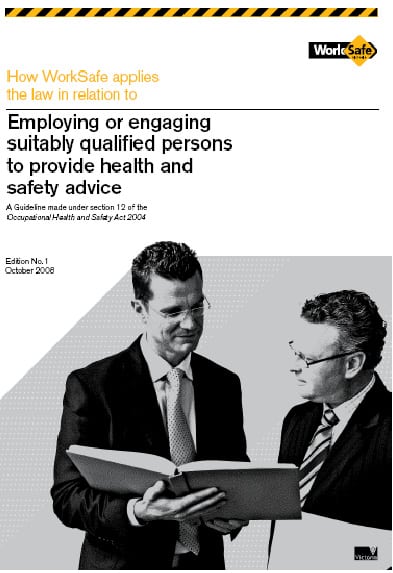
“Suitably qualified” OHS professionals – who benefits?

For many years OHS regulators have been concerned about the quality of advice that OHS experts have been providing to businesses in Australia.  Some States have a regulated profession, others do not. Certainly there is no regime in Australia that compares to the “closed-shop” of Singapore.

I have seen no evidence of bad OHS advice to business.  Looking through legal databases doesn’t help, as cases are too difficult to find and the regulators say they have evidence but they usually don’t share.

For over thirty years, OHS legislation has stated that OHS management in a workplace is, principally, the responsibility of the employer.  This also means that an employer is responsible for any OHS decisions made based on their own assessments, which may involve advice from an external adviser.

As an OHS consultant I provide the best advice I can.  If the client needs advice in an area that I am not knowledgeable in, I contract a suitably knowledgeable colleague as part of servicing my client.  Any advice I provide is clearly specified as coming from the information provided by the client and my observations on the day.  What decision the client makes is up to them. This point is made in the WorkSafe Victoria paper mentioned below.  The paper says

“It is important to note that employing or engaging a suitably qualified person to provide OHS advice does not discharge the employer from their legal responsibilities to ensure health and safety as required under Part 3 of the OHS Act. This duty cannot be delegated”

This week WorkSafe Victoria released a position paper to clarify a section of the OHS Act.  According to the website

“This document sets out WorkSafe’s position on the meaning of section 22(2)(b) in the context of duty holders meeting their obligations under Part 3 of the Occupational Health and Safety Act 2004 (OHS Act).

Part 3 (sections 21 to 23) of the OHS Act places duties on employers to ensure health and safety.

Section 22(2)(b) provides that employers must, so far as is reasonably practicable, employ or engage persons who are suitably qualified in relation to occupational health and safety to provide advice to the employer concerning the health and safety of employees of the employer.”

My belief is that OHS consultants should be called in, primarily, for a second opinion.  This opinion is provided after the employer and worker representatives have “had a go” at identifying hazards.  In my experience, businesses have a fair idea of the workplace hazards present but are not sure how to prioritise the controls of those hazards, and may be unaware of new control measures.  This is where the OHS consultant comes in.

Few OHS professional associations in Australia provide their members with information on how to do your job, or how to apply your knowledge in a commercial context.  Until recently few tertiary institutions provided this service and I would like to hear of those OHS courses that now do teach business practices to graduates.

(I remember attending a Ergonomics Society conference in Sydney almost ten years ago.  It was the first time anyone had spoken on the issue of professional ethics to the ergonomists.  I would be surprised if other Australian professional associations have progressed this far)

According to the position paper, these are the elements that they consider “may” make a suitable qualified person:

  • Knowledge
  • Industry experience
  • Professional activity
  • Reputation
  • Professional association
  • Communication skills
  • Technical expertise
  • OHS legislative understanding:
  • Risk management strategies

From that basis, below is my plain English checklist for businesses to assess their OHS advisers. Comments are in brackets:

  • Knowledge: Does the professional have an educational qualification that is relevant for your needs? (I have never been asked to show my education qualifications by a client. Also, having an educational qualification does not equate to competence, in itself, no matter what the education evangelists say)
  • Industry experience: Do they know what they are talking about? (This is impossible to verify unless they have worked in an industry for a long time in a prominent role. One could ask for references but the references are always friendly to the adviser)
  • Professional activity: Can the person demonstrate recent professional activity in the relevant OHS field? (Activity does not mean that the quality of that activity was any good. A snake-oil salesman could have been in business for a decade but they still sell snake oil. This is also relevant to the educational evangelists – academic papers in peer-reviewed journals do not indicate competence in advising companies on the best hazard control measures)
  • Reputation: Have they been any good in the past? (This can be indicated by googling their full name. I recently found an OHS adviser with a criminal record and jail time for “failing to act honestly as a director of various companies”. However, an internet campaign can be used to unfairly discredit someone. The best way of checking their reputation is the talk with the adviser’s professional association, should they be in one and should that association know what it’s on about.)
  • Professional association: Do they belong to a relevant professional association? (This is a good move but many associations allow advisers to buy membership without any verification of their competence? The flaw in this criterion is the validity of the association, its disciplinary procedures and its criteria for membership. Do not over-emphasise this criterion)
  • Communication skills: Can they read and write?
  • Technical expertise: Do they know how to use their tools properly?
  • OHS legislative understanding: Do they know there is an OHS law? Have they read it? Do they understand it?
  • Risk management strategies: Does their advice control the hazard or simply reduce its impact?

 But then, this could all be tosh.  Seek a second opinion.

Bullying, duty of care and compensation

The growth of attention to psychosocial hazards in Australia received a considerable boost from a stress survey undertaken by the ACTU some years ago.  During the survey of union-members, it became clear that bullying was a major generator and perpetrator of workplace stress.  The unions went to town on this data and set the agenda for some time in OHS.  Their success was echoed and mirrored in the United Kingdom and Europe. (In fact, Europe seems to be the jurisdiction that has kept the momentum)

The survey and campaign got the attention of regulators and OHS professionals to the presence of, perhaps, the next generation of occupational health and safety activity.

Since that time psychosocial hazards have splintered into sub-groups of stress, occupational violence, workload, fatigue management, shift work, dignity at work and a range of other matters. However bullying persists as the front runner.

As with many elements of OHS, risk management and cultural studies the defence forces provide signposts to future civilian issues. Yesterday the Australian Defence Force agreed to pay ex-gratia payments to family members of defence personnel who had committed suicide as a result of bullying suffered at the hands of their colleagues.  There are many significant signposts from these incidents but one of particular note was that the payments were not made to dependents but to other family members.

According to the ABC radio report by Karen Barlow:

“The suicides date back up to 12 years, when Lance-Corporal Nicholas Shiels killed himself after accidentally shooting his best friend dead during Army training.

Private John Satatas hanged himself at Holsworthy Barracks, in western Sydney, five years ago after being bullied and racially taunted.

Private David Hayward committed suicide four years ago after he was injured and had gone AWOL.” 

The Defence Minister, Joel Fitzgibbon, was interviewed on this issue, and others, on Radio National on 23 October 2008 and  has referred the matter to a general review of the defence forces. Fitzgibbon acknowledged that “shortcomings in the defence force system” contributed to the situation and could have been better handled after the event.

The day before the media attention the Australian Defence Force released the findings of its annual attitudinal survey of personnel.  The 2007 survey found, according to a media statement:

“… a marked improvement in knowledge of mental health issues as well as members’ assessments of their own mental health. Since 1999, the data also shows an increasing proportion of personnel who believe that unacceptable behaviour is well managed.”

As Australia moves to a national OHS and workers compensation system, or at least a harmonised system, more attention should be given to some of the responses and OHS initiatives in Commonwealth departments as these will be just as influential on OHS law and management as any State initiative.

Federal IR Minister speaks on OHS laws

Julia Gillard, Deputy Prime Minister and Minister for Workplace Relations, received a dorothy-dix question on 16 October 2008 (pages 52-53) concerning OHS harmonisation and the creation of SafeWork Australia.  Sadly, the good points the Minister made were overshadowed by political point-scoring at the Opposition Leader, Malcolm Turnbull.  It is still early days for the Labor Government in Parliament and Minister Gillard is one of the top parliamentary performers.  It is disappointing she did not use her full six minutes to give the issue the prominence it deserved or needed.

The nuggets of information she provided, prior to party politics interfering, were

  • harmonisation will help “39,000 businesses that operate across state boundaries”;
  • “300 Australians are killed at work each year”;
  • “over 140,000 Australians are injured at work each year”;
  • these deaths and injuries are “costing the economy $34 billion”  (presumably) each year.

The report of the inquiry into model OHS laws is due to release its interim report in October 2008 with the final report being presented to government in late-January or early-February 2009.

Insurance for OHS penalties

OHS law is generally structured in a positive way and based on the logic that people will act appropriately if there is a deterrent for doing the wrong thing.  This logic applies to many levels of public administration, commerce and psychology.

Some years ago, this logic was challenged during some consultation I undertook for a prison workshop.  It was necessary to assess the guarding of a machine not just for the “accidental” injuries but for malicious and purposeful injuries.  This established a lower common denominator than in the majority of workplaces. 

In this work environment to some inmates, the penalty for harming oneself and others was worth the risk.  It did not deter everyone.

Recently, an allegation has come to the attention of SafetyAtWorkBlog that a company providing OHS compliance advice to small businesses in Australia is also offering insurance coverage for OHS penalties.  Should a business proprietor be financially penalized by the OHS regulator for a breach of the legislation, the business proprietor would pay an excess of around $2000 and the (unnamed) insurance company would pay the balance.

Such a service places a $2,000 cap on OHS penalties and would remove a major reason behind penalties for unsafe practices and workplaces.

This is of concern to OHS professionals as we “trade” on the importance of OHS having a strong business case as well as a social benefit.

SafetyAtWorkBlog would be interested to hear from anyone who may have come across such insurance options elsewhere or have an opinion on such an option.

Concatenate Web Development
© Designed and developed by Concatenate Aust Pty Ltd