Australian silicosis research mirrored in the US

At the end of October 2019 the Australia New Zealand Society of Occupational Medicine (ANZSOM) will be conducting its annual scientific meeting in Adelaide. There are many issues on the agenda but silicosis is likely to figure prominently as it did last year, and as it should. The politics, knowledge and regulatory action has changed in the intervening twelve months.

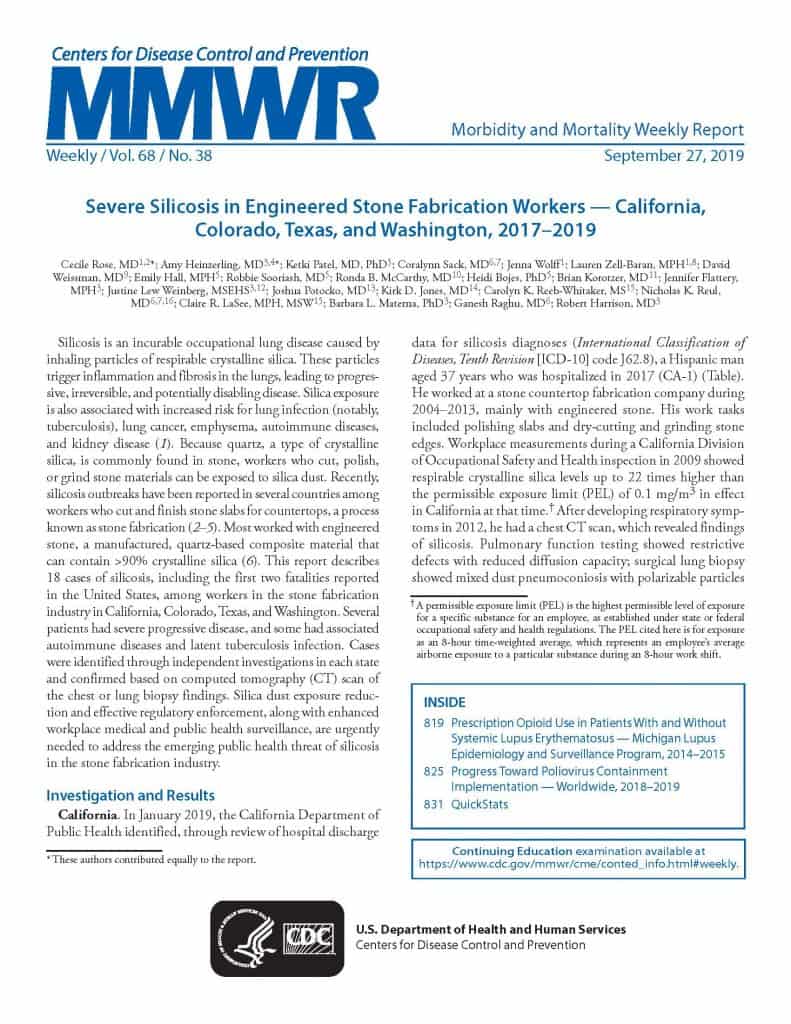
Australia has new guidances from several occupational health and safety (OHS) regulators and agencies which restrict or ban dry-cutting of engineered stone and change other safety-related practices. There is also at least one political move to ban the use of engineered stone. But perhaps more important is that new research on silicosis risks is appearing and not just from Australia. The United States’ Centers for Disease Control and Prevention published new research on 27 September 2019 based on medical assessments and several silicosis-related deaths.

Subscribe to SafetyAtWorkBlog to continue reading.
Subscribe Help
Already a member? Log in here

Bystanders, safety hazards and prevention of harm – “what you do or don’t do”

Occupational health and safety (OHS) relies on workers to “blow the whistle” on the existence of hazards to their employers, even though the process is not considered whistleblowing. The avoidance of many workplace hazards has always relied on bystanders – one’s work colleagues who may say “watch out!” In recent years, the action of notifying employers and authorities of hazards, and of drawing colleagues’ attention to0 hazards has increased in prominence and debate, especially around the issue of psychological harm and, a subset of that harm – sexual harassment.

In September 2019, the Victorian Government released what it describes as a toolkit on bystander interventions in relation to sexual harassment and sexism. The full document is useful but, as with many government guidances on this issue, almost ignores the role of health and safety management in the prevention and reduction of this type of hazard.

Subscribe to SafetyAtWorkBlog to continue reading.
Subscribe Help
Already a member? Log in here

COSBOA is outraged over mental health and jail

On September 24 2019, the Council of Small Business Organisations Australia (COSBOA) called for the withdrawal of the Boland review into Australia’s work health and safety (WHS) laws.

In a media release COSBOA’s CEO, Peter Strong, states:

“The report solely focusses on workers, giving zero consideration to the mental health of employers and the self-employed….”

Continue reading “COSBOA is outraged over mental health and jail”

CEDA provides business insights but more is needed

One of the missed opportunities for improving occupational health and safety (OHS) over the last 30 years has been the application of corporate social responsibilities (CSR) to the supply chain and not to one’s own health and safety performance. CSR and OHS and social justice and decent work are all elements of the Venn Diagram of keeping people safe.

But this diagram exists in a world where economics dominates political decision-making and conflict results. Recently in Australia corporate leaders have spoken about various controversial social issues. Last week the Assistant Minister to the Prime Minister and Cabinet, Ben Morton advised companies to stop this advocacy and focus on the economic fundamentals of business. This week the Committee for Economic Development of Australia (CEDA) released its Company Pulse survey results which shows that the community accepts that company executives can advocate for social issues.

Subscribe to SafetyAtWorkBlog to continue reading.
Subscribe Help
Already a member? Log in here

More safety in politics

Here’s a quick summary of several mentions of occupational health and safety (OHS) in the various Parliaments in Australia over the last week or so.

Answers to Questions on Notice

In Parliamentary Committees, speakers often put questions “on notice” as they do not have the answer at hand. Often these questions fade from memory but answers do appear, usually. A good example has been provided in the South Australian Parliament on September 11, 2009 with the Treasurer, Rob Lucas, providing answers to questions from Estimates Committee B on July 24 2019. For the number junkies out there, according to Hansard, in 2018/19 SafeWork SA:

Subscribe to SafetyAtWorkBlog to continue reading.
Subscribe Help
Already a member? Log in here

Aim for prevention, to affect real change

The Minerals Council of Australia (MCA) has released its submission (not yet online) to the Safe Work Australia’s (SWA) review of the Regulatory Impact Statement on the recommendations from the Boland review of the Model Work Health and Safety laws. It is comprehensive but contains little that is new. An interesting interpretation of the submission comes from considering how the MCA’s recommendations prevent harm, for prevention is the challenge.

Subscribe to SafetyAtWorkBlog to continue reading.
Subscribe Help
Already a member? Log in here

Listening anew to the voice that has always been there

The growth of visible and prominent customer services, such as those in the collective term of “gig economy” – has coincided with an increased consideration of alternative socioeconomic structures and broader political diversity, especially in the UK and to a lesser extent Australia and New Zealand. One manifestation of this change is an emerging consideration of Co-operatives and worker ownership. This may seem outside the occupational health and safety (OHS) purview of this blog but co-operatives often allow workers more input into business operations and therefore more influence on OHS standards and management. However, should this influence come from increased worker wealth or is OHS more fundamental than money?

Subscribe to SafetyAtWorkBlog to continue reading.
Subscribe Help
Already a member? Log in here
Concatenate Web Development
© Designed and developed by Concatenate Aust Pty Ltd