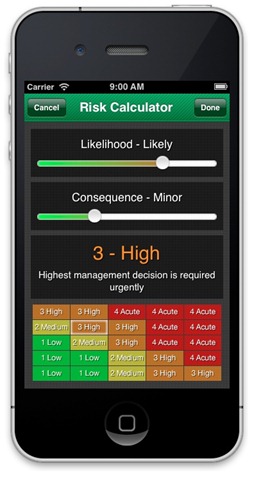
OHS app is attractive but may be no better than a paper system

Over the last few months I have been using my iPad to take photographs of good and bad workplace practices.  These photos are usually shown to a site or business manager after a visit so that control measures can be identified.  The advantage of an iPad is that no one has to squint at a small screen to try to see the hazard.  I have kept my eyes open for potentially useful OHS apps for the iPad.  One app recommended to me is iJSA.

iJSA, designed for the iPhone initially, is packed with features that could assist the tech-savvy OHS professional in developing Job Safety Analyses (JSA) (Job Hazard Analysis in the United States).  However any app must prove to be better, more convenient and more effective than existing measures and I am not sure that iJSA does this. Continue reading “OHS app is attractive but may be no better than a paper system”

OHS Strategy to nowhere

Throughout 2011, Safe Work Australia (SWA) has been conducting consultative workshops in the development of the next ten-year National OHS Strategy.  SafetyAtWorkBlog reported previously on the Melbourne meeting.  SWA has released their report into that Melbourne meeting.

The meeting had a set of criteria for the stakeholders to consider.  Sadly, there was no forewarning of the issues to be discussed so the workshop took some time to gain traction.  With only one day of consultation, it would have been more productive to release the agenda topics a day or two earlier.  These topics, each of which could have generated at least a half-day’s debate, are listed below

“Social/Economic/Emerging Issues in the Workforce, Business and Technology…

Hazards – Enhancing the capacity of workplaces to respond to:

  • Disease-Causing Hazards …
  • Injury-Causing Hazards …
  • Psychological Injury-Causing Hazards …

Work Health and Safety Systems – Challenges and Solutions in Safe Design and Work Systems, Skills and Training, and in Safety Leadership and Organisational Culture…..”

The report has responses to each of these topics but many of the suggestions are already known.  The lack of creativity in the suggestions is largely disappointing.  The responses to “what will success looks like in ten years” are mostly extensions of programs that are already in place or a perpetuation of the “way things are done now”.  Innovation was largely missing, perhaps due to the participants not being able to lose their own agendas.  The earlier SafetyAtWorkBlog article discussed the negative impact of the shadow of harmonisation, a term found only once in SWA’s report. Continue reading “OHS Strategy to nowhere”

Australia risks OHS ridicule in the media

The Sunday Herald-Sun ran an article that would not have been out-of-place in the English tabloid newspapers.  The article, “Safety regulations taking the fun out of schools”, indicates many of the confused lines of responsibility that English articles include.

In Victoria, the safety requirements of government schools are determined by the Department of Education and Early Childhood Development (DEECD).  The OHS regulator, WorkSafe, has some influence but far less that DEECD. (The only really school-related OHS document from WorkSafe Victoria was released in 2008)

The Sunday Herald-Sun article states, in some pictures not in the online version, that the Victorian Principals Association has been told of OHS regulations that require teachers to  “put on mask, surgical gloves to apply a band-aid”.  Continue reading “Australia risks OHS ridicule in the media”

Some journeys should never be needed

Relatives of people who have died in workplaces regularly complain about the lack of communication from OHS regulators and other government and legal agencies who are charged with investigating an incident.  A recent example of this is Ann Maitland whose daughter, Michelle, died in a gymnastics class in 2009, but Ann Maitland took action and the safety level of gymnastics classes, and many other workplaces,  is likely to improve considerably as a result.

Prior to discussing the government’s report into gymnastics safety, it is worth acknowledging the arduous journey that Ann Maitland ( an occasional commenter on this blog) undertook.

In response to complaints by Ann Maitland, the Queensland Department of Justice and Attorney-General engaged conducted an independent review of the actions of Work Health and Safety Queensland (WHSQ)  in relation to Michelle Maitland’s death.  The review report found that

“A key deficiency highlighted by Mr Byrne was the inadequate communication with Ann Maitland. He further adds that “any similar situation in the future by the creation of the liaison officer position”. In this regard the Investigations Liaison Support Officer position was implemented in January 2011.”

There were several other recommendations from the review for WHSQ to tighten up enforcement procedures.  The fact that an independent review was conducted at all is a major win for Ann Maitland and other Queensland families.  The fact that such an independent review was required at all should be a matter of great concern. Continue reading “Some journeys should never be needed”

Australian politician jumps on possible OHS concession from Government

Politics has again entered the OHS harmonisation debate in Australia.  Federal Workplace Relations Minister, Chris Evans, issued a statement on 10 November 2011, part of which that has been pounced on by the Opposition and slightly twisted by the online media.

“Senator Evans also announced that transitional arrangements for the model OHS laws have been developed by Safe Work Australia to assist businesses to move to the new harmonised arrangements.

“The transitional arrangements will apply to the model OHS Regulations and provide delayed commencement of up to 12 months or more where the new laws result in a new or significantly different set of duties,” Senator Evans said.

“The developments of sensible transitional arrangements are part and parcel of any new laws.”

The Shadow Minister for Workplace Relations, Eric Abetz, quickly responded with a media release of his own.

“Minister Evans has today conceded that businesses will be able to delay implementing new national health and safety laws by up to 12 months if the regulations result in them having to undertake significant change.  Given that almost every business will have to make significant change, this is the Minister’s back door way of delaying the laws implementation.”

It is important to read the entirety of Senator Evans statement as it reiterates some of the points that SafetyAtWorkBlog reported on several weeks ago.   Continue reading “Australian politician jumps on possible OHS concession from Government”

Australia inactive on environmental tobacco smoke

Safe Work Australia has released a couple of packages of draft codes of practice in line with the Australian Government’s OHS harmonisation strategy but where is the code that addresses the established risk of environmental tobacco smoke (ETS) or second-hand smoke?  This is a question that was asked during the recent Safe Work Australia week by Smoke Free Australia, an alliance of employee and health groups.

Smoke Free’s media release stated that

“….thousands of Australians are working in areas contaminated by highly toxic, carcinogenic tobacco smoke – and Safe Work Australia has done nothing to prevent it”

Stafford Sanders, the coordinator for Smoke Free Australia, was struggling to understand why ETS had not been given prominence in the new draft codes of practice given that second-hand smoke is a known killer. Continue reading “Australia inactive on environmental tobacco smoke”

Bullying has many causes and too many avenues of appeal

On 18 October 2011, there was a brief discussion on workplace bullying in the ACT Legislative Assembly of the Australian Capital Territory (ACT).  The question to Chief Minister Katy Gallagher, stemmed, ostensibly, from a recent WorkSafe ACT assessment of Canberra restaurants and food retailers.  The assessment identified that:

“… only 66 per cent of food outlets were compliant with workplace bullying regulations.”

Such a statement needs considerable explanation to be of use in safety management but it led to a further question from Greens MP Meredith Hunter, one which indicates the confused status of workplace bullying control options.

“Minister, what consideration has the ACT government given to bullying as a ground for discrimination under the ACT’s Discrimination Act, which would give complainants and respondents to bullying complaints access to the Human Rights Commission’s investigation and conciliation functions and clear remedies for victimisation of a person making a complaint?”

It is unreasonable to expect that a Code of Practice on workplace bullying drafted under OHS laws would have the capacity to control the hazard, or provide sufficient guidance, when there are other avenues for restitution that are far more involved, such as discrimination and human rights commissions and tribunals. Continue reading “Bullying has many causes and too many avenues of appeal”

Concatenate Web Development
© Designed and developed by Concatenate Aust Pty Ltd