Quad bike manufacturers walk out of safety working group

In early 2010, Australia’s Heads of Workplace Safety Authorities (HWSA) established a trans-Tasman working party to look at the safety issues of quad bikes, often called all-terrain vehicles.  The working group is in the final stages of its report and a major motorcycle industry representative has not liked the findings and has apparently withdrawn from the working group.  A report on the increasing tensions was published in  this week’s The Weekly Times.  SafetyAtWorkBlog has been told that the quad bike industry representative has walked out in protest.

Let’s look at what HWSA said about the working group in May 2010:

“HWSA Chair, John Watson, said every farming fatality leads to immeasurable suffering in close-knit rural communities and these figures are not acceptable.
“The working group is expected to deliver solutions to safety problems associated with use of quad bikes on farm properties and raise awareness of practical risk controls,…
“The group will look at issues that include design, safety equipment, training and instruction, aftermarket accessories, safe use and point of sale,….
“The joint program of work will be delivered through an Industry Solutions Program where industry and regulators work together to address high risk safety issues – an initiative that has successfully provided practical solutions to a number of issues across many industries.
“The working group is focused on producing tangible and sustainable safety outcomes across the farming and agricultural industry where quad bikes are commonly used….”
Of significance in that media release is that Chief Executive of the Federal Chamber of Automotive Industries (FCAI) Andrew McKellar said

“It is our objective that all quad bike users are well informed of the manufacturer’s recommendations in relation to the safe use of these vehicles…”

The sticking point in the working group was, according to The Weekly Times, that

“”…the committee was expected to back the recommendation to “consider fitting an anti-crush device”, the strongest position yet for roll-over protection.”

The committee did recommend this and apparently the FCAI walked.  Attempts have been made to contact the FCAI to confirm their action and their objections. Continue reading “Quad bike manufacturers walk out of safety working group”

Compliance or Confidence?

A reader has been inspired by recent articles discussing OHS compliance to contribute their own article on some of the issues raised:

“Compliance”, while being a way forward in OHS, misses the mark. We should ask the question: Why do regulators want compliance anyway?

Compliance, or conformance as is alternatively used, is a means to an end. Not an end in itself. In haste to improve the world via compliance we sometimes forget that.

Compliance presumes that rules laid down by regulators are a “good enough” way to achieve safety. Compliance’s foundation is the minimum-standard. Foundations cannot be anything like the maximum-standard because best practice regulation knowledge backs up our common sense that maximum standards would be bad and expensive. But wouldn’t it be comforting to be able to encourage and get more than just the minimum?

Some who have felt the stick end of compliance might think some regulators believe their rules and guides are the only path to safety. But the fact is that even the best codes & regulations have flaws; they do change. Furthermore, exemptions get provided, position papers and codes of practice get written to fill the gaps. And they get re-written. Sometimes the reasons for a rule are lost in time. Shamefully, sometimes valid reasons never existed. Sometimes rules are written to serve the purposes of some over others or to empower authority. We can know this because COAG and the OBPR have to warn against it. Continue reading “Compliance or Confidence?”

Regulating The Great Leap Forward (Into The Bleeding Obvious)

Col Finnie has provided the following article in response to OHS compliance checklists:

It’s gotta be time to bite-the-bullet.  The wish-fulfilment approach – that people will apply some sort of system to how they look after safety because that’s the only sensible way to do it – well, that’s not working, particularly it seems, in the small business area.

Time to regulate for the obligation to have something that can, at very least, lay the foundation for a comprehensive systematic approach.  Seems just a bit whacked to me that a demonstrable systematic approach is required once a worker is injured (with the return-to-work obligations) and yet there is nuthin’ for the prevention stuff.

Getting a slapping from a magistrate for having no safe work procedures (as one part of a systematic approach) would work as an incentive if people were busted as often as they are for road traffic naughtiness; but we know that frequency of OHS busts are just not going to happen.

The Great Leap Forward (Into The Bleeding Obvious) would have to be regulated in a smart way.   Continue reading “Regulating The Great Leap Forward (Into The Bleeding Obvious)”

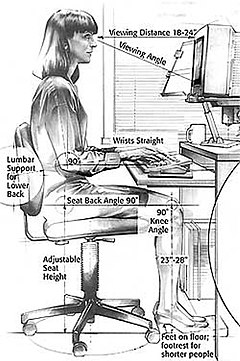
Ergonomics advice does not always reflect the reality

It is common for companies to invest in expensive office furniture in the belief that the furniture will encourage the worker to undertake tasks more safely.  In most circumstances, this is a waste of money and a major distraction from managing safety throughout workplaces.

The safety message is also being confused by some OHS regulators.  It is well-established that injured backs and other musculoskeletal injuries improve with movement rather than the traditional bed-rest.  However this encouragement to move is not reflected in most of the advice for configuring workstations.  Continue reading “Ergonomics advice does not always reflect the reality”

OHS compliance checklists

For several months some Australian OHS regulators have been providing “Compliance at a glance” checklists. These are not intended to establish compliance, particularly in the small business sector as listed on one regulator’s website , but are more brief indicators of areas for greater improvement.

Nevertheless the items listed in the “red zone” of the checklists establish a benchmark of NON-compliance. These items are listed below:

ILO provides thoughtful information for Workers’ Memorial Day

Workers’ Memorial Day, or the World Day for Safety and Health At Work, gains considerable attention at local levels.  In particular, Australia and Canada have a large number of commemorative events.  However, the activities of the International Labor Organization (ILO) should not be ignored and the activities for 2011 are of particular note.

The Deputy General of the ILO, Juan Somavia, reminds us that in 2001 the ILO published its Guidelines on Occupational Safety and Health Management Systems, a document that has had a major influence on those countries that do not have the resources necessary to develop their own OHS regulatory support services.

Ten years after the release of that document the ILO has released a reflective report entitled “OSH Management System: A tool for continual improvement”. This report reads as a little simple for those who focus on occupational health and safety management systems (OHSMS) but every so often even the most specialised of professionals needs to be reminded of the basic building blocks of that profession.  This is particularly so in countries like Australia, where the OHS profession is distracted by legal harmonisation, or England, where budget cuts and economic challenges are focussing business attention away from safety management.

The report reminds in plain English that

“The OSHMS approach ensures that:

Brodie’s Law on bullying needs more consideration for workplace application

Recent attention on the presentation of the Crimes Amendment (Bullying) Bill 2011 to the Victorian Parliament has, understandably, focussed on the changes to the criminal code. However some of that attention should also have been given to the existing rules and control measures under workplace law, particularly considering that the proposed amendments, commonly referred to as Brodie’s law, are being described in the context of workplace bullying.

WorkSafe Victoria’s 2005 guidance on workplace violence and bullying specifies what elements of the Crimes Act 1958 could be relevant to workplace bullying:

  • Intentionally or Recklessly Causing Serious Injury
  • Intentionally or Recklessly Causing Injury
  • Threats to Kill
  • Threats to Inflict Serious Injury
  • Stalking

The inclusion of the last item may surprise some who have been reading only the newspaper coverage of Brodie’s Law as there was a clear implication that the application of stalking to workplace bullying was new.

Law firm Clayton Utz reminds us that workplace bullying remains undefined in the Crimes Act and that the Bill

“… extends the definition of the pre-existing offence of stalking by expanding the definition of that offence to pick up the type of behaviours that are typical of workplace bullying.”

If the Bill passes the Victorian Parliament, the OHS regulator will need to amend its advice on workplace bullying to reflect the expanded definition of stalking. But as can be seen by the bullet points above, changes to guidance may be minor as stalking is already seen as a potential element of workplace bullying. Continue reading “Brodie’s Law on bullying needs more consideration for workplace application”

Concatenate Web Development
© Designed and developed by Concatenate Aust Pty Ltd