If all you have is a hammer, everything looks like a nail

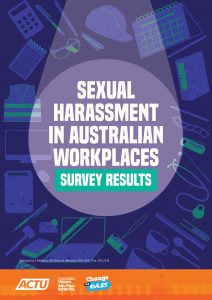
The trade union movement has often been instrumental in affecting and sometimes creating government policy on occupational health and safety (OHS).  The latest generation of hazards – psychosocial – can be traced back to a survey late last century of workplace stress conducted by the Australian Council of Trade Unions (ACTU).  This week the ACTU released its survey into sexual harassment at work.

The current survey should not be seen as representative of any social group other than trade union members even though the survey was completed by 10,000 of them.  Also, this survey is far less likely to be as newsworthy as last century’s surveys as the agenda on workplace sexual harassment has already been established by reports from groups like Universities Australia and, especially, the current work by the Sexual Discrimination Commissioner and the Australian Human Rights Commission.  It is also likely to be covered, probably as a secondary issue, in the various mental health inquiries scheduled for 2019.

The ACTU survey provides additional information to our understanding of sexual harassment at work but certainly not the whole picture.

Subscribe to SafetyAtWorkBlog to continue reading.
Subscribe Help
Already a member? Log in here

Productivity Commission sets stage for inquiry into mental health

The Australian Government has released the terms of reference into its Productivity Commission inquiry into mental health.  The inquiry has broad aims that clearly include occupational health and safety (OHS) and may set some evidence challenges for some of those in the workplace wellbeing sector:

“It will look at how governments across Australia, employers, professional and community groups in healthcare, education, employment, social services, housing and justice can contribute to improving mental health for people of all ages and cultural backgrounds.” (emphasis added)

The Treasurer Josh Frydenberg MP has written that

“the Commission should consider the role of mental health in supporting economic participation, enhancing productivity and economic growth.”

Subscribe to SafetyAtWorkBlog to continue reading.
Subscribe Help
Already a member? Log in here

Bad bosses

Benjamin ArtzAmanda H. Goodall  and Andrew J. Oswald determined that

“There are no published papers — to our knowledge — that assess in an internationally consistent way the rarity or commonness of ‘bad bosses’.”

So they undertook there own research, published under the title “

Subscribe to SafetyAtWorkBlog to continue reading.
Subscribe Help
Already a member? Log in here

The sexual harassment you walk past is the sexual harassment you accept

Australian Human Rights Commissioner, Kate Jenkins, has released the findings of the Commission’s latest survey on sexual harassment in workplaces.  It is an important analysis of an improving dataset that should make actions to prevent sexual harassment more effective.

The statistical report is separate from the Commission’s National Inquiry into Sexual Harassment in Australian Workplaces and does not emphasise the role of harm prevention but it does contain references to prevention that are worth considering.

Subscribe to SafetyAtWorkBlog to continue reading.
Subscribe Help
Already a member? Log in here

An iron fist in a velvet glove to HR over psych claims

Dr Rebecca Michalak has just published an extraordinary article calling on the Human Resources profession and many others to take a good, hard look at how they treat workers who may have been subjected to psychological pressures at work.

Human Resources personnel could feel particularly hard done by but Michalak stresses that there are many players in the process of creating and managing psychologically healthy workplace and of not adequately managing psychologically injured workers.  She makes her proposition clear up front:

Subscribe to SafetyAtWorkBlog to continue reading.
Subscribe Help
Already a member? Log in here

Arts Wellbeing Collective gets a future

In November 2017, SafetyAtWorkBlog wrote about a pilot occupational health and safety (OHS) and wellness program created by the Victorian Arts Centre.  At the time the future of this very good program was in doubt as continuing funding was not available.

On August 30 2018, Victorian Premier, Daniel Andrews, pledged some funding to the Arts Wellbeing Collective.  How much funding has not been revealed but providing a future for the program is a sound OHS and political move.

A major attraction of the Arts Wellbeing Collective is that it was an initiative from outside the established OHS and Human Resources networks.  This cuts out a lot of baggage but also risks acting without an understanding of what has gone before.

Perhaps more importantly, this program is not a response to the Weinstein issues or the #metoo agenda.  It was developed prior to both of these events but will benefit from the profiles these tragedies have created. All strength to it.

Kevin Jones

Paula Schubert was bullied before her suicide

In November 2016, 53-year old Paula Schubert hanged herself. On July 25 2018 the Northern Territory Coroner Greg Cavanagh described the behaviour of managers at her employer, the Norther Territory Department of Children and Families/Territory Families as bullying.

The full Coronial Findings are an important read for any organisation to understand how managerial activities and attitudes can negatively affect workers. 

Subscribe to SafetyAtWorkBlog to continue reading.
Subscribe Help
Already a member? Log in here
Concatenate Web Development
© Designed and developed by Concatenate Aust Pty Ltd