WorkSafe acts on allegations of gruelling workplace conditions in a Victorian law firm

On October 12 2018 the Australian Financial Review (AFR) published an exclusive article about an investigation by WorkSafe Victoria into excessive working hours at an Australian law firm, King & Wood Mallesons (KWM). The article was later expanded on line.

There are several curious elements of this report that could reflect other workplaces that may experience sudden high workload demands and fatigue.  Some seem to see the significance of this article as being less about the workloads and fatigue but more about WorkSafe Victoria’s involvement in an industry sector where it does not usually play.

The Australian Government announced a Royal Commission into the Banking and Financial sectors in 2017.  It was created urgently and given only 12 months to conclude its investigations.  As a result banks and financial institutions

Subscribe to SafetyAtWorkBlog to continue reading.
Subscribe Help
Already a member? Log in here

Political tennis on silicosis begins

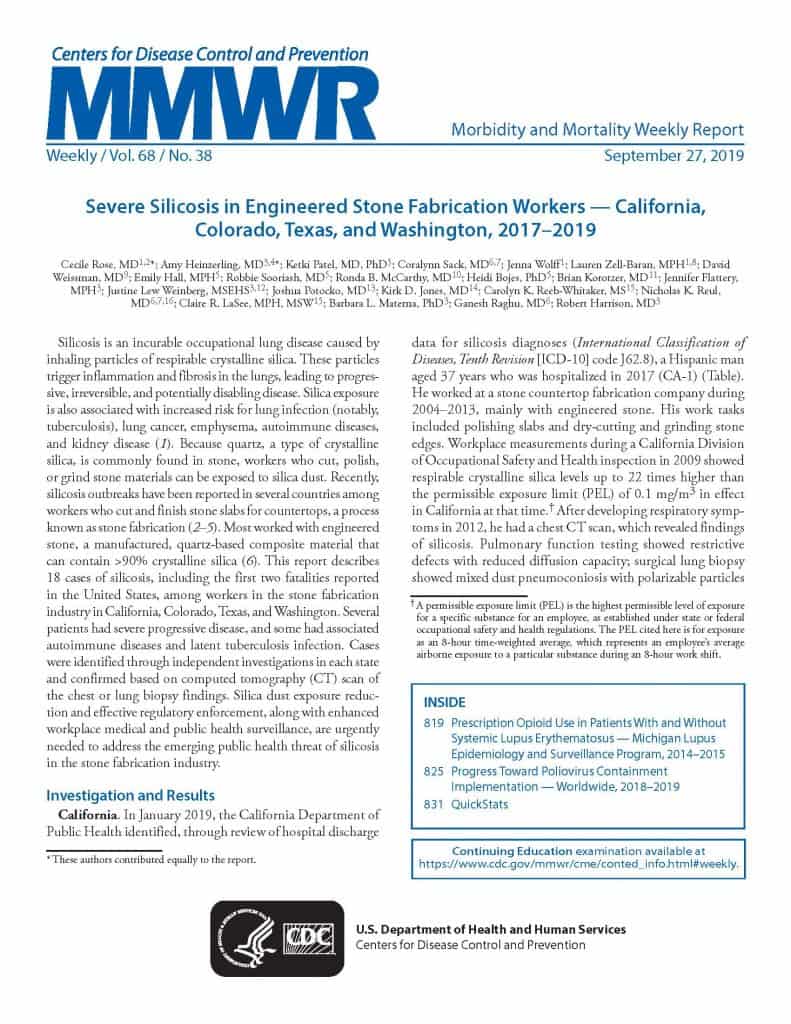
Pictured from Dr Ryan Hoy’s ANZSOM presentation

It was reported on October 11 2018 that Australia’s Health Minister, Greg Hunt, has called for:

“… state workplace regulators to immediately investigate risks to the health of stonemasons, and stop unsafe work practices.”

Some reports have said that a statement was issued:

“Mr Hunt issued a statement saying he and the Chief Medical Officer would raise the issue at a health COAG meeting in Adelaide on Friday. He said the meeting would be asked to consider whether a national dust diseases register should be developed.”

However the Minister’s Office has advised SafetyAtWorkBlog that no formal statement has been made.  This makes it a bit hard to determine what exactly he is asking for on the prevention of silicosis but the States have begun to respond.

The Victorian Minister for Health,

Subscribe to SafetyAtWorkBlog to continue reading.
Subscribe Help
Already a member? Log in here

By looking at the silicosis tree, we might miss the forest of dust

Rumours of a TV report on the increasing hazards of silicosis have floated around for a week or so.  On October 10 2018, the show appeared on the Australian Broadcasting Corporation’s 7.30 program.  But the story is much bigger than the ten minutes or so on that program.

The focus is understandably on silica but perhaps that is too specific.  Maybe the issue of dust, in general, needs more attention.

However,

Subscribe to SafetyAtWorkBlog to continue reading.
Subscribe Help
Already a member? Log in here

Glyphosate presents an OHS problem but maybe OHS is the path to a solution

Occupational health and safety (OHS) related decisions are made on the state of knowledge about hazards and it is up to OHS people to make sure the state of knowledge is at its best so that the best decisions can be made.  But what do you do if the state of knowledge on a hazard seems to be made purposely uncertain and that uncertainty is leading to the status quo, which also happens to provide a huge income for the owner of the product creating the hazard.

This seems to be a situation at the moment in Australia in relation to the use of the weedkiller, glyphosate, marketed heavily by the global chemical company, Monsanto.  The alleged corruption of data on which OHS people and workers base their safety decisions was perhaps one of the most disturbing elements of the recent ABC Four Corners program on the chemical (

Subscribe to SafetyAtWorkBlog to continue reading.
Subscribe Help
Already a member? Log in here

Structural v Individual approaches to preventing psychological harm persist

At the end of September 2018 the Australian Psychological Society held its 2018 Congress.  As conferences do, various media statements are released to generate interest in the speakers.  One caught the attention of this blog.  It was released on September 25 2018, and was called:

“Resilience isn’t enough to combat the effects of burnout, world renowned psychology expert says”

This sounded like it may look closely at the prevention of harm and SafetyAtWorkBlog was able to interview that world-renowned psychology expert,

Subscribe to SafetyAtWorkBlog to continue reading.
Subscribe Help
Already a member? Log in here

Mixed bag conference format succeeds

The Safety Institute of Australia (soon to be trading as the Australian Institute of Health and Safety) conducted its Perth Safety Symposium on September 28 2018.  It was the event’s second year and, overall, was a success.  But how does one measure the success of a one-day conference?

Firstly, one has to have an interesting and, if possible, fascinating pool of speakers. The keynote speakers included:

Simon Millman MLA represented the West Australia Premier Continue reading “Mixed bag conference format succeeds”

The jury remains out on standing desks but maybe we are asking the wrong questions

The 20th Congress of the International Ergonomics Association in Florence Italy recently concluded.  Australia’s Professor David Caple attended and brought the latest research into the benefits of sit/stand desks to the September meeting of the Central Safety Group in Melbourne.  Caple said that evidence remains confusing on this increasingly popular piece of office furniture and echoed the modern approach to occupational health and safety (OHS) matters – look at what the work involves and how and where people do it.

Caple explained how large companies are moving away from open-plan offices to those designed around “activity-based work or

Subscribe to SafetyAtWorkBlog to continue reading.
Subscribe Help
Already a member? Log in here
Concatenate Web Development
© Designed and developed by Concatenate Aust Pty Ltd