Workplace falls continue even during a safety week

Several years ago while visiting a local council with an OHS mentor, a call came through that a worker had fallen over 10 metres through a skylight into a plant room at a commercial swimming pool.  It was the first time I had been on site shortly after a workplace incident and was party to the negotiations and advice between OHS advisers, health & safety representatives and quickly after the event, the CEO.

I am reminded of that day too often when reports come through of workplace falls and deaths.  Workplace incidents do not take a holiday even during Safe Work Australia Week and this year was no different.  Below are a couple of short reports of incidents from last week.  As they did not result in a death, they were unlikely to be reported in the mainstream press.

“A man has fallen through a warehouse roof, dropping eight metres onto concrete at Brunswick [on 30 October 2009].

‘The 24 year old man landed on the concrete and some bicycles that were on the floor,’ according to Intensive care paramedic Kate Cantwell. ‘Even though he had fallen about eight metres, he is extremely lucky that he landed on his arm and side, and not on his head. He has quite a severe fracture to his arm, and possibly a fractured pelvis.”

“A 62-year-old man fell nearly three metres to the ground when he slipped off a ladder in Heidelberg Heights [on 26 October 2009].  Advanced life support paramedics from Oak Park and Epping were called to the residential building site at 11.05am.

Paramedic Haley McCartin said they arrived within eight minutes to find the man lying on the ground in a significant amount of pain.  ‘He suffered a suspected fractured hip and wrist,’ she said.”

Both these cases were posted by the Ambulance Service in Victoria and reinforce that falls in workplaces continue to occur.  Not all falls cause death but falls invariably result in serious injuries.

It is fair to say that gravity continues to be the number one contributory factor to workplace falls.

Kevin Jones

Prosecution results from fall through roof

On 22 October 2007, a commercial premise in Southbank, Victoria, was to undergo renovations which included replacing the asbestos roof with an iron roof.   Two men were employed as project managers and during the roof replacement, according to WorkSafe Victoria.

“…the dogman fell [through an unguarded shaft] a total distance of 8 metres and as a result he broke 3 bones of his right wrist and a fractured scapula as well as sustaining bruising to the body and serious lacerations to the head.”

On 16 October 2009, the Magistrates’ Court fined the specialist roofing company contracted for the task $A15,000.  The prosecution summary says that as the company specialised in roofing, the hazards of working on an asbestos roof, and unprotected edges, would have been well-known.

The two project managers were fined $A7,500 each as they were not sufficiently experienced for their project management roles.  The lack of fall protection for those working on the roof was of particular note according to the Prosecution Summary from WorkSafe Victoria.

More details on the prosecution are available from the WorkSafe hyperlinks in this article.

It would be interesting to run this prosecution summary as a hypothetical under the proposed National OHS Model law to provide a contrast between the old and new laws particularly on the following matters, although many more could be considered if further details were available:

  • who controls the workplace
  • competence
  • suitably qualified
  • role and enforcement of JSA’s
  • contractor management

Kevin Jones

Uncovered holes

Recently SafetyAtWorkBlog reported on a new WorkSafe Victoria guidance on guarding cellar doors.  Comcare has started legal action against a company a similar hazard but one located in public.

Comcare has instigated proceedings against Australia’s leading telecommunications company, Telstra, for an unguarded pit in a public area.  According to the media release dated 19 August 2009,

“The proceedings arise from an incident on 31 January 2008 when two Telstra sub-contractors opened an access pit while conducting work.  The pit is located on a pathway between a train station in Brisbane and the office of an organisation that provides services to persons with impaired vision.  While the access pit was allegedly left open and unguarded, a member of the public, with a vision impairment, fell into the pit and sustained a serious personal injury.

The maximum pecuniary penalty for a breach of s17 of the Act by a body corporate is $242,000.”

This is not a new hazard and open telecommunications pits have been guarded for decades, often with canvas to provide weather protection for workers.   We’ll report on the judgement when it is handed down.

Kevin Jones

Another mining death in Western Australia

Rarely have workplace fatalities gained as much political attention as the current spate of deaths in Western Australia.  Most have related to the iron ore operations of BHP Billiton but, according to one media report, on 8 August 2009

“New Zealander Daniel Williams, 26, died … at the Kanowna Belle mine site near Kalgoorlie, operated by Barrick Gold, after falling from an iron ore path into a hole.”

The media report clearly indicates that there are wider issues in the enforcement of OHS in that State other than just the operations of Barrick Gold.

Not surprisingly the unions are calling for a broader inquiry into safety of the industry.

SafetyAtWorkBlog has heard that Daniel Williams fell over 30 metres while checking a blockage in an ore pass grizzly shortly after midnight.  Perhaps, this should be considered an example of a fall from height moreso than a mining death.

Barrick Gold has been contacted for any additional information

Kevin Jones

Share Solutions for the 21st century

SafetyAtWorkBlog has received several enquiries around the Share Solutions mentioned in an August 5, 2009 blog posting.  Coincidentally overnight WorkSafe Victoria released one of its “Health and Safety Solutions” dealing with falls through cellar trapdoors in the hospitality industry.

HSS0076-Hospitality-Preventing-1167006770801531700000000000000000000000000000000000000000000000000000000000000000000000000000.000000allsthrough ellartrapdoors_Page_148135104HSS0076-Hospitality-Preventing-1167006770801532000000000000000000000000000000000000000000000000000000000000000000000000000000.000000allsthrough ellartrapdoors_Page_148135104

For those of the “Youtube generation” the video below shows the risks of not controlling the hazard of an open cellar door.

Information distribution

This latest is a good example of how good old ideas can be updated, but it would still be good to see such solutions “harmonised” through a national process and disseminated more widely that relying on business finding these items on the website.

It is understood that WorkSafe believes that the OHS professionals are an important medium for this type of information, and this mention in SafetyAWorkBlog perhaps illustrates that strategy.  Looking at the websites of some of the OHS associations in Australia, none seem to be lining through to new WorkSafe content or reproducing the content on their own sites for their members.  The commercial sites are doing the work for regulators and the associations and funding their activities through advertising.

This certainly makes a low cost distribution model for WorkSafe but one that is short-sighted and of questionable sustainability.

Kevin Jones

Latest Code of Practice on Scaffolding

Australia has had some awful scaffolding collapses and swing-stage incidents over recent times.  (At least four articles on the issue can be found in SafetyAtWorkBlog by using the search function on the right).  Sometimes, some would say often, Australian OHS regulators can respond quickly to a workplace situation.

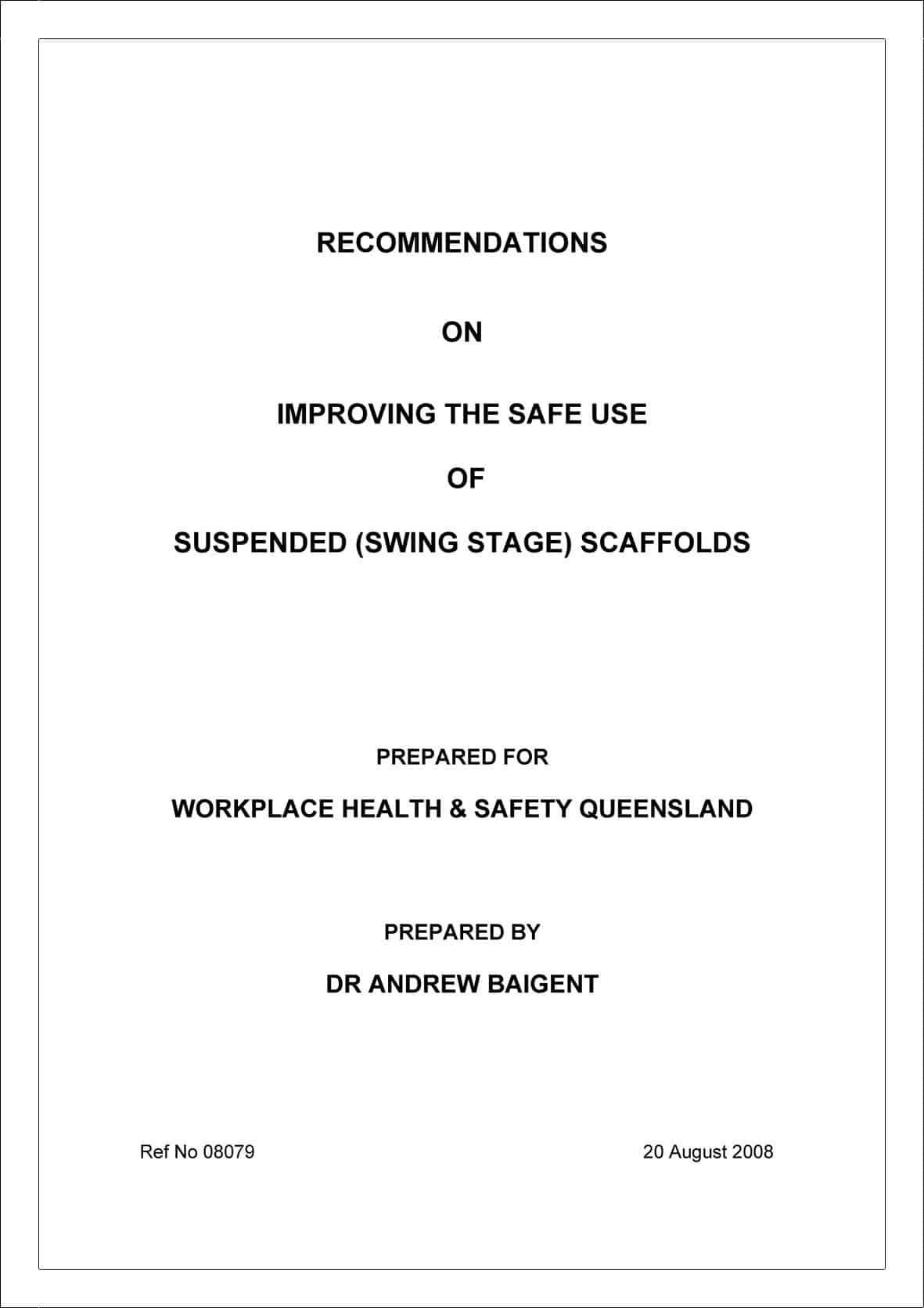
The Queensland Government commissioned a review of suspended, or swing stage, scaffolding  by Dr Andrew Baigent.  The report was finalised in August 2008.  A new scaffolding code of practice was released in early July 2009.
report-suspendedscaffolds coverscaffolding_code2009 cover

New Inventors – scaffold safety – video

For several years now the Australian Broadcasting Corporation has run the New Inventors.  This show displays new Australian inventions which increasingly is showing innovations in workplace safety.  In the past many award winning hazard solutions have first come to the attention of the marketplace and OHS regulators through the program.

On 17 June 2009, the show included an innovative scaffold fall protection barrier, HeightGuard. For a limited time only, the video of the invention is available online.  The product should be seen to be best understood.

A media release on HeightGuard is also available in support of the inventors’ appearance at the Queensland Safety Show.

Kevin Jones

Concatenate Web Development
© Designed and developed by Concatenate Aust Pty Ltd