Front page OHS article gives half the story

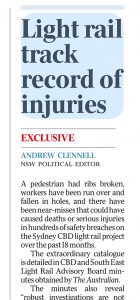
Years ago I was advised how to read a newspaper article – the first two paragraphs and the last.  The exclusive front page article in The Australian ($ paywalled) on August 15 2018 about occupational health and safety (OHS) management at Sydney’s light rail construction project is a good example of what journalists choose to write and what they are obliged to write.

“A pedestrian had ribs broken, workers have been run over and fallen in holes, and there have been near-misses that could have caused deaths or serious injuries in hundreds of safety breaches on the Sydney CBD light rail project over the past 18 months.

The extraordinary catalogue is detailed in CBD and South East Light Rail Advisory Board minutes obtained by The Australian.”

and

Subscribe to SafetyAtWorkBlog to continue reading.
Subscribe Help
Already a member? Log in here

Stop whingeing and manage OHS properly

The Australian Securities Exchange (ASX) regularly updates the Corporate Governance Principles and Recommendations administered by its Corporate Governance Council.  The Council has recently closed submissions on its consultation on the Fourth Edition.  The submissions are worth looking at to see how occupational health and safety (OHS) fairs, and it is also worth looking for mentions of the “social licence to operate”.

The 3rd edition of the principles provides examples of what it means to be a “good corporate citizen” (page 19),

Subscribe to SafetyAtWorkBlog to continue reading.
Subscribe Help
Already a member? Log in here

It’s not about doing the least possible but about doing the best

It is almost impossible to underestimate the impact that Australia’s Royal Commission into Misconduct in the Banking, Superannuation
and Financial Services Industry is already having on the corporate cultures of Australian businesses.  The effective management of occupational health and safety (OHS) relies on effective consultation, trust and respect just as does any other element in a company’s organisational culture.

The media on August 13 2018 has been

Subscribe to SafetyAtWorkBlog to continue reading.
Subscribe Help
Already a member? Log in here

Families of the Dead speak to government

Last time we looked at the Australian Senate Inquiry into “The framework surrounding the prevention, investigation and prosecution of industrial deaths in Australia“, various submissions were considered.  The Inquiry is continuing to hold public hearings, the most recent of these provided an opportunity for relatives of deceased workers to present their arguments.  It is an enlightening insight into a pain that few of us will face but also into the struggles of many to effectively enforce workplace health and safety with, and without, Industrial Manslaughter laws.

The first couple at the 17 July 2018 hearing was Michael and Lee Garrels, the parents of 20-year-old 

Subscribe to SafetyAtWorkBlog to continue reading.
Subscribe Help
Already a member? Log in here

Michalak’s evidence should change the wellbeing and OHS industries

Dr Rebecca Michalak has only recently come to my attention, mainly through challenging some of my statements on social media.  I was able to meet her and watch her presentation at the Safety Institute of Australia’s National Health and Safety Conference in May 2018.  It is likely her voice will become heard more broadly in coming years as she challenges elements of the Establishment.

Many elements of Michalak’s conference presentation can also be heard in the Fit For Work Podcast of Sally McMahon but there were a couple of statements that were notable.

Coping Strategies

“I had a theory that it’s not either/or – it’s an “it depends” thing and what I found across all well-being outcomes, six coping strategies and two samples – that’s 48 mediations – it makes no difference and in fact, most coping strategies make well-being worse.” (emphasis added)

Subscribe to SafetyAtWorkBlog to continue reading.
Subscribe Help
Already a member? Log in here

Lessons in integrity and discipline

Australia’s occupational health and safety (OHS) profession was late to the process of certifying its members.  The Safety Institute of Australia (SIA) has been running its certification program for a couple of years so it is difficult to assess the benefit to members and the community but a critical element in any certification is the treatment of members who breach the Code of Ethics or Code of Conduct.  The revelations of corruption and misconduct from Australia’s Royal Commission into Misconduct in the Banking, Superannuation and Financial Services Industry provide important lessons in integrity and fairness to all professions.

Subscribe to SafetyAtWorkBlog to continue reading.
Subscribe Help
Already a member? Log in here

Duty of care needs a moral analysis

In my readings on Industrial Manslaughter, a reader recommended a book to help me understand how the world works.  I haven’t found the time to read it through because I get angry and/or depressed, but I wanted to share a suggestion that may help clarify our occupational health and safety (OHS) obligations and provide a reconsideration of the employer’s duty of care.

In “Why Not Jail? – Industrial Catastrophes, Corporate Malfeasance, and Government Inaction“, Rena Steinzor summarised some work by David Luban and others in a research paper called “Moral Responsibility in the Age of Bureaucracy“. Steinzor outlines five managerial duties:

Subscribe to SafetyAtWorkBlog to continue reading.
Subscribe Help
Already a member? Log in here
Concatenate Web Development
© Designed and developed by Concatenate Aust Pty Ltd