Industrial Manslaughter arguments cover old ground

The Queensland Government is in the middle of a debate in Parliament and the media about the introduction of industrial manslaughter as an offence related to serious occupational health and safety (OHS) breaches.  It is both a good and a bad time for this debate. The laws are likely to pass but the debate is showing old arguments, weak arguments, political expediency and union-bashing but not a lot about improvement in workplace safety.

Timeline

Following two major fatal workplace incidents, in April 2017 the Government established an
Subscribe to SafetyAtWorkBlog to continue reading.
Subscribe Help
Already a member? Log in here

Queensland’s Industrial Manslaughter push moves to Parliament this week

Queensland’s Minister for Employment and Industrial Relations, Grace Grace is continuing to apply political pressure on the opposition (conservative) party over the issue of industrial manslaughter laws, prior to their debate in State Parliament this week.
In a media statement released on October 6 2017, Grace states that

“We owe it to the victims and their loved ones to ensure Queensland has strong industrial manslaughter laws to protect people on the job.”

This is an appealing statement during Australia’s National Safe Work Month but the relationship between industrial manslaughter laws and safer workers is not as clear and direct as the political statements suggest. Continue reading “Queensland’s Industrial Manslaughter push moves to Parliament this week”

Near Kill – Jim Ward speaks

Jim Ward is hardly known outside the Australian trade union movement but many people over the age of thirty, or in the occupational health and safety (OHS) profession, may remember the person Esso blamed for the Esso Longford explosion in 1998.  Just after the nineteenth anniversary of the incident that killed two workers and injured eight other, SafetyAtWorkBlog interviewed Ward about the incident but, more significantly, also about how that incident changed his world view.

For some time now Jim Ward has been the National OHS Director for the Australian Workers’ Union.  Here is a long interview with Ward that provides a useful perspective on OHS while Australia conducts its National Safe Work Month.

[Note: any links in the text have been applied by SafetyAtWorkBlog]

SAWB: Jim, what happened at Longford, and what did it mean for you.

JW:   So, on 25 September 1998, I got up out of bed and went to work, just as I’d done for the previous 18 years of my working life, at the Esso gas plant facility at Longford in Victoria.

There was nothing unforeseen or untoward about that particular day.  But due to, as one judge elegantly described it, “a confluence of events”, it turned out to be the most significant day of my life.

Subscribe to SafetyAtWorkBlog to continue reading.
Subscribe Help
Already a member? Log in here

Was it worth going to the World Congress on Safety and Health?

I travelled to the 21st World Congress on Safety and Health in Singapore as a delegate and a media representative from my home in Australia.  Was it worth attending? Yes and no.  That may seem a weak answer but I attended in two capacities with two purposes – as an occupational health and safety (OHS) professional and an independent media representative.  Both were satisfied a little bit and both could have been better.  Here’s a personal report on my professional and media experiences at the World Congress.

Subscribe to SafetyAtWorkBlog to continue reading.
Subscribe Help
Already a member? Log in here

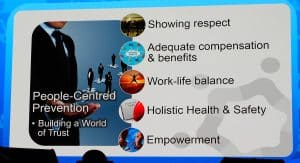
People Centred Prevention should not be a new concept

The World Congress on Safety and Health is physically and mentally exhausting.  Physically, simply because of its size.  Mentally because there is so much information.  Some that confirms your occupational health and safety (OHS) approach and others that conflict with what you know. Some information that seems incredibly dated and anachronistic but you look around and this seems new and wonderful to other delegates.

A major theme of the Congress was “People Centred Prevention” (PCP). This is one of the anachronisms. Wasn’t OHS always about keeping people safe?  If this theme had originated in the United Kingdom, it could have been contextualised as redressing the red tape attack on OHS regulation by previous governments – bringing the humanity back to OHS – but it is being proposed in this Congress as a significant change of focus and perspective.

Subscribe to SafetyAtWorkBlog to continue reading.
Subscribe Help
Already a member? Log in here

Zero, health and people – themes of the World Congress on Safety & Health

In front of thousands of delegates and dignitaries, the 21st World Congress on Safety and Health was officially opened yesterday by the Singapore Prime Minister Lee Hsien Loong.
There are three themes of this conference:

  • Vision Zero – From Vision to Reality
  • Healthy work—Healthy life
  • People-centred prevention
Subscribe to SafetyAtWorkBlog to continue reading.
Subscribe Help
Already a member? Log in here

Marnie Williams talks of farm safety, responsibility and a radical future

WorkSafe Victoria’s Executive Director, Health and Safety , Marnie Williams, has had a horrid week. Last Saturday, while being ill with a cold, she stood in for the Victorian Industrial Relations Minister at a Migrant Worker Forum, at which she was asked “what you gonna do about it?”. However she continues to make herself available, a crucial element for any leader of a regulatory agency.

Farm Safety

A couple of days later at a safety conference run by the Safety Institute of Australia,  SafetyAtWorkBlog accused WorkSafe of not doing enough about the safety of Victorian farmers. Williams rejected the accusation and forecast a new, and surprising, approach for agricultural safety.

Subscribe to SafetyAtWorkBlog to continue reading.
Subscribe Help
Already a member? Log in here
Concatenate Web Development
© Designed and developed by Concatenate Aust Pty Ltd