
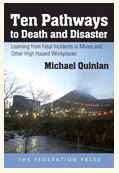
New book challenges current OHS trends

Quinlan coverProfessor Michael Quinlan has a new book that focuses on lessons from recent mining disasters but, as with the best of occupational health and safety (OHS) books, it challenges orthodoxies.  Some OHS consultants and experts have built careers on these orthodoxies, trends and fads, and will feel uncomfortable with the evidence put forward by Quinlan in “Ten Pathways to Death and Disaster – Learning from Fatal Incidents in Mines and Other High Hazard Workplaces“. The honesty and humanity in this book makes it an essential part of any OHS professional’s library.

Quinlan establishes an important tenet from the very start:

“… knowledge is not created in a social vacuum.” (page xi)

This simple dictum is vital to an understanding of the true causal factors on OHS decision-making.  People die from OHS failures.  Politicians create laws and situations that can encourage failures, increase risk and can provide a veneer of respect for heartlessness and exploitation.  Business owners may feel pressured to place production before safety.  Some OHS writers and advocates stop, often unconsciously, at the point where their theory or market research would fail scrutiny.  Some apply critical thought only “as far as is reasonably practicable” to continue a business activity that is short-term or to sell their consultancy package to gullible or naive corporate executives.

Quinlan writes of the “political economy of safety”:

“The political economy perspective argues that safety, including workplace disasters, can only be understood in the context of the distribution of wealth and power within societies, and dominant social policy paradigms that privilege markets and profit, production or economic growth over safety.” (page 24, emphasis added)

To many readers this may sound like socialism in its mention of wealth distribution and power but such a perspective is valid even though it may be unfashionable.  Such a broad perspective allows for a critical assessment of other OHS research approaches such as, for instance, the culture advocates. 
Subscribe to SafetyAtWorkBlog to continue reading.
Subscribe Help
Already a member? Log in here

Research project opportunity

SafetyAtWorkBlog believes that the following research project may be of interest to readers.

Underhill graphicA research team from the Faculty of Business & Law at Deakin University, led by Drs. Elsa Underhill & Melissa Parris, are conducting a research project to:

  • Develop a better understanding of how health, safety and well-being outcomes differ between types of workers (ie. permanents, casuals & labour hire) within the same workplace; and
  • Develop an understanding of how employment status impacts on work/life balance.

Their findings are intended to better inform HRM and WHS practitioners on the development of evidence based strategies and policies to improve the health, safety and wellbeing of all employees.

 They are seeking organisations which will allow them to survey their employees including, where appropriate, labour hire workers placed with organisation.  Responses will be anonymous and respondents will have the chance to win 1 of 10 mini Ipads. Participating organisations will receive a report specific to their organisation, as well as the full project report.

 Is your organisation interested in participating?  If so, please contact Elsa.Underhill@deakin.edu.au for further information.

Impairment argument fails to convince Fair Work Commission over unfair dismissal

On 16 January 2015 the Australian newspaper (paywall) reported on a Fair Work Commission (FWC) decision involving an unfair dismissal claim by a worker who, as a result of a random drug test, was found to have methylamphetamine in her system “at levels four times above the minimum detection level”.  The company, Downer EDI Mining, sacked the worker, Leah Cunningham, as she presented a hazard to her work colleagues. The newspaper article was called “CFMEU slammed for drugs defence” and the FWC decision is Tara Leah Cunningham v Downer EDI Mining Pty Limited (U2014/1457) (14 January 2015).

The Australian, a newspaper with no love for the trade union movement and the CFMEU in particular, focussed on the apparent absurdity of a trade union, that places such a high priority on workplace safety,  contesting the dismissal of a worker who presented a hazard to herself and others at work.  The newspaper quotes Commissioner Ian Cambridge:

““It was highly regrettable to observe during the hearing that an organisation, which apparently conducts campaigns which strongly advocate safety in the workplace, could contemplate a proposition which, in effect, would countenance a person driving a 580-tonne truck whilst having methylamphetamine in their body at a level four times the reportable cut-off figure,” he said in his decision this week.

“Any realistic and responsible pursuit of the case on behalf of the applicant should have been confined to the development of evidentiary support for the applicant’s explanation for the presence of the methylamphetamine. Indeed, much greater energy and focus should have been devoted to such an evidentiary position rather than any attempt to defend the indefensible.”

Subscribe to SafetyAtWorkBlog to continue reading.
Subscribe Help
Already a member? Log in here

Trade Union Royal Commission affects OHS credibility

Whether one believes that the Royal Commission into Trade Union Governance and Corruption is a political witch-hunt or a genuine attempt to clean up a corrupt industry sector, the Royal Commission seems to have revealed an abuse and exploitation of occupational health and safety (OHS) – an exploitation that has received next to no attention. The release of the Commission’s interim report allows for a quick analysis of this situation.

Former Prime Minister Julia Gillard was a particular target of the Commission in relation to a “slush fund” established by her then-boyfriend, Bruce Wilson, commonly referred to as the “AWU affair“.  The “slush fund”, known as the Australian Workers Union Workplace Reform Association, was developed, according to Gillard

“… to support the re-election of union officials who would campaign for workplace reforms including better occupational health and safety.” (Interim Report, Vol 1, page 99)

Subscribe to SafetyAtWorkBlog to continue reading.
Subscribe Help
Already a member? Log in here

FOI request for cost of introducing WHS laws fails again

Last year SafetyAtWorkBlog reported its failure at gaining the release of the Victorian Government’s full cost analysis of the introduction of the national Work Health and Safety laws.  In November 2014 the Victorian Government changed from conservative Liberal to traditionally more worker-friendly Labor Party.  So I submitted another request, with the same result, the report…

Subscribe to SafetyAtWorkBlog to continue reading.
Subscribe Help
Already a member? Log in here

Media tips for Australian OHS professionals

The occupational health and safety (OHS) profession in Australia has suffered from the lack of a public voice.  This is partly due to ineffective and disorganised professional associations but more it is due to fear – fear of embarrassment, fear of ridicule, fear of failure….  This is peculiar because a fundamental element of OHS is communication.  Below is some information from an Australian journalism textbook that may help reduce some of that fear.

Code of Ethics

The Media Entertainment and Arts Alliance (ie. the journalists’ “union” in Australia) publishes a Code of Ethics. (Similar organisations round the world have equivalent documents and obligations)  This is vital information for any journalist but also important for those who want to engage with the media, perhaps through interviews.  For instance, on the use of sources, the Code says

“Aim to attribute information to its source.  Where a source seeks anonymity, do not agree without first considering the source’s motives and any alternative attributable source.  Where confidences are accepted,  respect them in all circumstances.”

Continue reading “Media tips for Australian OHS professionals”

Some are losing faith in the Victorian Workcover Authority

At a remembrance service in December 2014, the founder and outgoing deputy director of the Creative Ministries Network (CMN), John Bottomley, explained his refusal of funding from the Victorian WorkCover Authority (VWA) for CMN’s work-related grief support services (now called GriefWork). VWA has a different take on his comments.

In discussing the relevance of the Book of Isaiah to the motivations of the CMN to help people, Bottomley said that

“… it is God’s response to injustice and suffering that has planted this same spirit at the heart of our endeavours to transform work-related harm.

So CMN rejected VWA’s contract in April this year, after WorkSafe had funded our agency for over ten years to provide grief support services. My reason for rejecting the new contract was that VWA wanted to hide bereaved families grief from the public domain of injustice at work. The contract brief treated grief as an individual psychological problem to be addressed behind the closed doors of a clinic shut off from the rest of society. The contract wanted to treat work-related grief like an illness, and treat grieving families as sick and lacking the ability to ‘cope’. This heaps injustice upon injustice.”

Subscribe to SafetyAtWorkBlog to continue reading.
Subscribe Help
Already a member? Log in here
Concatenate Web Development
© Designed and developed by Concatenate Aust Pty Ltd