
Local safety article reflects bigger issues

Workplace safety hardly ever gets a mention in the daily newspapers unless there is a big corporate name involved or a record fine.   Local newspapers often provide more coverage of workplace incidents because the local angle allows for the reporting of the social and familial impact of an incident within days of it occurring.

The 9 February 2011 edition of the Melbourne Times Weekly included a feature article – “Risky Business” by Genevieve Gannon.   The existence of any media mention of workplace safety is of note in itself but Gannon’s article, with assistance from the always-helpful WorkSafe spokesperson, Michael Birt, does not only focus on the fatalities (23 in 2010) but also on the maimings.   Around 70 people had life-threatening injuries in Victoria in 2010 and 20,000 were seriously injured. Continue reading “Local safety article reflects bigger issues”
Is night shift reasonable practicable?

Tony Carter, has provided some additional information about occupational fatigue after reading the fatigue article on this blog earlier today.

Carter was one of three authors of a 2007 article in The Annals of Occupational Hygiene entitled “Epidemiological Diagnosis of Occupational Fatigue in a Fly-In–Fly-Out Operation of the Mineral Industry” (abstract only available online).   The abstract says that:

“A disturbed diurnal rhythm at the beginning of night shift and a roster of more than eight consecutive days were identified as the primary contributing factors to occupational fatigue in this setting.”

It is fair to say night shift and eight consecutive days of work are the causes in this research but research without proposed controls is of little practical use.  Thankfully the study by Anthony Carter, Reinhold Muller and Ann Williamson provides some control suggestions – naps and changes to lighting.  Simple in concept but possibly difficult to implement.  How does a company provide naps in a production line operation?  Can production continue as lighting lux levels are reduced? Continue reading “Is night shift reasonable practicable?”

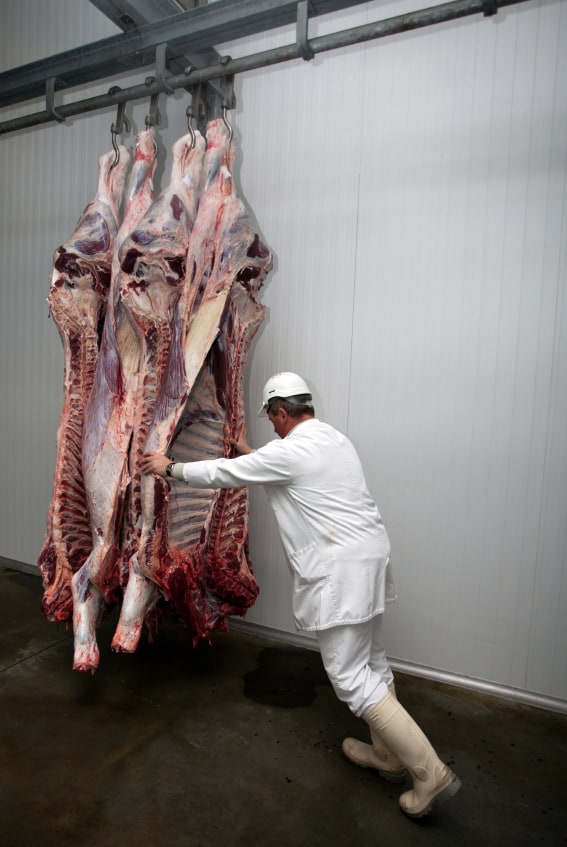
Only animals should die in abattoirs

The Sunday Age of 30 January 2011 ran an article about the status of workplace safety in some of Victoria’s abattoirs.  The article has some similarities to the landmark investigations by Eric Schlosser into work practices and compensation issues related to meatworks in the United States.

The Sunday Age says that

“(Last financial year [2009/2010], there were 355 workers’ compensation claims in Victoria’s meat industry that required at least 10 days off work, or cost more than $580 in treatment, or both – almost one a day. Nationally the industry’s injury and illness rate remains twice as high as that in the construction industry, and four times the average of all workplaces.”

Many would say that meat work is “inherently dangerous” but in the article lawyer Trevor Monti, contests the perception

”Yes, it’s a difficult industry and the work can be hard,” he says. ”But with proper consideration given to the system of work, the risk of injury can be significantly reduced.”

This is a position with which OHS professionals and regulators would agree.

It is significant that, if the comparative figures quoted above by the Sunday Age are accurate, abattoirs do not receive the enforcement attention that the construction industry receives.  Is it that the construction industry is largely unionised and the meat industry much less so?  Is it that abattoirs are rorting the immigration visa system as asserted by the Australian Meat Industry? Continue reading “Only animals should die in abattoirs”

Quad bike fatality costs over $80k in penalties

A Western Australian company has been fined $A50,000 over the death of one of its workers in November 2008  The worker rode a quad bike into a wire gate and died.  The recent WorkSafe WA media release focuses, understandably on the fine imposed in the Perth Magistrates’ Court on Jenara P/L but a clearer picture of the incident is available from an earlier WorkSafe report into the incident.  The accused, in this instance, was Seatown Holdings, a labour hire firm who was fined $A30,000 :

“The accused was a labour hire company which employed a worker for remuneration and arranged for said worker to work for Jenara Pty Ltd who was one of its clients.

The client ran a grain growing farm near Miling.

During the afternoon on Sunday 16 November 2008 the worker was working alone and riding an All Terrain Vehicle (ATV) on a road on the client’s farm when he rode into a wire gate known as a ‘cockies gate’. Continue reading “Quad bike fatality costs over $80k in penalties”

Safety rationalisation doesn’t end with an improving economy!

Guest contributor, Gerard May, writes

The economic circumstances an organisation finds itself in can greatly affect their approach to workplace health and safety.  Tough economic times are still ahead for some industries and organisations, while others who rationalised for survival through the global financial crisis will begin to prosper.  This article will delve into what may be happening to Occupational Health and Safety (OH&S) in organisations heading into both tough and improving economic times.  The economy will play a role.

Rationalisation in the manufacturing industry appears likely as the Australian Industry Group’s Performance of Manufacturing Index showed nine out of the 12 sub-sectors in the industry went backwards in December 2010[1].  Pricewaterhousecooper‘s (PwC) Australian-based global head of industrial manufacturing, Graeme Billings, recently stated,

“In the face of…declines in activity and the continuing slump in new orders, it is imperative that businesses continue to search for efficiencies, improvements and innovative approaches to their markets, products and business models[2].”

OH&S will surely be in the sights of rationalisation in the sector.

Continue reading “Safety rationalisation doesn’t end with an improving economy!”

Insurance company “fire-bomber” dies in custody

Almost 12 months ago, Paul Wayne Clarke “loaded a shopping trolley with jerry cans of fuel and set it alight inside a Darwin insurance office, injuring 15 people”.  Clarke died on 21 January 2011 after a failed suicide attempt whilst in custody.

On February 2010 media report provided a few details of Clarke’s circumstances:

“The bomber reportedly goes by the name “Bird” and is a former security guard who worked at a Darwin pub until being injured on the job in October 2007.

He allegedly blamed the insurer for loss of earnings that forced him to leave his three-bedroom home in Humpty Doo and move into a shipping container.”

The incident was enormously traumatic for the 15 staff and customers of the Territory Insurance Office (TIO) who were injured by the incident.

The Coroner will be investigating Clarke’s death but the motivation for Clarke’s initial actions against TIO will remain a mystery.  Continue reading “Insurance company “fire-bomber” dies in custody”

WorkSafe prosecutes Dept of Corrective Services and G4S

In June 2010 WorkSafe WA began investigating the 2008 death from heat stroke of 46-year-old aboriginal elder Mr Ward.  According to one media report :

“A broken air conditioner forced Mr Ward to endure temperatures above 50 degrees during the non-stop, four-hour journey to face a drink-driving charge in court.”

The same article noted that in June 2010 the Director of Public Prosecutions Joe McGrath announced that no charges would be laid against two security guards over the 46-year-old’s death.

On 19 January 2011, WorkSafe announced that it

“… will prosecute the State of Western Australia (Department of Corrective Services), government contractor G4S Custodial Services Pty Ltd (formerly GSL Custodial Services Pty Ltd) and the two drivers involved in the death of Mr Ward in January 2008.”

WorkSafe notes in its media release that

“A Coronial Inquest was completed in May 2009, with the State Coroner Alastair Hope concluding that all four parties [listed in the above quote] contributed to the death.” Continue reading “WorkSafe prosecutes Dept of Corrective Services and G4S”

Concatenate Web Development
© Designed and developed by Concatenate Aust Pty Ltd