
It is essential for corporate OHS policy-makers to leave their high-rise offices to experience high-risk workplaces such as factories and small business. This exposure to reality will add a practicality and ease of implementation to their OHS initiatives.
 In a similar way it is important that OHS professionals in industrialised nations with online references immediately to hand, and assistance at the end of a mobile phone call, realise that workplace safety can implemented, taught and regulated with a lot less. Some countries have no option but to work with lean resources but good skills.
In 2002 I conducted an interview with Stanley D Pirione, the Deputy Commissioner of Labour for the Solomon Islands. In 2008 Mr Pirione was the Under-Secretary – Strategic Policy and Reform of the Public Service. Over the last seven years, the Solomon Islands has faced many political and economic crises.
The interview below is from 2002 but, I think, it is a useful reminder of how some our colleagues have to achieve similar performance targets with a lot less.
SAW: Could you provide us with an outline of your Department’s activity and structure?
SP: Eight workers usually staff the OHS Unit but at the moment, we have only 3 workers. We operate under the Labour Division of the Ministry of Commerce and Employment and Industries. The main objective is to provide protection for workers from work hazards, promote and control safety and health at the workplace and provide advice to employers and employees about their respective duties as stipulated in the various Acts and Laws. We also carry out inspections on work policies and practices within industries to ensure compliance with our standards.
We also have Labour Inspectors who conduct respect inspections and surprise inspections. We usually go on tours to the provinces. The geography of the islands means that the islands are very far from Honiara, the main place. We conduct no more than two or three visits a year.
We promote Labour laws through the local newspapers, brochures, even through the radio. We host workshops and seminars for the middle managers and health and safety officers.
SAW: Does the Department’s workforce include the Inspectors?
SP: We usually conduct inspections on Honiara because it is less costly and close to our offices. The islands are very scattered and it can take 10 to 15 hours to travel by boat to the other side. To go by plane is too costly.
We do have overseers in our sub-centres but due to the government problems, some of the workers have been called back to the main centre in Honiara. But what we are doing now is we are providing “extension services” where we appoint workers from the private sector to do labour inspections for the Government. We go through a number of procedures with them; the Government blesses them and gives them the mandate to inspect. These people then have the same powers as the Labour Officers. We are opening up for those in the private sector.
For the past 16 or 18 months, the rate of inspections has really declined because of our problems in the Solomons.
SAW: How is the integrity of the inspection by the “extension services” maintained?
SP: We appoint inspectors in their own respective fields, especially those in manufacturing, mining, fisheries and forestry. Each inspector inspects within his own area of work.
SAW: In a country of limited resources, what is the major source of information on new OHS hazards, or hazard controls?
SP: We always tip in on ILO Suva who give us much information. Last year, two of our officers attended regional workshops on health and safety in Nadi. We make use of this information and then disseminate it to the industries.
However, the standard of information to the public is very low. Most of the workers in the industries are not really aware of the safety standards. The Government itself has not really recognised the role of the OHS Unit. We work on every possible means of resources that we have in giving them out to these people.
SAW: How long has the Solomons had workplace safety legislation?
SP: Since Independence. We have only two Acts here – the Workers Compensation Act and the Safety At Work Act. They were enacted in Parliament in 1982 and the latest review was in 1996. We still need to update these Acts because there are a lot of things to be done.
The standard of safety practiced by foreign companies in the Solomons is very much higher compared to our safety legislation. The Safety At Work Act is too general. It does not cover specific industries like those in mining and fisheries
SAW: I suspect that overseas companies dominate mining.
SP: So far, we only have one mine and mining company, an Australian company. But it is the logging industry that has dominated the workforce here.
We have 15 to 18 logging operations in the Solomons, mostly from Malaysia. The problem is that this group do not enforce their labour standards here, compared to the New Zealand and Australian companies.
SAW: Do the Solomons pay close attention to voluntary standards imposed by overseas companies?
SP: The conditions we place on foreign companies when they move in are to make sure that their standards match ours. But there are too much politics involved and then they will just get through. We usually make use of the powers that we have available through our legislation. We give companies enough time to improve on their standards. Mostly when the investors come in we say this is what we expect from you.
SAW: Many countries have to balance the enforcement of safety standards so as not to deter investment. Is that the case in the Solomons?
SP: The Government has appealed to all the Departments to facilitate as much as possible to let these people in. There should not be any hindrance, there should not be any delay in processing whatever they intend to do. In fact health and safety is also treated as a hindrance to their intended activities but we always state that they should not operate below our standards.
SAW: Do the Australian companies have difficulty in that arrangement?
SP: The Australian companies in mining and manufacturing have higher standards than their Asian counterparts. We always use their standards to inspect, particularly in the Asian logging companies. We are using Codes o Practices as guidelines, from New Zealand, even from Australia. We use them as a standard, we know that that is higher than the one we have here but we know that that is internationally recognised.
SAW: Is logging the dominant industry in the Solomons?
SP: For the post 10 years or so, logging has been the dominant industry. The logging companies employ 20-30% of the private sector. This is the industry that we have a lot of injuries from. Mostly, minor injuries like cuts and lacerations. Over the last 5 years we have received many accidents from the manufacturing and forestry sectors. We have an average of 2-3 fatal cases each year.
SAW: Principally in the logging industry?
SP: Yes
SAW: Are injured logging workers rehabilitated through the companies’ processes or is the compensation and rehabilitation mainly through the Government’s workers compensation legislation and processes?
SP: For fatal accidents, the company pays out for the funeral expenses. They meet all the payments and sometimes pay some compensation to the worker’s relatives and dependents. That is treated differently from what is required under the Workers Compensation Act.
We follow our own formula and procedures. The companies have nothing to say about that. Once we give a claim, we charge them for negligence, for not abiding by the provisions. There should be no questions about that.
For small incidents like abrasions, contusions or small simple fractures or sprains and strains, we follow the Workers Compensation Act.
But there are particular arrangements that occur between the employee and the employer, outside of the Act. We always welcome those.
SAW: Are the mines in the Solomons open-cut or underground?
SP: Open cut. The mining industry is very new and started about 6 years ago. We haven’t yet tried to make provisions for Codes of Practice with regards to mining. We are confident because of the standard of health and safety within this mining company. We are not concentrating on mining because we know too well that the standards are much higher than in logging.
SAW: What industry do most people want to be employed in? Is it logging because of high pay? Alternatively, is it mining because it is a safe industry with an Australian company? Do the citizens of the Solomons consider safety when they go for jobs?
SP: These industries have generated a great deal of money in a very short time. These have attracted workers because of the high pay and all sorts of allowances. Before that most of the workers were focussing in the manufacturing sector or the fishing sector. Just because the work is lighter particularly in the manufacturing sector, there’s not as much exposure to hazards. There is a lot less risk than in the logging.
The logging companies do pay bonuses for those who are exposed to very dangerous situations.
The fishing is quite similar. Due to the problems in the fishing sector, many workers have left and moved to the logging sector. Most of the workers go to the industries based on higher wages.
SAW: Some countries separate the OHS enforcement of fishing from land-based industries. Does this happen in the Solomons?
SP: The Safety at Work Act is too general. It only mentions responsibilities of employers and workers. It does not say anything about fishing although it gives more time for the Minister responsible to put out rules or regulations. Mostly, the Safety at Work Act covers only the manufacturing sector, not specifically fishing or even logging and mining. We have a bit of difficulty so can only place their obligation under the Safety at Work Act. Regardless of what industry you are involved in, regardless of what activity you are doing, as long as you are the employer, defined by the Law, and then this is your responsibility.
SAW: If you were able to have anything to improve OHS in the Solomons, what would you choose?
SP: We have a range of programs here to give out enforcement standards to workers. We have a lot of workshops and programs targeting certain industries. We also have radio programs, we have field and enterprise inspections. We usually go out on courtesy visits and then we talk with the employer and the employee. It is not like a policing attitude. We suggest, in a friendly manner, what they should do.
We also issue pamphlets and brochures but the problem with all this is that we do not have enough money to carry out all our programs. That’s why we are now establishing “extension services”. The Government then does not have to go and spend money for inspections. We appoint inspectors in their own respective industries.
We also need training programs. We did have a project sponsored by the UNDP, where some of our officers used to go out to New Zealand. Last week, Papua New Guinea’s OHS Division sends us information but now the UNDP has withdrawn its sponsor….
SAW: Many countries have support on workplace safety from the trade union movement. Is that so in the Solomons?
SP: The union movement in the Solomon Islands deals with wage increases and other conditions of services but not necessarily on occupational health and safety. It is quite weak. Many workers have been frustrated by the weaknesses of the union. The union movement has been talking too much about politics and not concentrating on their members or increasing the membership.
The safety standards have not really been discussed in negotiations. They are more concerned with better wages and better housing.
SAW: The political problems have resulted in some areas that you cannot go to. How much did the instability hamper you Department’s operations?
SP: During the 1997 Government there was a lot of consultation with overseas groups from Australia and New Zealand providing seminars. There was a lot of motivation. We have tried very hard to improve on labour law reviews. We also tried to work out Codes of Practices in new areas, put up new Regulations. The activity of the OHS Unit have been gradually increased since 1997. The Government has been very supportive of our work plans. The Government gave us a vehicle to use to carry out inspections.
Due to the ethnic problems of the Solomons, nearly 50% of our operations have been affected. There are no finances. Some of our workers have been left out. A former OHS Officer is now a Minister of the Government. He resigned, went home and then ran for election. Some of our workers now work in the private sector. This is because the Government has not been very supportive in addressing the problems we have encountered.
We are optimistic as things gradually improve. It is only law and order that is the problem we have right now. But we are optimistic, we are now establishing the “extension services”.
Recently I conducted two inspections. One was a logging company in one of the provinces and I will be going out inspecting in July, August, and September. By the end of this year, I should have covered at least six or seven logging companies.
We have just finished one workshop and we are trying to have another in June.
SAW: Thank you very much for your time.

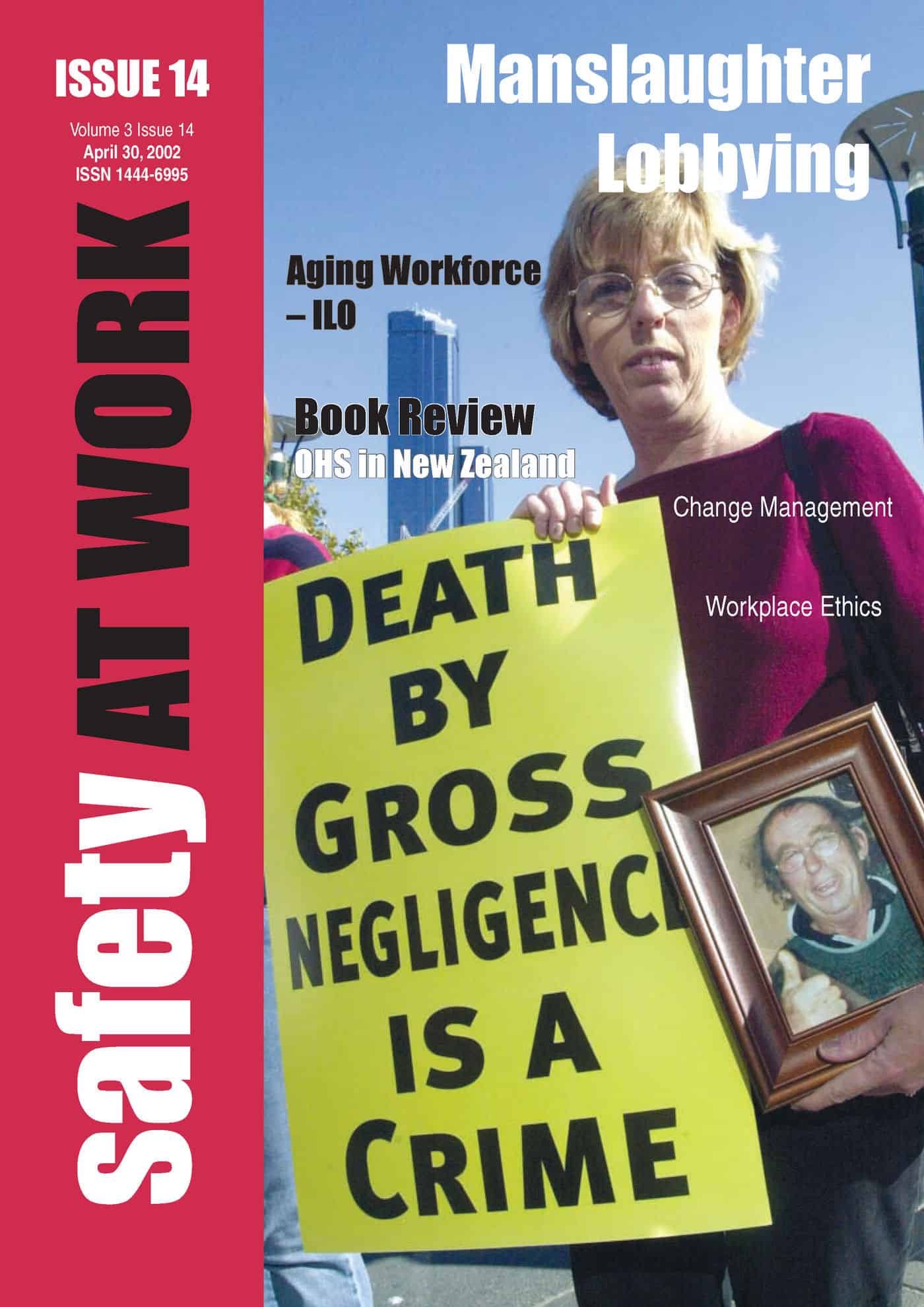 The policy has been allowed to fade from the books of most of the Australian left-wing parties but for a while, corporate manslaughter was THE issue. In fact over the last 10 years, it has been the only time that directors and CEOs from thousands of companies have paid serious attention to safety management.
