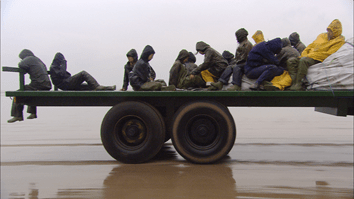
Deaths in isolated work camp from tropical storm

It is relatively easy to manage a workplace in an urban environment.  The buildings stay in one place, the neighbours are almost always the same and the weather bureau provides plenty of warnings.  But in isolated areas, particularly in Australia, it seems the work environment is often more exposed.  Certainly this was the case in mid-March 2007 when Cyclone George hit a railway construction camp killing several workers and injuring twenty.

The camp accommodation of demountable units, called dongas, were supposedly cyclone-proof.  At the time, the Construction Forestry Mining and Energy Union said that administrative staff were evacuated but construction workers were directed to the dongas.

The owner of the worksite, Fortescue Metals Groups said on 11 December 2008 that it will fight 40 charges brought by Worksafe WA under the West Australian Occupational Health and Safety Act.

According to one media report:

“The charges include the failure to provide a safe work environment, failure to design and construct temporary accommodation and other buildings capable of withstanding a cyclone and failure to properly instruct and train workers.”

The installer of the demountable buildings, Sunbrood, had all charges dismissed.

The court case will continue in Western Australia in February and March next year.

Safe Work Bill and Parliament

It has always seemed an odd timetable for the Australian Government to introduce a Bill for replacing the Australian Safety & Compensation Council with Safe Work Australia when there is also an active  national review into the laws that the authority may end up managing.  

This week the Minister for Workplace Relations, Julia Gillard, set aside the Safe Work Bill because she would not accept amendments by the Opposition or she had to verify changes through the Workplace Relations Ministerial Council, depending on your political leanings.

Parliament has ended for 2008 so the reintroduction of the Bill will wait till 2009.  This allows the government to make another pitch by including the recommendations of the National Review.  The Review has consulted broadly across the political spectrum and should present legalistic sweeteners to all.  This also allows  the government to say that they didn’t get cross and arrogant but have been able to be more inclusive and consultative.

The amendments proposed by the Opposition don’t have a great deal to do with safe workplaces but a lot to do with limiting union influence in the decision-making of the new OHS body.  Some amendments are just unnecessarily provocative by trying to limit ministerial interference.  The alternative jargon to this is the exercising of ministerial discretion.  It’s the same thing except to those on the receiving end or who feel excluded from the process.

Of course, the government is not obliged to accept all the recommendations of the review panel and over the next few months it will be closely watching the reception of its industrial relations legislative platform to perhaps indicate a more successful pathway for its Safe Work Bill.  

A sticking point, and overlap of the two legislations, is the right of entry.  Currently there is a political stink about how much access unions are entitled to in workplaces, some of which does seem unnecessarily intrusive, but frequently workplace safety is the impetus for entry requests, as per the recent intrusion to the desalination plant in New South Wales.  Right of entry will not go away as a political issue over the Christmas break while there are large infrastructure projects in New South Wales and Western Australia, in particular.

The insidiousness of “reasonably practicable”

WorkSafe Victoria recently released a guideline, or clarification, on what it considers to be the issues surrounding “employing or engaging suitably qualified persons to provide health and safety advice“.

SafetyAtWorkBlog remains to be convinced that such a process will lead to better safety outcomes in the small to medium-sized enterprises at which this program is aimed.  The OHS legislation clearly states that the employer is the ultimate decider on which control measures to implement to address a workplace hazard.  This is echoed in the WorkSafe guideline

“It is important to note that employing or engaging a suitably qualified person to provide OHS advice does not discharge the employer from their legal responsibilities to ensure health and safety as required under Part 3 of the OHS Act. This duty cannot be delegated.”

A business manager will weigh up the advice sought or given from a variety of sources and make a decision.  A good business manager will take responsibility for the good or bad results of their decision.  But they need to have a clear understanding of their obligations and Victoria’s legislation could be confusing.

The guideline says that

“Employers are expected to take a proactive approach to identify and control hazards in the workplace before they cause an incident, injury, illness or disease.”

This reitereates one of the safety principles in the 2004 OHS Act

“Employers and self-employed persons should be proactive, and take all reasonably practicable measures, to ensure health and safety at workplaces and in the conduct of undertakings.”

But the principles are not legislative obligations.  As Michael Tooma writes in his “Annotated Occupational Health and Safety Act 2004

“… it is the intention of the Parliament that the principles be taken into account in the administration of the Act.”

The principles are there for judicial colour and community reassurance but with no real impact.

The obligations on an employer, the section that determines the actions and plans of the business owner or managers, are, as well as general duties:

“Duties of employers to employees

(1) An employer must, so far as is reasonably practicable, provide and maintain for employees of the employer a working environment that is safe and without risks to health……..

(2) Without limiting sub-section (1), an employer contravenes that sub-section if the employer fails to do any of the following-

(a) provide or maintain plant or systems of work that are, so far as is reasonably practicable, safe and without risks to health;

(b) make arrangements for ensuring, so far as is reasonably practicable, safety and the absence of risks to health in connection with the use, handling, storage or transport of plant or substances;

(c) maintain, so far as is reasonably practicable, each workplace under the employer’s management and control in a condition that is safe and without risks to health;

(d) provide, so far as is reasonably practicable, adequate facilities for the welfare of employees at any workplace under the management and control of the employer;

(e) provide such information, instruction, training or supervision to employees of the employer as is necessary to enable those persons to perform their work in a way that is safe and without risks to health. “

The “as far as is reasonably practicable” insertions allow business considerable flexibility in arguing the validity of their decisions after an incident but hamper the employer in being “pro-active” – (a hateful and lazy piece of business jargon).

The impediments to “pro-activity” can be seen in the general duties of Section 20 where 

“to avoid doubt, a duty imposed on a person…to ensure, as far is reasonably practicable, health and safety requires the person –

(a) to eliminate risks to health and safety so far as is reasonably practicable:…..”

This contrasts with the objects of the, same, Act which states that one of the aims is

“to eliminate, at the source, risks to the health, safety and welfare of employees and other persons at work:…”

It is strongly suspected that a crucial element of OHS legislation and management will likely disappear and this is to eliminate hazards “at the source”.  Outside of the objects of the Act this aim is not mentioned anywhere else in the legislation.  “Reasonably practicable” will erase this important social and moral clause.

Eliminating something “at the source” encourages research into new ways of eliminating hazards by placing an obligation on us to determine the source.  “Reasonably practicable” encourages us to research control measures until it is practicable to do so no more.  That is a half-quest that solves nothing.  What if Frodo was asked to dispose of the ring in Mordor only if “reasonably practicable”? The story would have been a novella instead of a classic trilogy.

Employer associations are lobbying for increased workplace flexibility.  That has nothing to do with the health and safety benefits of the employees but rather the health and safety of the balance sheet.  “Reasonably practicable” similarly focuses on business management and not safety management.

The battle against this insidious weakening of the OHS profession is not lost.  Heart should be taken from the preparedness of governments to roll-back unpopular legislation such as some industrial relations initiatives.  Hindsight can be an important motivator for change.

Recent fatalities data may sway some in government that OHS regulators are achieving their social and operational targets but OHS professionals know that fatality rates are not an accurate indication of the success of safety initiatives.  New workplace hazards are appearing regularly and many of the new ones don’t result in death but lead instead to misery and an incapacity to live a healthy life or to work again in a chosen profession.  

“Reasonably practicable” allows businesses to try, in differing degrees, to eliminate the hazards, such as psychosocial hazards, of its workforce and then shift them to social security and disability benefits.  And why not? It seems that corporations can serve their clients and stakeholders “as far as is reasonably practicable” and then expect a bailout from government over their mismanagement.  Immorality applies to much more than economics.

Fair Work and OHS

Last week the Deputy Prime Minister and Minister for Workplace Relations, Julia Gillard, delivered on some of the government’s promises by presenting the Fair Work Australia Bill into the Australian Parliament.  This does not present a revolution but is a solid rollback of some of the excesses of the previous (conservative) government.  The responses from employer groups and trade unions were in the tones and on the topics that were expected.

The National Review into Model OHS Laws rolls on towards its January 2009 deadline.  The OHS law review was not something urgent for the government, even though it was an election pledge, and it does not indicate a commitment by the government to improving the level of safety in Australia.  The aim is to provide an easier way of managing safety across state borders in Australia with the hope that this will flow to benefit the safety of workers.

It is important to remember that this review came after years of concern about the perception(?) that OHS was part of the red tape of managing businesses, and therefore an unacceptable cost burden.  The danger in this review is that the recommendations will reduce the business costs with no discernible improvement in safety.

There are many OHS professionals and organisations who are hoping for some grand review of workplace safety.  It is a review of law and business bureaucracy, not safety.  Those who will most benefit will be large companies that operate in multiple States.  It will provide no change to small business.  It will not increase safety in the vast majority of workplaces.  It may improve the bottom line company results in 2009 when profit growth is declining but that just means that managerial bonuses are less than normal.  It does not mean that the cost savings will be used to improve safety.

The Fair Work Australia Bill and the National OHS Law Review may change some of the ways in which corporates approach OHS but they will have little, if any, benefit to individual workers.

It is important to remember that any legal changes always benefit legal practitioners, as well.  And OHS lawyers are almost always there after the incident in order to minimise company damage.  Policies and procedures are largely determined without legal involvement.  Machine guarding is not installed by lawyers.  Abusive supervisors are not tempered by legal threats.  Safety is the manager’s job in partnership with the employees, and it will always be so.

It is harder to prevent than compensate, but more important

Tonight in Adelaide the President of the Australian Human Rights Commission, Catherine Branson QC, will be delivering the 2008 Don Dunstan Foundation Oration.

Ms Branson has said

“I want to live in a society where everyone can take advantage of his or her abilities and where everyone has a real say about the world they live in, be they an Indigenous person, a person of Muslim faith, a parent wanting leave from work to care for a child, or a person in a same-sex relationship.

“We all want a society where we can all feel safe and protected from violence and harassment no matter who we are or where our children can access appropriate educational opportunities no matter where they live.

“These are hardly controversial ideas.”

Indeed they are not.  But in many of the past discussions on human rights, rights at work are missed, yet they are just as important.  The omission may be because it seems there is a plethora of avenues of appeal in the workplace – discrimination, unfair dismissal, sexual harassment tribunals etc.  Yet none of these focus on the prevention of harm in the way that legislative OHS obligations do.

Until the human rights advocates’ speeches become inclusive of workplace matters, there will be societal anchor dragging on progress of basic human rights.

Sexual harassment and politicians

Bernard Keane, political columnist with Crikey.com, wrote on 20 November 2008 about the unacceptable conduct of Australian politicians.  He wrote:

We’re not talking here about ordinary poor behaviour. There are boors and fools and thugs in workplaces across the country. It’s the sense of entitlement that seems to motivate many MPs to treat other people — whether they are staff, or waiters, or anyone who happens to cross them — with contempt. It’s a sense of entitlement encouraged by the job — one with a large salary, expenses, vehicles, travel and public profile. Most MPs manage to prevent it from going to their heads. But a lot don’t, and they make other people’s lives hell. Particularly because MPs aren’t under the same workplace laws as everyone else. 

SafetyAtWorkBlog believes that, as the sexual harassment is occurring in workplaces, predominantly, that MP’s ARE “under the same workplace laws as everyone else”.

Keane refers to one case where a Minister who was sexually harassing a staff member was relocated to another ministry.  The case recalls the Catholic Church’s risk control measure with paedophile priests.

Workplace safety regulators have been trying to emphasise for years that unacceptable behaviour in workplaces is more serious than a “bad day” or a “bad mood” and that this can be symptomatic of a sick workplace culture.

It is hoped that Crikey readers get to realise that inappropriate conduct at work can be criminal, a breach of OHS legislation or, even, a contravention of our Human Rights obligations.  That the Australian political parties tolerate such behaviour is shameful

Important victory for aircraft maintenance workers

The Department of Veterans’ Affairs may have to pay compensation to the maintenance crews of F-111 fighter planes.  In the 1970s employees worked within the fuel tanks of the fighters with little, if any, PPE.  In 2004 these workers were excluded from a healthcare and compensation scheme even though, according to one media report, evidence was presented that the workers had

  • a 50% increased risk of cancer
  • a two-fold increase in obstructive lung disease;
  • a two-and-a-half fold increase in sexual dysfunction; and
  • a two-fold increase in anxiety and depression.

One of the reasons the maintenance crews were denied compensation was that the Royal Australian Air Force (RAAF) had destroyed the maintenance records from before 1992.

An inquiry into the affair has received a submission from the commonwealth Ombudsman, John McMillan, and Labor MP, Arch Bevis, that strongly criticised the destruction and inadequacy of records.

In safety management, record-keeping is often seen, and dismissed, as “red tape”.  The reduction of red tape is not the elimination of red tape and the reality of Australia’s increasing litigious legal system is that more records need to be kept, and for longer, than ever before.

Perhaps, the government, in its pledge to reduce red tape and business costs, should look at the lawyers’ insistence to business that the first port-of-call after an industrial incident is to call them so that everything becomes covered by legal-client privilege.

Perhaps it is the pressure to create paperwork than the paperwork itself that is the problem.  In the case of the F-111 maintenance crews, regardless of the lack of paperwork, justice seems to be happening.  It is just sad that so much pain and suffering had to be endured before getting close to a resolution.

Click HERE for a personal reflection on the health issues of the workers from one of Australian Rugby League’s champions, Tommy Raudonikis.

Concatenate Web Development
© Designed and developed by Concatenate Aust Pty Ltd