Victims of industrial crime

On May 13 2019 the Australian media published articles based on research (released after embargo) conducted by the RMIT’s Centre for Innovative Justice and about victims of crime which those advocating for Industrial Manslaughter laws should seriously consider.

The Age newspaper reports

“Victims of crime felt let down by the system when offenders pleaded guilty to a less serious charge and did not proceed to trial ‘‘ because they wanted the opportunity to tell their story’’ , …..”

and that

“One victim interviewed during the research said they felt left out of discussions with the OPP when charges in their case were downgraded from murder to manslaughter for a plea of guilt …”

Occupational health and safety (OHS) seems a little ahead of the game here as relatives of deceased workers have been integrated into OHS consultation in both Queensland and Victoria. Relatives had a very strong voice through the Senate Inquiry into Industrial Deaths. Victim Impact Statements have been possible in the Courts for many years but Industrial Manslaughter laws add an additional depth to the participation of victims of industrial crime, and an additional risk of false promises.


Subscribe to SafetyAtWorkBlog to continue reading.
Subscribe Help
Already a member? Log in here

Industrial manslaughter laws are (still) unlikely to save lives in the workplace

In June 2018, Rick Sarre, now the Dean of Law at the University of South Australia’s School of Law, wrote an article in The Conversation titled
Why industrial manslaughter laws are unlikely to save lives in the workplace“. On the eve of the #safetyscape conference and an upcoming conference on enforcement in which presentations on Industrial Manslaughter laws will feature, SafetyAtWorkBlog asked the very busy Professor for an update on some of the themes and thoughts in his article. Below are his responses.

Subscribe to SafetyAtWorkBlog to continue reading.
Subscribe Help
Already a member? Log in here

Industrial Manslaughter – still thin on details and justification

Shortly after a SafetyAtWorkBlog article on occupational health and safety in the Australian federal election campaign, the Australian Labor Party (ALP) and the Australian Council of Trade Unions (ACTU) release media statements. It is a coincidence but one I should have anticipated as yesterday was International Workers’ Memorial Day.

The Shadow Minister for Employment and Workplace Relations, Brendan O’Connor, and Shadow Assistance Minister, Lisa Chesters, said that Australia’s work health and safety laws:

“are no longer harmonised or adequate,…..

This is the closest we will get to an admission that the harmonisation of occupational health and safety (OHS) laws in Australia has been a failure. Both the ALP and the Liberal/National coalition have responsibility for this failure. the harmonisation process was announced by the Liberal’s John Howard, but the Labor Party had the running of the process for most of its length. Many States introduced the laws but both political parties in Victoria have refused to participate, based on flawed economic assessments. The continued disinterest from Victoria’s Labor Party in harmonisation remains puzzling.

Subscribe to SafetyAtWorkBlog to continue reading.
Subscribe Help
Already a member? Log in here

Industrial Manslaughter laws for NSW? Sizzle but no steak

Some trade union and occupational health and safety (OHS) newsletters are stating that the New South Wales Labor Party has pledged to introduce Industrial Manslaughter laws should it win this weekend’s State Election. Looking at the actual pledges shows the commitment may not be as solid as some expect and others hope.

The NSWLabor website related to workplace safety matters seems to make no commitment for the introduction of Industrial Manslaughter laws, only to discuss laws and penalties in comparison to the penalty for manslaughter under other laws:

Subscribe to SafetyAtWorkBlog to continue reading.
Subscribe Help
Already a member? Log in here

New OHS conference with prominent speakers

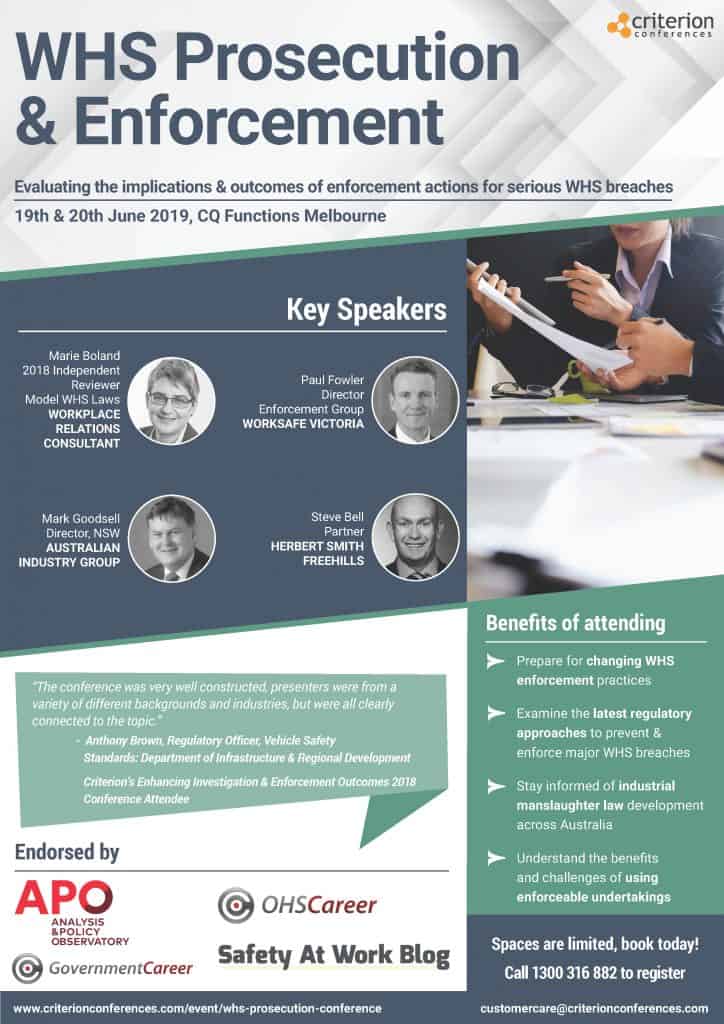
One of the hottest occupational health and safety (OHS) issues at the moment is Industrial Manslaughter but this is just one aspect of the enforcement of OHS and prosecution for breaches. In June 2019 a two-day conference on OHS/WHS Prosecution and Enforcement is being held in Melbourne, Australia with a list of respected speakers who are prominent in Australian labour law circles.

The conference is more expensive than some other OHS conferences but the list of speakers is impressive and the theme could not be more topical. (A brochure is available for download) Until March 15 2019, Criterion Conferences is applying an Early Bird discount of $500 for each delegate. SafetyAtWorkBlog has negotiated a further discount applicable to Subscribers only.

Subscribe to SafetyAtWorkBlog to continue reading.
Subscribe Help
Already a member? Log in here

Would Reckless Endangerment improve safety and health more than would Industrial Manslaughter laws?

The reckless endangerment provision of Victoria’s Occupational Health and Safety Act 2004 is likely to be crucial to this year’s discussions on Industrial Manslaughter laws and the management of workplace health and safety more generally, particularly as Victoria’s Minister for Workplace Safety, Jill Hennessy, has announced an implementation taskforce that includes a Workplace Fatalities and Serious Incidents Reference Group.

Section 32 says:

“A person who, without lawful excuse, recklessly engages in conduct that places or may place another person who is at a workplace in danger of serious injury is guilty of an indictable offence and liable to—
(a) in the case of a natural person, a term of imprisonment not exceeding 5 years, or a fine not exceeding 1800 penalty units, or
both; and
(b) in the case of a body corporate, a fine not exceeding 20, 000 penalty units.”

Subscribe to SafetyAtWorkBlog to continue reading.
Subscribe Help
Already a member? Log in here

One of the most useful books about OHS law

It is difficult to make a book about occupational health and safety (OHS) law interesting.  Some try with creative design but the most successful is when laws are interpreted into real world circumstances.  Thankfully Breen Creighton and Peter Rozen have written the latter in the 4th edition of Health and Safety Law in Victoria. Independent Australian publishers, Federation Press, recognise the significance of this edition:

“This is an entirely re-written and greatly expanded edition of this standard text on occupational health and safety law in Victoria….[and]

…Critically, the new edition locates the 2004 Victorian Act firmly in the context of the harmonised work health and safety regime…”

This discussion of context lifts this book from an analysis of one State’s OHS laws to an analysis of harmonisation, which may be offer a useful counterpoint to

Subscribe to SafetyAtWorkBlog to continue reading.
Subscribe Help
Already a member? Log in here
Concatenate Web Development
© Designed and developed by Concatenate Aust Pty Ltd