Public Comments – Fishing and Legionnaire’s

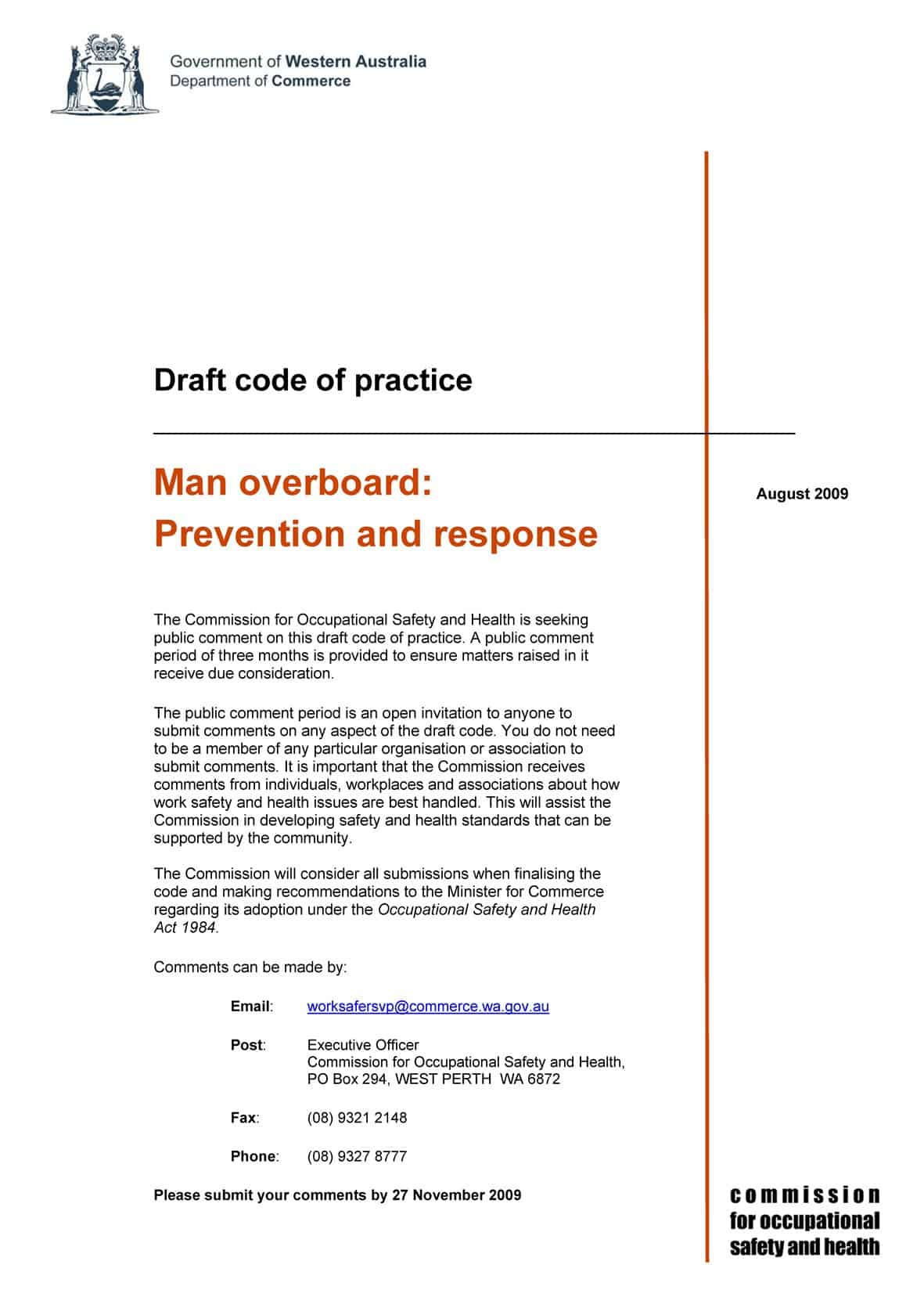
WorkSafe Western Australia has two documents currently open for public comment.   One concerns a draft code of practice  for the prevention of falls from commercial fishing vessels.  The other may have a wider appeal as it is a draft code of practice for the prevention and control of Legionnaires’ disease.

man_overboard coverThe man overboard code is an example of established hazard management and risk control options for a niche hazard in a niche working environment, however, it is often in these areas where procedural and technical processes are most easily recognised.  The draft code is in a format, and has a degree of clarity, that encourages discussion and examination.

Readers may find some useful information for those workers who work alone or in isolation, for those who need to undertake tasks at nighttime and in intense darkness, and for those workplaces that require a strict induction for new workers.

LEGIONNAIRES__Public_comment coverSimilarly, the Legionnaire’s code of practice builds on established risk management concepts and shows that businesses still need to prevent legionnaire’s infections even if there is a regulatory/licensing system in place for cooling towers.

On a formatting note, both these draft codes could have benefited from the regulators embracing more of the Web 2.0 concepts.  The PDF files do have some hyperlinks for some more information or emails but there could be a lot more effort put in to making the drafts a hub for the documents’ references.  For instance, mentions of legislation could lead to online versions so that those commenting online can flick back and forth from reference to topic.

[Just imagine how much more helpful a code of practice with such functionality could be to a small business – wiki + blog+ safety = better compliance]

In the Legionnaire’s draft there are tags on page 36 that could lead to the online text of the Acts referred to.  The tags are a good idea but could use increased functionality.

Lastly, the Legionnaire’s code references eight Australian Standards and publications.  It is a reasonable expectation that, for this hazard, industry submissions will be the majority and those parties already have the Standards.  However, if a broad consultation is required, many interested parties may find purchasing these Standards a substantial cost burden,  which SafetyAtWorkBlog calculated to be at least $A390 for the PDF versions.

Kevin Jones

Working Hours and Political Scandal

Over the last month or so, Australian politics has been scandalised by a senior Treasury official admitting to faking an email that implied political favouritism by the Australian Treasurer, Wayne Swan, and the Prime Minister, Kevin Rudd.

Godwin Grech is the public servant who has admitted faking the email and there are many reasons he has put forward, and journalists have endlessly speculated on, for his actions.  SafetyAtWorkBlog will discuss a minor element of the “Ozcar affair” that has been almost entirely overlooked – OHS.

Since the scandal broke in a Senate inquiry, Godwin Grech kept a fairly low profile and was last reported to be receiving treatment in a Canberra psychiatric facility.  It has been reported that Grech has a history of physical health problems and it has been reported, in an investigation into the affair by the Australian National Audit Office (ANAO), that administering the scheme was taxing on Grech.  The report says

“The under‐resourcing of the implementation phase of the policy placed at risk the anticipated policy outcomes. It also placed a considerable workload on Mr Godwin Grech, the Treasury official primarily responsible for the development and implementation of the policy measure, particularly in light of his medical condition.”

It needs to be noted that additional resources were offered to Grech to assist in administering the scheme. But Treasury was also criticised in the report.

“There were no indications that these matters, or Mr Grech’s medical condition, were given due weight in the implementation planning and delivery.”

Grech admitted to the ANAO that he had not informed his employer, the Department of Treasury, of his ongoing struggle with depression.

“What senior Treasury management did not know – as I have only very recently discovered – was that I have also been suffering from chronic clinical depression for some years, dating back to at least 2003. This had not been treated.”

Page 100 of the ANAO report has Grech quoting the OHS Act’s employer obligation to “take all reasonably practicable steps to protect the health and safety at work of [its] employees’”, and then lists his working hours required by the scheme.

“My work on the Oz Car program required me to work between 75‐85 hours per week including on weekends from late October 2008 until the onset of my bowel obstruction in early February 2009. My hours varied from 60‐70 hours per week from late February to June 2009.”

The amount of hours expected is phenomenal and there is little surprise that health problems or poor judgement occurred on this hazard alone.

However, what Grech fails to quote in the information to the ANAO is another section of the OHS Act 1991 – Section 21

“Duties of employees in relation to occupational health and safety

(1) An employee must, at all times while at work, take all reasonably practicable steps:

(a) to ensure that the employee does not take any action, or make any omission, that creates a risk, or increases an existing risk, to the health or safety of the employee, or of other persons (whether employees or not) at or near the place at which the employee is at work; ……”

Employees have a legislative obligation to not put themselves at risk. It would be interesting to know why Grech took on more than was healthy for him.

This dichotomy of choice is a crucial but difficult one for all employees in all industries.  When is it the right time to say no more or to ask for help or to say something is unsafe or unhealthy?

A further complexity to employment relations comes when industrial relations legislation specifies a maximum amount of working hours.  The Australian Government’s very recent Fair Work Act 2009 specifies maximum weekly hours of 38.  So what does this say about the employer’s OHS obligations to  civil servants, such as Godwin Grech?

The Fair Work Act says (Division 3, Section 62 (1))

“An employer must not request or require an employee to work more than the following number of hours in a week unless the additional hours are reasonable:

(a) for a full time employee—38 hours; or
(b) for an employee who is not a full time employee—the lesser of:

(i) 38 hours; and
(ii) the employee’s ordinary hours of work in a week.

Employee may refuse to work unreasonable additional hours.”

In May 2008, the Prime Minister, Kevin Rudd, said the following about public service workloads:

“I understand that there has been some criticism around the edges that some public servants are finding the hours a bit much ….. Well, I suppose I’ve simply got news for the public service — there’ll be more.  This Government was elected with a clear-cut mandate.  We intend to proceed with that.  The work ethic of this Government will not decrease.  It will increase.”

Godwin Grech could be considered one example of the Rudd Government work ethic.

In this political scandal OHS is an oblique and fringe issue but its existence cannot be ignored and it raises legitimate questions about how a Labor Government, the traditional friend of the worker, manages the safety of its employees.

Kevin Jones

Complacency and arrogance are the problems with mine safety in Australia

The signs are not good for the future of BHP Billiton’s safety program.  At the Diggers & Dealers conference in Western Australia on 5 August 2009, Ian Ashby, the President of BHP Billiton Iron Ore expanded on his statements some months ago about the poor safety practices at the company’s Pilbara worksites.

According to one media report, Ashby has said that BHP’s safety performance was  “generally showing improving trends”. He also said

“We’re looking for systems to eliminate these tragic events….. There hasn’t been any epiphany but we need to increase the intentionality and focus.”

Ashby specified two particular occupational hazards

  • traffic management, and
  • “fatigue management to prevent excess working hours”.

In April 2009, Ashby identified the following safety areas as those requiring attention:

  • Reduce site access;
  • Improve contractor management;
  • Enhance existing strategies to prevent excess working hours;
  • Move rail operations from the Mine Safety and Inspection Act to the Rail Safety Act;
  • Enhance traffic management standards, and;
  • Suspend all non-essential work outside daylight hours

Ashby’s presentation to the conference is now available for download.

Pages from diggersAndDealersMiningForumPresentation cover

The concern for the future safety performance of BHP Billiton comes from Ashby statements that, according to the press report, “the root of the problem was a poor attitude towards safety in the Pilbara region.

“There is an element that I don’t like to dwell on, but there is a complacency generally in the Australian workforce and a bit of an arrogance. I think some of that is quite manifest in the Pilbara.”

Ashby must have read the comments by Warren Edney about the lack of “safety brainwashing” in relation to the Pilbara miners. [SafetyAtWorkBlog has tried to clarify Edney’s comments with his employer, Royal Bank of Scotland]

The machismo of mine workers and new mining employers may be part of the issue but, as has been pointed out before, a similar Australian company in the same industry sector in very similar geographies – Rio Tinto – does not have anywhere near the same amount of fatalities even though it draw from the same worker demographics.

The OHS issue at BHP Billiton seems to be developing into a classic study of safety versus production.

It may be useful to note the report in the business section of The Age newspaper entitled “China taking all the ore we can ship: BHP“, a  report generated from the same presentation by Ian Ashby at Diggers & Dealers’.

Kevin Jones

New Work/Life Research

There seems to be new institutes and academic schools popping up regularly over research into the issue of work/life balance.  Recently one of the oldest and most prominent of the institutes, the Centre for Work + Life at the University of South Australia, released new research data.AWALI--full cover

The latest Australian Work and Life Index (AWALI) was released in late July 2009.  The executive summary identifies several important issues relevant to OHS:

“Three years of data about work-life interference in Australia tell us that many employees experience frequent interference from work in their personal, home and community lives, many feel overloaded at work and feelings of time pressure are also common and growing.”

“Work hours are central to work-life interference….. Many Australians are a long way from their preferred working hours and the 2008/09 economic downturn has not made any difference to the incidence of this mismatch.”

The work by Barbara Pocock and others at the Centre is characterised by recommendations for improvements rather than simply describing a situation.  In this data the researchers say

“Our AWALI reports over the past three years suggest that employers and public policy makers can help workers deal with work-life pressures.  This involves improving the quality of supervision and workplace culture, controlling workloads, designing ‘do-able’ jobs, reducing long working hours and work-related commuting, increasing employee-centered flexibility and options for permanent part-time work, improving the fit between actual and preferred hours and increasing care supports.”

It is obvious from these comments that OHS professionals need to work hard on these matters to create, or maintain, their workplace safety cultures.

Kevin Jones

The myth of the three-hour sleep

The Australian media has widely reported that Australian Prime Minister, Kevin Rudd, exists on three-hours sleep per night.  He doesn’t and Professor Drew Dawson, a prominent Australian sleep researcher, discusses the exaggeration of high-flying professionals in an article at Crikey.com on 21 July 2009.

More research of  Professor Drew Dawson, Director, Centre for Sleep Research, University of South Australia, is available online.

An OHS look at the Fair Work book

On 9 July 2009 I wrote in SafetyAtWorkBlog

“The  Fair Work Act has no relevance to occupational health and safety, so why mention this on SafetyAtWorkBlog?”

The Fair Work Act changes the negotiating and consultative structure of Australian workplaces stemming from changes in industrial relations law.

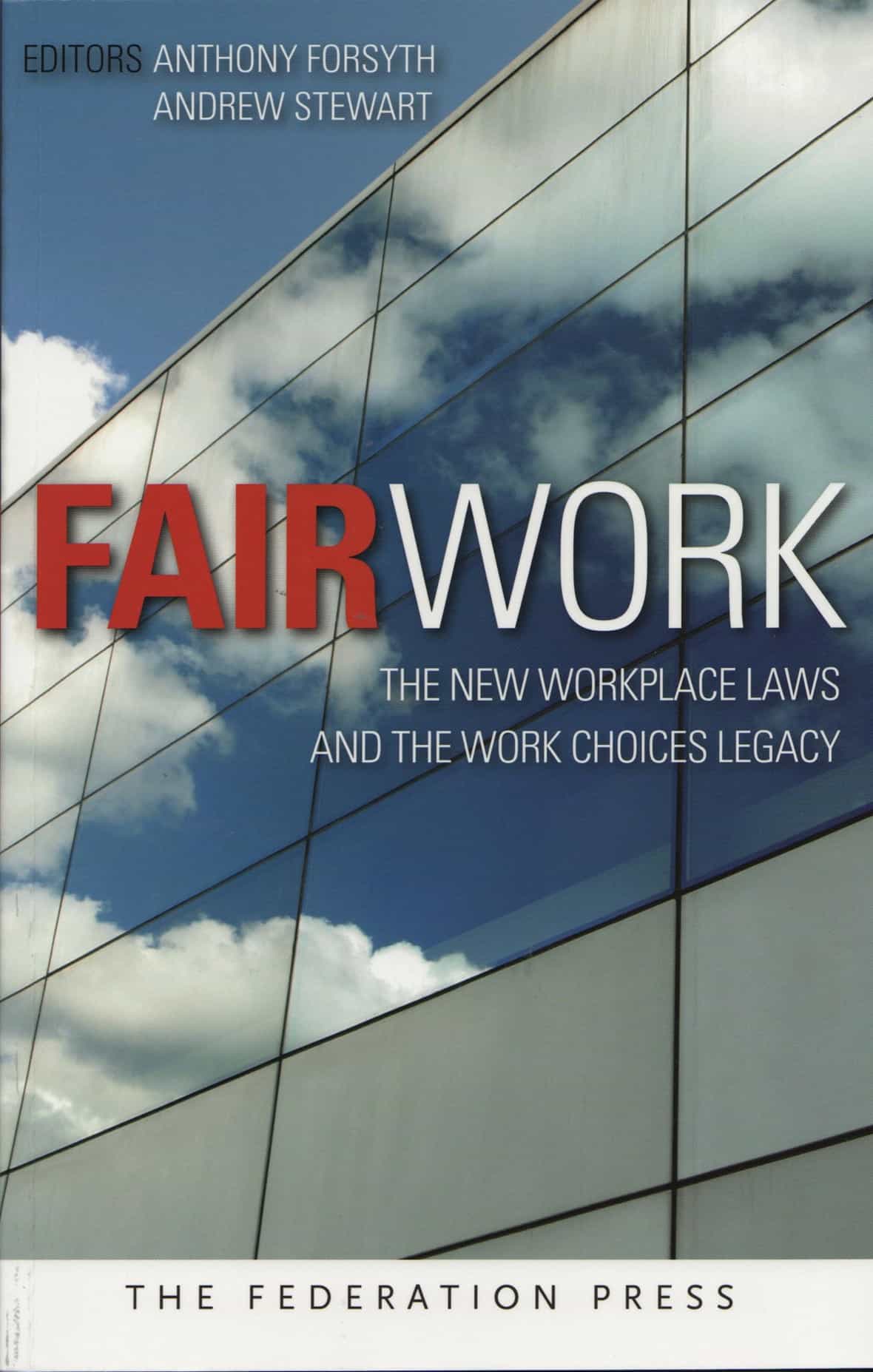
Fair Work Book cover 002A book that came across my desk this morning suggests several other overlaps of OHS and IR in the new regime.  Federation Press sent a copy of  “Fair Work – The New Workplace Laws and the Work Choices Legacy“, a book edited by Anthony Forsyth and Andrew Stewart.

In Andrew Stewart’s chapter he talks of how the New South Wales Industrial Relations Commission made several extreme rulings on the application of State OHS laws to federal employees.  He states that the government of Kevin Rudd has progressed OHS legislative reforms considerably by the government has “not indicated any interest in taking over the field itself”.  The reticence has seemed strange and I was one of those who tipped a greater role for Comcare as a  body for national OHS oversight.

Stewart has interpreted the government’s suspension of Comcare licences for national workers compensation coverage as  illustrating the government’s interest lies

“in streamlining workers compensation for multi-State employers, rather than imposing a national regime”.

Ron McCallum is an Australia labour academic who always demands attention. Stewart includes a particularly salient reference

“Ron McCallum, for example, has argued that labour laws that are centred around corporations are unlikely to retain a ‘wholesome’ balance between employers and employees.  Ultimately, he suggests, such laws are likely to become ‘little more that a sub-set of corporations law because inevitably they will fasten upon the economic needs of corporations and their employees will be viewed as but one aspect of the productive process in our globalized economy.”

The path to fairness is likely to continue to be rocky even during the terms of a government that originated from the labour movement.

NES

Jill Murray and Rosemary Owens write a chapter focusing on the Safety Net, a set of legislated minimum standards – National Employment Standards (NES).  These standards are not “lines in the sand” and have purposely been given inherently flexibility.  One of the issues discussed by Murray & Owens is maximum working hours.

This is particularly important to those of us who are trying to manage the issues of fatigue and impairment in workplaces.  The authors state that it remains between the employer and employee to determine what hours, additional to the 38-hour working week, are “reasonable”.  Some of the relevant safety factors in determining reasonableness are listed as

  • “Occupational health and safety risks”
  • “Personal circumstances, including family responsibilities”, as well as
  • “Needs of the workplace or enterprise” and
  • “any other relevant matter.”

Murray & Owens say that to determine reasonableness is almost impossible to negotiate between individuals because there is no priority allocated to each of the eleven criteria.    The authors say

“… this kind of conflict is exactly what the provision must confront: a business might have urgent demands on production, yet an individual worker has to get home to cook tea for the family.”

Murray & Owens go on

“By placing the potential to expand working hours in the hands of the parties at the workplace, the NES, like WorkChoices, really mean that whoever holds the greater power (and, perhaps, knowledge of their rights) is likley to prevail, notwithstanding any calculation of reasonableness.”

Here is the opportunity for the union movement to generate additional members and in an industrial relations climate that allows fro greater access to employees.  It is rare to find any individual who understands their own employment rights sufficiently to negotiate by and for themselves.  The union movement could again become the “Friend of the Workers” by actually being the friend of workers and doing some solid footwork.

The Fair Work book is far more than this short article indicates.  I only received the book this morning but am promising myself that I will read the rest.

As safety management broadens itself to cover psychosocial risks, it increasingly overlaps industrial relations, a workplace element that, with luck and a bit of work, could have been avoided by OHS professionals in the past.  That is no longer the case and OHS professionals must understand how industrial relations changes will affect their own workplace and how they do their jobs.  The Fair Work book is a great place to start.

Kevin Jones

What the next generation of graduates wants

A survey of graduates by GradConnection released on 15 July 2009 has important information for Australian companies and provides some optimism for the OHS profession and regulators.

A dominant element of modern employment is work/life balance. In some disciplines this is taken as workplace flexibility. In terms of workplace safety, work/life balance is a euphemism for psychosocial hazards of stress, bullying, fatigue, and workload amongst others. From this position, the survey findings showed that, when asked “What are the most important extra benefits?”, work/life balance scored the most support at almost 39%.

Companies that want to recruit graduates, often those companies which are looking to refresh their staff and workplace culture but also need to build sustainability and longevity, need to review their existing working conditions to match the desires of job seekers. This could be an enormous task for corporations that will take years but smaller companies can afford to be more reactive and flexible and may get the edge on attracting graduates.

It must be acknowledged that over 60% identified high salaries as the most important element in their salary packages. But the work/life balance indicates a growing reality that graduates are less likely to trade off wellbeing for dollars.

This is supported in terms of extra benefits where flexitime and flexible working arrangements gained around 24% and 22% support, respectively. Companies must operate within the time constraints of their industry, suppliers and customers but they should also identify those work processes that allow for flexibility. It may be useful to formalize start and finish times so that there remains a core set of hours within the working day where interaction of staff and clients can be maximised. Some of the social structures are already pushing in this direction with issues of public transport, schooling and childcare already accommodating this flexibility.

David Jenkins, the director of GradConnection, told SafetyAtWorkBlog that

The data we have extracted is drawn from contributions by about 10,500 graduates currently looking at their career options. It gives employers clear indicators as to what grads are looking for in their careers and helps potential employers adjust or increase their messaging about careers on offer at their companies.

Hope for OHS professionals and regulators comes from the fact that of the values that graduates wanted an employer to embrace, health and safety ranked third, behind equal opportunities and environmental sustainability.

This survey is the first generated through the website of GradConnections so the next survey should be able to provide some trend data.

Kevin Jones

Concatenate Web Development
© Designed and developed by Concatenate Aust Pty Ltd