
 It seems that we are constantly being urged to innovate, to be creative and to think differently. This is equally true in the discipline of occupational health and safety (OHS), but part of thinking differently in the future should also involve reassessing the past.
It is often said that many the OHS performance indicators, predominantly Lost Time Injury (LTI) calculations, have shown a “plateau-ing” of safety performance. From this common position, companies have moved to new OHS training strategies that involve behaviours, values, cultural norms, safety culture and other employee and organisational recalibrations. But what if the case in support of these strategies was not as strong as first thought? What if the “plateau-ing” did not exist or the increase in performance was not as strong as the LTI-based data seemed to indicate?
Academics,

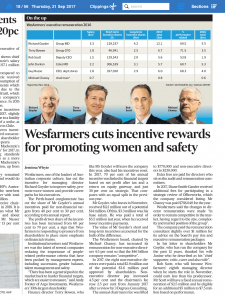 Today’s issue of the Australian Financial Review (AFR) contained an article that shows that the trend for companies and boards embracing their occupational health and safety (OHS) obligations is not uniform. The article “W
 Recently
  The launch of a “Vision Zero” campaign about occupational health and safety (OHS) was a major element of the recent