
Hierarchy of Control podcast

It always surprises me when clients and colleagues ignore the Hierarchy of Controls when deciding what control measures to introduce.  Recently Oregon’s OSHA released a podcast about the Hierarchy of Controls which shares some of my concerns.

It was concerning that the podcast stated that some hierarchies place Administrative Controls on the same level as Engineering Controls and that some consider fall protection devices as Engineering Controls due the engineering of the anchor point (a dubious engineering control as this blog has discussed previously).

Below are several quotes from the 4 minute podcast Michael Wood of Oregon OSHA.

“A control that fully eliminates the hazard is always preferred to one that does not.”

“The hierarchy improves the control’s reliability.”

“The hierarchy of control recognises that perfection in human performance can not be attained.”

This short podcast is a good quick reminder to occupational health and safety professionals but could also be discussion catalyst on basic hazard management.

Kevin Jones

Professional sportspeople are workers, so make them safe

Player Reaches To Catch Ball In Australian Rules Football GameThere is no doubt that football fields are the workplaces of professional football players and their support staff. So they are covered by occupational health and safety (OHS) and/or work health and safety (WHS) laws but what does this mean in relation to OHS regulators, and the sportspeople’s employers? Recently Eric Windholz looked at this particular issue.

Windholz recently published “Professional Sport, Work Health and Safety Law and Reluctant Regulators” in which he states:

“The application of WHS law to professional sport is almost absent from practitioner and academic discourse. An examination of the websites of Australia’s WHS and sport regulators reveals none contains WHS guidance directed to professional sports.” (page 1, references are included in the paper)

The example he uses to show this apparent lack of interest, even by the Victorian OHS regulator, WorkSafe Victoria, is the Essendon Football Club supplements saga.  Windholz writes

“Had these events occurred in the construction, manufacturing or transport industry, for example, it is difficult to imagine WHS regulators not intervening. Yet, WorkSafe Victoria initially was reluctant to investigate choosing to defer to ‘more appropriate bodies’. It only commenced an investigation when compelled by a request from a member of the public.” (page 2)

Subscribe to SafetyAtWorkBlog to continue reading.
Subscribe Help
Already a member? Log in here

A moderate entry in the IR/OHS conflict

innes_willox_hi_resDuring last week’s conference session on occupational health and safety and industrial relations, Innes Willox of the Australian Industry Group also spoke but was not included in the previous SafetyAtWorkBlog article.  However, his speech notes for that session have just been released and deserve consideration. Continue reading “A moderate entry in the IR/OHS conflict”
Drug and alcohol testing for Australian construction sites

On 18 September 2015 Senator Eric Abetz introduced amendments to the Building Code so that drug and alcohol testing will be required on construction sites.  In his media release he states that:

“The construction industry is a high risk industry where the risks associated with the use of heavy machinery, mobile equipment, working in congested areas and working from heights, are accentuated by the effects of alcohol and drug use.”

Following this argument, would not greater safety benefit be gained by addressing the risks posed by machinery, working at heights and in congested areas?  Drug and alcohol testing will do little to reduce these risks, or more correctly, hazards.  Being impaired may make it more likely for a worker to fall while working at heights but creative and safe design could eliminate the risk of working at heights altogether. Continue reading “Drug and alcohol testing for Australian construction sites”

Death from a well-known hazard – culture is only part of the answer

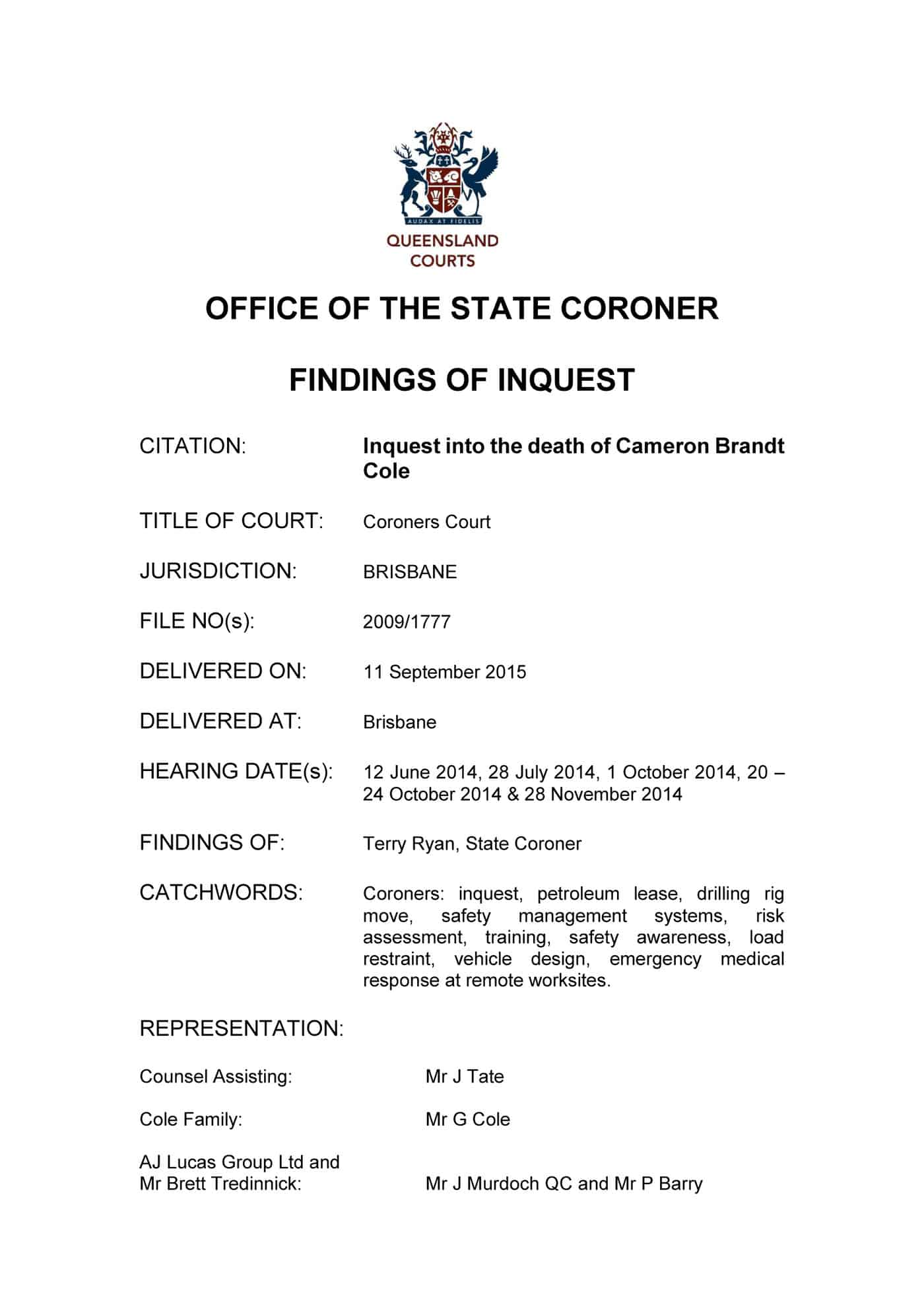
Cover of cif-cole-cb-20150911A coronial finding in Queensland in September 2015 illustrates how daily activities can lead to tragedy but also the role of safety culture.

According to one media report, in investigating the 2009 death of 24-year-old Cameron Cole who was hit as a pipe rack fell from a truck, the Queensland Coroner, Terry Ryan, found that

“…the semi-trailer had been over packed, not properly secured and there was no exclusion zone around the vehicle when the load was being released.”

From this event the Coroner makes many recommendations about the safety management of work practices at that time.  Many of these reflect common work practices that exist to this day on many Australian worksites.

Subscribe to SafetyAtWorkBlog to continue reading.
Subscribe Help
Already a member? Log in here

Inquiry into precarious/insecure work includes OHS

2015 has been a big year for public attention on the exploitation of workers.  In May, the Four Corners program revealed the exploitation of, largely, migrant or illegal workers in the food processing and vegetable growing sectors.  In the last month, 7Eleven workers have featured, also after a Four Corners investigation in conjunction with Fairfax Media.  In both cases, workplace safety has been mentioned but not featured.

In September 2015, the Victorian (Labor) Government released the

Subscribe to SafetyAtWorkBlog to continue reading.
Subscribe Help
Already a member? Log in here
Concatenate Web Development
© Designed and developed by Concatenate Aust Pty Ltd