National OHS Review – initial comments

Several OHS colleagues on an international discussion forum have expressed some opinions on the final report of the Australia’s National Model OHS Law review.

Safety Alerts

One asked that better and more frequent safety alerts be published by the regulators and that those reports be based on fatalities, injuries and near misses.  

There is an inconsistency of  incident reporting in Australia.  For instance, emergency service departments have different ways of notifying the media of incidents.  Most rely on regular (multiple times each day) visits to their websites.  This option doesn’t work unless one has tracking software or are doing nothing else.  Several distribute email bulletins on a daily basis.  Most of the bulletins deal with traffic incidents, floods or bushfires, but several also report on emergency incidents to individuals and, although not explicit, many occur in workplaces.

Incident alerts from emergency services are good because it is a service that OHS regulators and enforcers also receive and act upon.

For many years, various Australia safety organisations have published OHS solutions databases or, initially, folders.  The maintenance of these have fluctuated over the years in relation to technological change and political interest.  It is pointless trying to establish a fixed-point or hard-copy library when the Internet is now the primary resource tool.

It should be added that considerable information can be garnered from court reports of OHS prosecutions however, the Magistrates’ Courts do not provide publicly accessible court reports so any matters heard at that level are rarely reported, except by someone who is sitting in the court.  To gain a proper understanding of the OHS legislative process, coverage of all levels of legal action should be encouraged.

Risk Management

Another colleague expressed concern about the use of “risk” throughout the report.  Below is a section of the report that explains the review panel’s approach:

“In Chapter 30, we discuss the role of the risk management  process in the model Act.  As we noted in our first report, risk  management is essential to achieving a safe and healthy work  environment. We found that risk management is implicit in the  definition of reasonably practicable, and as such, need not be  expressly required to be applied as part of the qualifier of
 the duties of care.  Further, as we discuss in this report, risks  can be successfully managed without mandating hazard  identification and risk assessment in all cases, particularly  where the hazards are well known and have universally  accepted controls.

 Therefore we recommend that the model Act should not  include a specific process of hazard identification and risk  assessment, or mandate a hierarchy of controls, but that the  regulation-making power in the model Act should allow for the  process to be established via regulation, with further guidance  provided in a code of practice, as is contemporary practice.
 The application of risk management process should however be  encouraged…” (page xviii)

Throughout the review process the Victorian OHS Act was the most influential piece of legislation and that Act removed the previous requirement to assess workplace risks to determine the most appropriate control measure.  WorkSafe Victoria had, for years, advocated in its publications and guidelines to “Find-Assess-Fix”.  The “Assess” was dropped in many instances as the suitable control measure had been well-established just not widely applied.  

The WorkSafe position was in response to those business operators who may say “I don’t care how hazardous the bloody thing is just fix it!”  It was hoped that this would save time and “unnecessary” paperwork, and that other State jurisdictions would take the same approach.  None did, and the removal of “Assess” confused businesses and safety professionals as it is a major inconsistency with the Australian Standard on Risk Management.

WorkSafe tried to calm the confusion by saying that they still though assessing risks was a good idea for many new and developing hazards, just that assessment could be done away with as a legislative requirements in most instances.

It seems like the National Review Panel supports the Victorian approach to risk assessment.  Not so long ago, the New South Wales government subsidised a lot of training for farmers and others in the agricultural sector on risk assessment.  Now it will have to re-explain.

The other concern with the panel’s approach to risk assessment is that it sees risk management as fitting within “reasonably practicable”, a concept that SafetyAtWorkBlog is not convinced helps in managing safety.  “Reasonably practicable” is a concept that is defined and refined through prosecutions and court processes, therefore, it can change and it is best interpreted by lawyers.  OHS legislation was designed to be readily understood by the layman for where the responsibility for safety sits with the employer and, to a lesser extent, the employee.  As soon as law firms are brought into the process, information is locked away under lawyer-client privilege, the cost of safety skyrockets and any safety management lessons are delayed until the court case is heard (or not heard) years later.

It should be remembered that the National OHS Model Law was about the law relating to workplace safety not the implementation of safety management.  It is this differentiation that needs to be constantly pushed to the government to avoid workplace safety becoming a management task that cannot be undertaken without a lawyer watching intently over one’s shoulder all the time.

Kevin Jones

Eye injury statistics for workplaces

In early February 2009, the Australian Institute of Health and Welfare released a statistical report on eye injuries in Australia.  There was a small chapter on eye injuries that occurred in workplaces.  Seeing as how the readers of SafetyAtWorkBlog love statistical reports, some of the data is presented below.

For further data, and graphs, it is recommended you download the report.

According to the report, Eye-related injuries in Australia,

 A total of 8,640 workers compensation claims with eye injury or disease as the primary diagnosis were contained in the NOSI database for the period July 1999 to June 2005.

Median time lost because of eye injury in total decreased from 2.0 weeks in 2000-01 to 1.6 weeks in 2004-05. In 2004-05, injuries described as ‘eye: other and multiple’ resulted in the longest median time loss (2.0 weeks).

Australia’s final report of OHS Model Law Review released

The final report of the review into Model OHS Law in Australia has been released.  As usual Deacons law firm is the first to provide an analysis of the major recommendations of the report.

Over the next week there will be a flurry of activity from, particularly, the labour law firms but the rush is unnecessary.  The timetable for when change becomes a reality is well over 12 months away and the global financial crisis has thrown political timetables to the winds. 

The timetable for Australia’s emissions trading scheme are becoming vague, state elections are perhaps being brought forward, where they can, and, most importantly, the business sector will be protesting long and hard on any regulation that may increase their costs.  If ever there was a time for safety professionals and associations to be campaigning on the truth that safety decreases operating costs in the long term, that time is now.

Judge leaders by how they react in a crisis not in the easy times.

New evidence of the risks of using glyphosate

RoundUp and other glyphosate products are herbicides used domestically and commercially.  New evidence supports the calls by the Institute of Science in Society for a ban on the use of these products. 

Scientists pinpoint how very low concentrations of the herbicide and other chemicals in Roundup formulations kill human cells, strengthening the case for phasing them out, and banning all further releases of Roundup-tolerant GM crops

Research that shows an alternate perspective is available through Monsanto’s website.

This type of opinion or science war makes it very difficult for safety professionals to determine appropriate control measures when the evidence fluctuates however, as ever, protect to the lowest common denominator and eliminate the hazard wherever possible.

Australia’s OHS Law Review

Last week, the release of the final report of Australia’s review into National Model OHS Law was touted by many as immediately after the meeting of the Workplace Relations Ministers Council (WRMC).  This occurred with the first report in 2008.  WRMC met in a teleconference yesterday.  When the report is released officially (rumours are that the report is already doing the rounds of the unions and the employer associations), SafetyAtWorkBlog will provide a link to the report and some initial commentary.

However, as reported yesterday, the Australian Financial Review obtained a copy of the report and highlighted several issues of interest.  The AFR report held no great surprise for safety professionals but the union movement is going to be ideologically tested.

Early in the review process, the New South Wales union movement was very vocal about the risk of losing their right to initiate prosecutions over OHS breaches.  The right was rarely applied and could be a very costly exercise.  Since that time there has been silence from that quarter, perhaps because they realised that its contentious right was out-of-step with the rest of the country and the review process is all about legislative harmonisation.

According to media reports this week, the Review Panel’s final report recommends the omission of the right to prosecute but allows an option to instigate prosecutions through the OHS regulators.  In effect it keeps the power where it is most cost-effective and through which a similar outcome could be achieved.  It gives the unions a seat at the table, just not the same seat but still with a comfy cushion.

Prior to the WRMC meeting,  Sharan Burrows issued a media statement on several matters, the source of the ACTU quotes in today’s AFR article, in which she said

Media reports also suggest that the Ministers will tonight discuss the final report of the National Review of OHS Laws.

“It is vital that the national, harmonised health and safety laws are based on the highest possible standards.  This should include providing workers with the right, through their unions, to initiate prosecutions against employers when there are serious health and safety breaches.

“In the past, union prosecutions have been few in number but have secured important improvements for employees who work in potentially dangerous situations.  We also need a truly tripartite, well resourced national workplace health and safety watchdog that is able to set, monitor and upgrade health and safety standards,” said Ms Burrow.

It seems that Ms Burrows may, pragmatically, welcome the cushion.

Also, the union movement would be well aware of the potential boost to the revenues of OHS training providers, a status many unions and union bodies enjoy.  A national five-day training course for Health & Safety Representatives could be financially useful.  Also the courses have always been a very good recruiting opportunity.

Kevin Jones


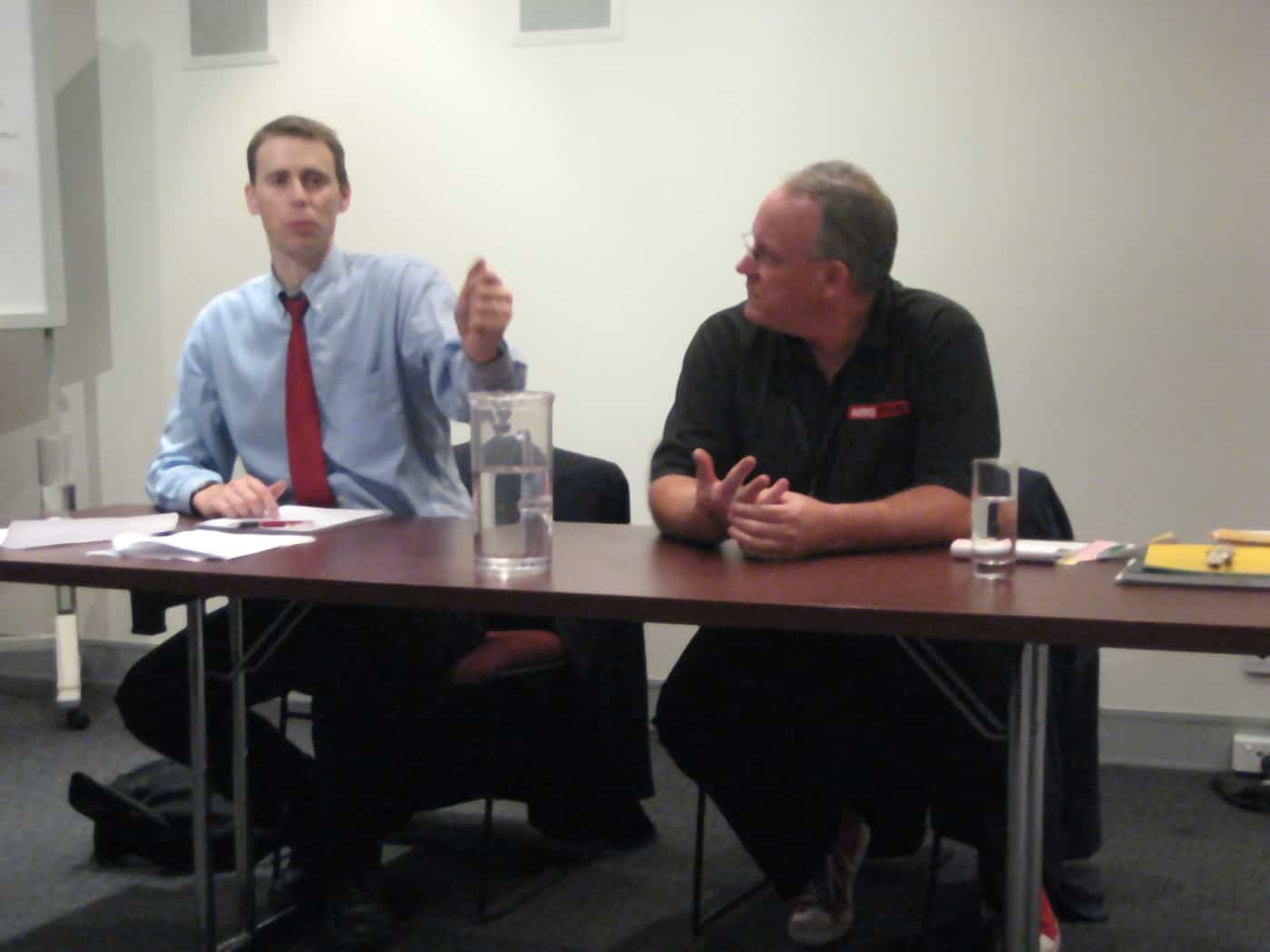
Sharan Burrows speaking at the 2008 Workers' Memorial in Melbourne

Workplace bullying – interview with Lawrence Lorber (2002)

In April 2002, I interviewed Lawrence Lorber of US law firm Proskauer Rose on workplace bullying.  It was at the height of the Enron collapse and corporate behaviour towards staff was gaining a lot of attention.  Over the last fortnight I have been researching some of the management books and concepts concerning leadership, emotional intelligence, modern expectations of managers – all of which could be thrown into “workplace culture.”

As I was reading back issue of the SafetyATWORK magazine, I used to published, there seemed to be valuable comments from Lawrence that remain relevant.  Below is an extract of the interview.  The full interview is available HERE

SAW: In Australia, the approach to workplace bullying seems to be coming from a systemic management system rather than one relying on psychological assessment.

LL: The highly competitive and highly contentious nature of what is coming out about Enron, the “up or out” atmosphere is one aspect of a system that can lead to managers or co-workers to engage in bullying. The characteristics of being tough or abrasive may be necessary to get ahead in the organisation. The environment can encourage or create bullying tendencies. However, not everybody turns into Attila the Hun in a highly competitive environment. Others survive without taking on the attributes of the bully.

Psychological testing is frequently applied in the States with regard to executive promotions. Dealing with bullying does require a combination of the systemic and individual approach. I work for some companies who are publicly perceived as fairly aggressive, there are tough people there who I might not want to work for but they are effective. They might be perceived as bullies. But looking at bullying as an environmental issue does mask the problem.

SAW: Managers sometimes need to motivate a staff member, perhaps, by rebuking them. The receiver of the rebuke may perceive that as bullying. How can we balance these perceptions?

LL: There were management books in the States in the 1980s, which encouraged management by intimidation. At one point that was the vogue. After the movie PATTON came out, everyone wanted to be General Patton.

If you look at a harsh manager who is demanding in an abrasive manner, that could be bullying.

How do you define bullying? Do you define it by your own reaction? A very US example is sex harassment. Is harassment in the eyes of the beholder? Does it have to be a reasonable woman who believes she is being harassed? In the circumstance where the bully is a male and the recipient is a female, frequently that becomes harassment.

SAW: That is a problem for the managers where for the last 30 years, harassment, bullying and discrimination has been handled outside the OHS field, in Human Resources. Now there are national and international moves to combat bullying because of the stress at work issues. I haven’t seen that approach in the United States.

LL: Here it’s not health and safety. Our definition of harassment is an “intimidating atmosphere”. That can also be a definition of bullying.

I don’t think it will be considered as a health and safety issue because workplace stress is not a field that is devoid of regulation. It is simply being regulated in a different context-employment discrimination and to a lesser extent under the disability laws. 


SafetyATWORK magazine April 2002 cover image
Concatenate Web Development
© Designed and developed by Concatenate Aust Pty Ltd