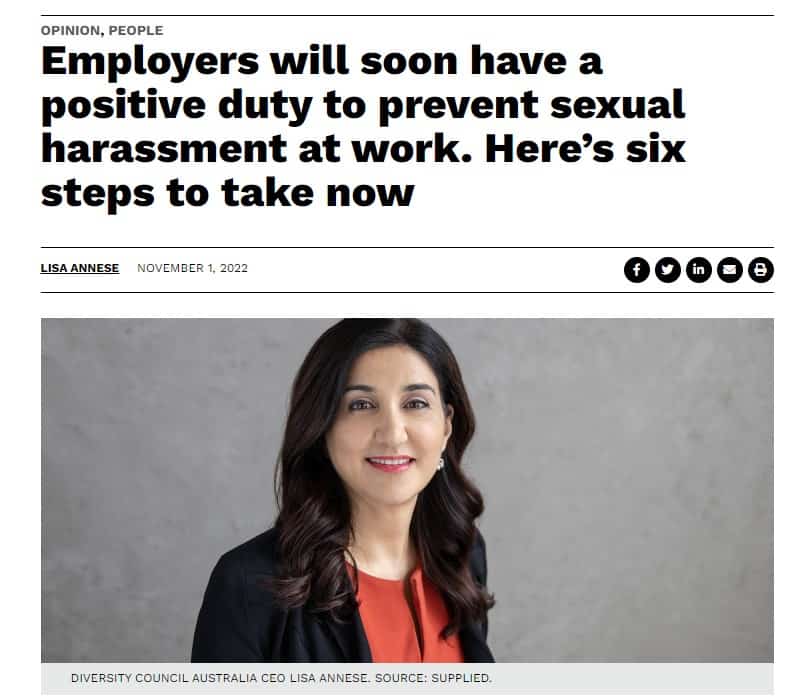
Lisa Annese‘s article is interesting but, as with many articles on sexual harassment at work, only goes so far. It is discussive rather than practical, even though it seems to promote action. Sometimes the actions are not clear enough to inspire change. Below are my thoughts on the six steps to complement Lisa’s recommendations.
Continue reading “Sexual Harassment advice needs to think deeper and face the challenges”Category: sexual harassment
More OHS activists needed
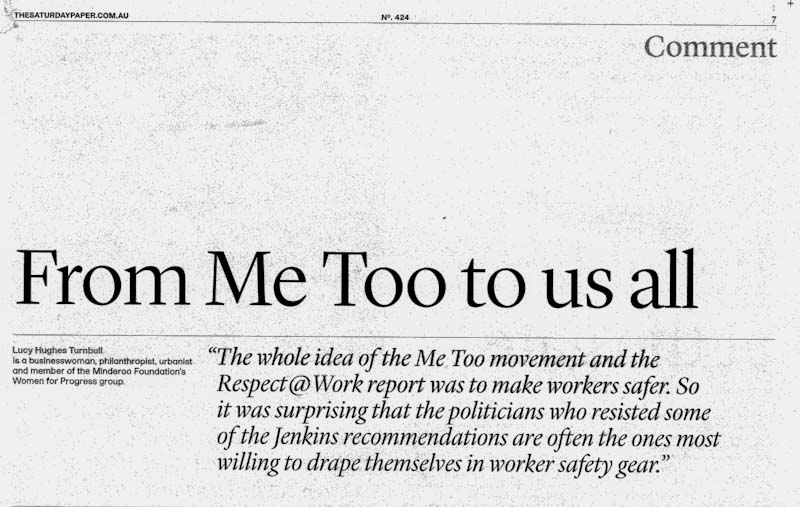
The Australian Government is set to introduce new workplace sexual harassment laws and obligations through Parliament. In The Saturday Paper on November 5 2022 (paywalled), businesswoman Lucy Hughes Turnbull wrote a short article that reminds us of the purpose of the new laws.
“The whole idea of the Me Too movement and the Respect@Work report was to make workers safer. So it was surprising that the politicians who resisted some of the Jenkins recommendations are often the ones most willing to drape themselves in worker safety gear. Protection from abuse and harassment is another key aspect of safety, like guardrails and fire exit signs. Now the legal system recognises it as such.
links added
This latest work safety bill is the best gift the parliament could give to mark the fifth anniversary of the global Me Too movement. Together with more paid parental leave and greater access to more affordable childcare, it has been a great few weeks for women and indeed all Australians.”
Disconnect and Positive Duties
Recently the Australian government released the interim report of the Select Committee on Work and Care. This committee is one to watch for many reasons; the least is that it is chaired by Senator Barabara Pocock, a leading researcher and writer on issues related to work/life balance and workplace equity. The report does not address occupational health and safety (OHS) risks directly;y but discusses many of the flexible work structures that can affect workers’ mental health.
One element of the Committee’s report deals with the Right to Disconnect – the right to turn off from the always-on workplace; a policy that returns the focus of days off to relaxation, hobbies or reconnection with friends and family.
Another is the imposition of another work-related positive duty.
New trade union psychological safety survey shows how little has changed
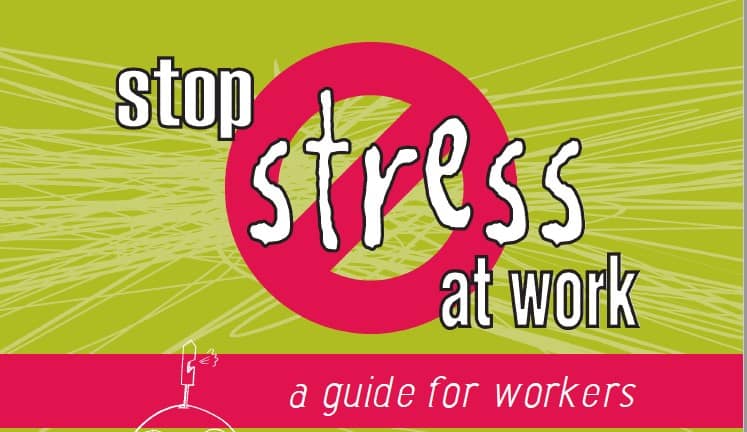
Australia’s trade union movement has long been active on the issue of workplace psychological harm. Its 1997 Stress At Work survey of members led directly to the creation of workplace bullying and occupational violence guidance in Victoria and elsewhere. Over 20 years later, the Australian Council of Trade Unions (ACTU) undertook another survey of its members (not publicly available), again on mental health at work.
Australia’s mental health industry is in transition
Dr Ian Hickie is a well-respected and knowledgeable advocate of mental health. His CV shows extensive experience in this area since the 1980s. Recently Dr Hickie spoke to the Australian Financial Review about EY’s announcement of a review into its workplace culture following the death by suicide of one of EY’s employees at their offices. The article (paywalled) seems to show a change in traditional approaches to mental health in workplaces, but the change needs to be much more significant and broader.
Australia’s mining sector can avoid becoming the next institutional pariah
Around a decade ago, parts of the Australian rail construction industry introduced the Pegasus Card. The intent was to have a single portal through which a worker’s competencies and eligibility to work could be verified. It evolved into the Rail Industry Worker Card in existence today. Pegasus remains in parts of the mining sector.
I was reminded of the Pegasus Card when I read the recent West Australian report into sexual harassment in the mining sector, Enough is Enough. One of its recommendations, Number 3, was that:
“The industry must explore ways to prevent perpetrators of serious sexual harassment simply finding reemployment on other sites and in other companies. This should involve:
– thorough exploration of an industry-wide workers’ register or other mechanism such as industry-wide accreditation, taking into account natural justice considerations and perhaps modelled on the Working With Children Card;…..
“industry-wide workers’ register”? Isn’t that what the Pegasus card helps to manage?
SafeWorkSA’s approach to psychological harm is as much as it can do but doesn’t have to be
The harm presented by working in Australia’s mining sector has been a concern for a long time. Over the last decade or two, the psychosocial harm from the same work has come to the fore. The occupational health and safety (OHS) responsibility sits clearly with the employers who, in Australia, are often well-resourced national and international corporations. Recently SafeWorkSA issued a media release entitled “Sexual harassment in mining sparks campaign“. SafetyAtWorkBlog took the opportunity to put some questions to the South Australia OHS agency, to which it has responded.