An OHS look at the Australian Labor Party’s National Platform

Cover of National Platform 2011 ALPThe leadership squabbles in the Australian Labor Party (ALP) have diminished  for the moment, and the next Federal election is set for September 2013.  Most everyone is tipping the ALP to lose the election.  The verb “lose” is specifically chosen, for the opposition Liberal/National coalition will probably win “by default”.  Whatever the electoral outcomes, the major political parties in Australia have current positions and policies on workplace safety.  Six months out from an election, it may be worth looking at those policies, as they currently stand. The first is that of the ALP.

The ALP has an extensive National Platform that was presented at its National Conference in 2012.  Below are some of the statements from that document as they pertain to occupational health and safety (OHS).  Some commentary is offered on these statements.

“The Labor Government places the highest priority on worker safety, particularly miner worker safety.” (page 42) Continue reading “An OHS look at the Australian Labor Party’s National Platform”

Latest review into workers compensation provides OHS clues

Cover of src_act_review_reportThe Australian Government has released its report into a review of its national workers’ compensation scheme, Comcare, and the Safety, Rehabilitation and Compensation (SRC) Act.  Some of the media (and politicians), as it often does, has focused on the seemingly absurd compensation claims.  Few cases have gained the same degree of national and international attention as the sex case for instance, and although most workers’ compensation reports focus on post-incident treatments, there is a glimmer of  hope on occupational health and safety (OHS) in this latest review.

The report, the latest undertaken by Peter Hanks QC, states that one of the guiding principles of the SRC Act should be an acknowledgement that

“The benefit and premium structure should promote incident prevention and reduce risk of loss.” (page 25)

This would be a wonderful benchmark to apply but is likely to be overshadowed by the compensation and rehabilitation issues of the review, unless OHS professionals and practitioners continue to remind regulators that prevention is better than cure.

Peter Hanks admits in a 2012 video interview on his review that injury prevention is not part of the terms of reference but there are elements of his report that require serious consideration by OHS professionals in consultation with their Human Resources (HR) colleagues. Continue reading “Latest review into workers compensation provides OHS clues”

Master Builders’ curious response on construction safety

In November 2012, the Australian Capital Territory (ACT) government released “Getting Home Safely“, a damning report written by Lynette Briggs and Mark McCabe, into the safety culture and performance of that territory’s building and construction industry.  But the Master Builders Association of the ACT has rejected several recommendations and questioned many others, yet refuses to release the evidence that it is assumed would support their position.

Cover of http___www.mba.orgIn February 2013, ACT’s Minister for Workplace Safety and Industrial Relations, Simon Corbell, accepted all 27 recommendations of the report, much to the surprise of some of us.  Corbell said in his media release that

“It is no longer acceptable for people in the construction industry to say there are safety issues in construction sites and then do nothing about them. This report compels unions, employers and government to stand up and actively promote a culture where everyone looks out for their mates, and everyone can go home safely every day…”

“As the report highlights, this is not simply an issue for Government. Safety is an issue for every person on a construction site with principal contractors, sub-contractors, workers, unions and the Regulator all working together.

“The Government expects employers and unions to demonstrate leadership on this issue.”

Safety Leadership or Conspiracy Theory

Today the Master Builders Association of the ACT released its response to “Getting Home Safely” (the Gower review).  That response indicates that not all Minister Corbell’s expectations are going to be met with the MBA.  In some ways this confirms many of the concerns in the report. Continue reading “Master Builders’ curious response on construction safety”

CSB pushes for a more effective discussion on fatigue management

Occupational health and safety has many examples of addressing small or short-term issues rather than  facing the difficult and hard, but more sustainable, control measures. I was reminded of this by a recent media statement from the United States Chemical Safety Board (CSB) in relation to fatigue management.

In 2007 the CSB recommended that, following the Texas City refinery fire,

“the American Petroleum Institute (API) and the United Steelworkers International Union (USW) jointly lead the development of an ANSI consensus standard with guidelines for fatigue prevention in the refinery and petrochemical industries.” [links added]

The progress of API and USW in developing the 2010 ANSI-approved Recommended Practice 755 (RP 755) has been reviewed by the CSB staff and they have found the following disturbing problems:

  • “The document was not the result of an effective consensus process, and therefore does not constitute a tool that multiple stakeholders in the industry can “own.” It was not balanced in terms of stakeholder interests and perspectives, and did not sufficiently incorporate or take into account the input of experts from other industry sectors that have addressed fatigue risks. Continue reading “CSB pushes for a more effective discussion on fatigue management”

Where are the Codes for establishing a safety culture?

Recently a safety professional told me he was investigating an incident on a work site and asked his first question “What do you think caused the incident?” The response was “safety culture”. Of course the next question will always be “what do you mean by safety culture?” and in most cases at this point the investigation will stall.

iStock_000023283219XSmallAll workplaces have a safety culture, it is just that most are dysfunctional or immature. In many workplaces, incident causes are handballed to this poorly understood concept of which most take as the latest iteration of “an act of God” or an SEP – “someone else’s problem”.

Safety regulators need to break the use of safety culture as an excuse by developing codes of practice on how to introduce and build an effective safety culture in Australian workplaces.

Continue reading “Where are the Codes for establishing a safety culture?”

Where to for the “the expensive and failed WorkHealth scheme”?

The Victorian Workcover Authority’s (VWA) WorkHealth program is coming to the end of its five-year life. But what is the way forward?  Has the $A600 million program achieved its aims?

Aims and Results

VWA’s annual report for 2008 (page 33) stated the following aims for WorkHealth, reiterated in the WorkHealth Strategic Framework 2010-12 (page 1):

“Over the long term, the program aims to:

  • cut the proportion of workers at risk of developing chronic disease by 10%
  • cut workplace injuries and disease by 5%, putting downward pressure on premiums
  • cut absenteeism by 10%.

These goals aim to drive productivity and reduce health expenditure that is associated with chronic disease.”

None of VWA’s annual reports since 2008 have included any mention of these benchmarks. Continue reading “Where to for the “the expensive and failed WorkHealth scheme”?”

Stargazing on harmonisation from 2003

Writing recent articles on workplace bullying and harmonisation reminded me of an interview I conducted in 2003 with the then head of the National OHS Commission, Robin Stewart-Compton.  NOHSC was a predecessor to Safe Work Australia.

The extract below reminds us that National Uniformity, a cousin to harmonisation, started over twenty years ago.

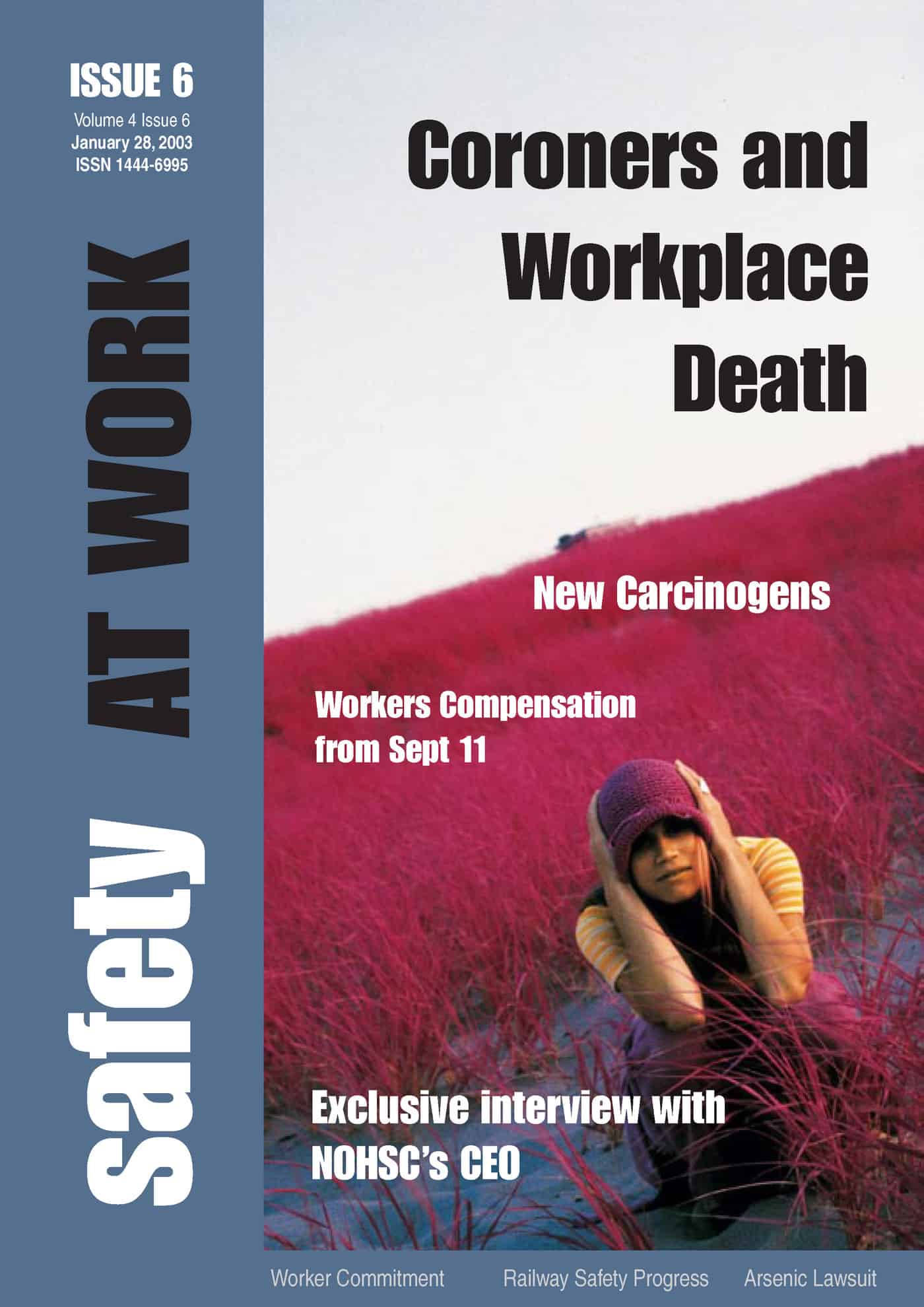
cover of 4i6 SAW: In the early 1990s there was a strong push for National Uniformity of OHS laws and a recent conference of the Royal Commission into the Building and Construction industry discussed this issue at length. Will the National Strategy achieve the aims of National Uniformity over 10 years ago?

RSC: The language has changed and you are more likely to hear of National Consistency than Uniformity but although this change has occurred there exists a paradox. Ten years ago we spoke commonly of the objective of National Uniformity and made very little progress toward achieving it. Continue reading “Stargazing on harmonisation from 2003”

Concatenate Web Development
© Designed and developed by Concatenate Aust Pty Ltd