Death at work differs from work-related death

Often immediately following an incident, the safety manager receives a brief phone call “There’s been an accident.” Information is scarce and, in my experience, often wrong or more fairly inadequate. in OHS there will always be an assumption that an injury or death is work-related as that is our patch but people die every day and they can die anywhere, even in your workplace. Is this a workplace incident? Yes. Is it an occupational incident? not necessarily.

It is vital in those first moments of confusion and panic, not to jump to conclusions and rush out to the incident site. If it is your responsibility you will become involved but often, by asking a few simple questions, you are able to avoid this confusion and avoid worsening the situation by “butting in” where you are not needed.

I was reminded of this when reading about a coronial inquest into two suicides that occurred at an Australian shooting range in October 2008. These two incidents occurred at a workplace but not from work-related activities. There may have been some workplace management issues that, in hindsight, relate to supervision or security but these are the type of issues that the Coroner will investigate.

The deaths are reportable to the OHS regulators as they occurred on a workplace but it is unlikely that the regulator will put a lot of resources into the investigation given the Police and Coroner are investigating.

Politics overrides safety

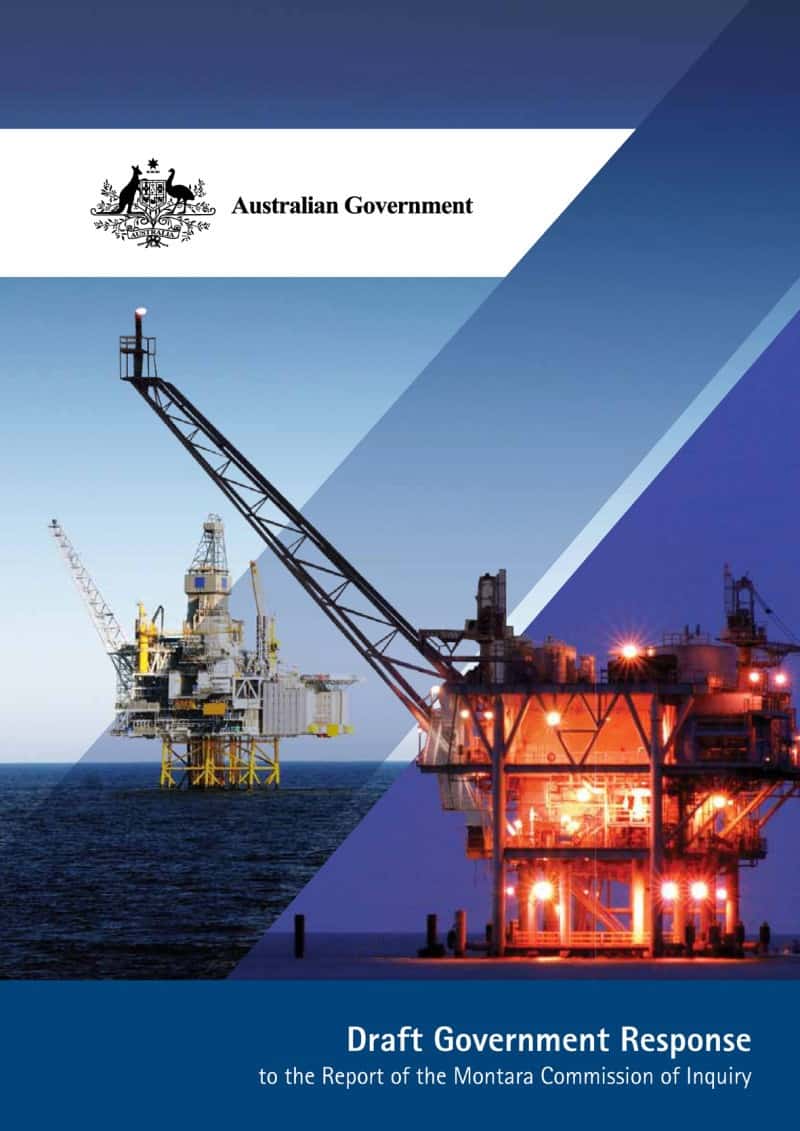
Why has the Australian government refused to release the investigation report into the Montara oil spill?

SafetyAtWorkBlog’s interest in this report is principally over the identification of potential risk control measures that could reduce the chances of another deep-sea oil rig exploding or identify any design or safety features that could stop such a savage leak of oil into the community.

The Australian Broadcasting Corporation reported on 12 August 2010 about the devastation to East Timor’s fishing and seaweed industries as a result of the spill in 2009 .  An earlier media report about Indonesia seeking compensation for its seaweed beds is available HERE.

The Australian Resources Minister, Martin Ferguson, said on 11 August 2010:

“The lessons to be learned from Montara, and I might say the Gulf [of Mexico], create a clear need in a very sensitive, important national industry, both environmentally, economically and from a health and safety point of view, for a strong single national regulator that’s well resourced and focussed,” ……

This may be the way to go but AAP reports that Ferguson he is refusing to release the investigation report until after the August 2010 general election!! Continue reading “Politics overrides safety”

Confusion over bullying and sexual discrimination on display in air traffic controller media reports

The Australian media is providing considerable coverage to the legal claim by two female workers against Airservices Australia over bullying and sexual discrimination.  Airservices Australia is a government organisation that control aircraft movement over Australian airspace.

The details of the harassment mentioned in the media are quite offensive and have no place in the modern workplace.

There are a couple of OHS related issues that pertain to the legal action and the media articles.  Firstly, the media struggles to differentiate between sexual discrimination, sexual harassment and workplace bullying.  Bullying has the most direct relationship to occupational health and safety but the others generate stress in the workplace and therefore the impacts, if not the actions, fall within the OHS purview.  The Australian Financial Review (AFR) (page 7, not available online) has a headline “Flight controllers sue for sexual discrimination” yet the article reports on bullying.   Continue reading “Confusion over bullying and sexual discrimination on display in air traffic controller media reports”

Patient safety is also workplace safety

Rosalind McDougall wrote in The Age on 26 July 2010 about the excessive and dangerous workloads of junior doctors in Australia. Similar articles have appeared elsewhere in the world for years but the hazard persists. Part of the reason for the hazard’s persistence is evident in the article if one considers the hazard as a workplace hazard rather than a patient safety hazard or a matter of customer service.

McDougall states the impact of excessive workloads for doctors:

“While most hospitals now have policies advocating ”safe hours”, the reality is many junior doctors work shifts that fail to meet the guidelines.”

“Numerous studies (as well as commonsense) indicate that doctors’ technical skills are compromised when they work too long.”

“While certainly not universal, some practices make it almost impossible for junior doctors to work safe hours.”

Where is the OHS regulator?  Is workers’ compensation for stress, fatigue or psychosocial hazards ever invoked by junior doctors? Are there OHS guidelines for the safe operation or design of hospitals and emergency wards? Continue reading “Patient safety is also workplace safety”

Australian PM mentions OHS harmonisation in election debate

On Sunday 25 July 2010, during the first debate of Australia’s election campaign, Prime Minister Julia Gillard used OHS harmonisation as an example of an achievement that she has been able to introduce that has benefited the Australian people.

The process is in a public hiatus at the moment that began before the election was called.  Much of the public discussion on harmonisation has concluded and now the stakeholders are developing drafts regulatiosn, codes and guidances behind the scenes in Canberra.

Prime Minister Gillard’s mention of OHS harmonisation should reassure that the government leaders have not forgotten that the process is occurring.  However it is highly unlikely that this issue resonates with the general public but, on this issue, that was not the audience.  Harmonisation was one of the few policy issues that is focussed on business concerns, business costs and has the wide support of the business community.  It does not involve taxes.  It does not (directly) involve industrial relations.  It does not rely on unions for implementation.

The fact that harmonisation has been mentioned in an election campaign debate is reassuring but nothing more than that.  It is an issue that could be used and that few would argue against because if one did, one would be arguing against the safety of people, at least in the understanding of the general public.

The mention is a footnote in the debate and is unlikely to get any mention in the press on Monday morning.  Indeed it is unlikely to get another mention in the election campaign, but it was, and we need to be content with that small win.

Kevin Jones

OHS law reform should not rely on Courts for clarification

Since the early 1970’s OHS law has been “de-lawyer-fied”.  The intention of the law is to empower workers and employers to manage safety in the workplace to meet basic human rights – the right not to be injured at work, the obligation not to hurt others.  Good law allows for the basic legislative tenets to be readily understood.  Poor law is difficult to understand and leads to increased business and personal costs in order to determine compliance.

I would argue that Australia’s recent aim of the national harmonisation of OHS laws will lead to complexity and cost – the opposite of what was intended – and a disempowerment of the workforce as the legal imperative overrides the safety management obligation.  The major weakness in the law is its seeming reliance on the Courts to clarify the laws, their application and their relevance.

Legal commentators on the laws have stated publicly that the impact of the law will not be clear for several years and that many questions about the laws will only be answered when prosecutions are brought and the Courts hand down decisions.  This process is sloppy, should not be accepted unquestionably by OHS professionals and does almost nothing to help the vast majority of Australian businesses to comply. Continue reading “OHS law reform should not rely on Courts for clarification”

Montara oil spill report still not released and restlessness is increasing

At least one state government in Australia is becoming annoyed with the delayed release of the investigation report in to the Montara oil spill in the Timor Sea in 2009.  The Federal Government has had the final report for almost one month.

In an ABC media report:

“The Country Liberals environment spokesman Peter Chandler [said] “There’s only one reason that anyone would want to stall releasing a report [and that] is because the report’s damning of perhaps both the Territory Government and the Federal Government in this matter,”….

The Australian Greens are also pursuing the final report.

Although the report will be of direct relevance to the oil and gas industries in Australia, the international significance from parallels with the BP Gulf of Mexico leak cannot be ignored.  This resonance could also be part of the report’s delay as the government refines a media strategy for the release.

The need for cautious assessment is understandable but it is just possible that an early release of the final report will assist in the United States’ control and remediation measures in the Gulf, the prevention of similar incidents in the hundreds of existing and planned deep sea oil rigs in the US and avoid the Federal election hoo-ha that seems to have already begun in Australia.

Kevin Jones

Concatenate Web Development
© Designed and developed by Concatenate Aust Pty Ltd