

Speculation is occurring about the introduction of Industrial Manslaughter (IM) amendments by the incoming Labor Government in New South Wales. It is likely, as the Australian Labor Party, when in opposition last year, introduced an IM Bill into Parliament. But Industrial Manslaughter laws promise more than they deliver as the push for these laws is based on politics rather than justice or workplace health and safety.
Category: politics

A Neverending Story – Supply chain safety dispute
Several weeks ago, Scott’s Refrigerated Logistics, a prominent Australia trucking company, entered receivership. It seems the Transport Workers’ Union (TWU), as part of a long campaign, chose to take another potshot at one of Australia’s few supermarkets, Aldi, accusing it of “pressuring supply chains” when the average profit margin in this sector has been described as an average profit margin of only 2.5 per cent. Occupational Health and Safety (OHS) in Australia’s transport industry has always been an important issue and is regularly a political football.
The union’s claims are being echoed by Senator Tony Sheldon, a former national secretary of the TWU, in Parliament.
OHS tidbits from the latest Productivity Commission Report
On March 17 2023, the Australian government released the Productivity Commission’s latest 5-year Productivity Inquiry report. At well over a thousand pages, few people are going to read it to the level it deserves. Nor will I, but I have dipped into it and found a couple of important comments that relate directly to the management of occupational health and safety (OHS).

Getting the (political) balance right
One can never accuse politicians of deep or systems thinking on the issues and policies for which they are responsible. Victoria’s Minister for WorkSafe, Danny Pearson, spoke at a press conference on March 6, 2023, about the viability of the workers’ compensation systems, which he described as broken, during a substantial increase in claims for workplace mental injury. Premier Dan Andrews has spoken of this matter since and with a similar perspective – politics rather than occupational health and safety (OHS).
How this issue develops over the next month may determine who speaks for the government at the April 28 Workers Memorial event.

OHS is now a fundamental human right. So what?
Last year the International Labour Organization (ILO) added occupational health and safety (OHS) to its Declaration on Fundamental Principles and Rights at Work. So what? I hear you cry. According to one trade union website:
“Contrary to Conventions – which are subject to ratification by individual Member States to be applicable, all Member States (187 Members) are expected to respect, promote and realize Fundamental Principles and Rights .”
This change has been a long time coming. Expect to hear a lot of discussion about this change at the 23rd World Congress in Sydney later this year, if not Ap[ril 28 and May Day. What Australia will say about this change is unknown, but it will be expected to say something.
Continue reading “OHS is now a fundamental human right. So what?”
Big consultancies sully their own nest
Large consulting firms have been getting a hammering lately. Fraud, leaking information, work-related suicides, corruption, unethical behaviour……. I bet they are nostalgic for the good old days when they were primarily auditors. There are several occupational health and safety (OHS) connections with the Big4, Big3 or Big 7. Auditing is the obvious overlap, but several recent books have identified some other strange relationships with Government that affect policy that, in turn, affect OHS. This is a brief look at one of those books – The Big Con.
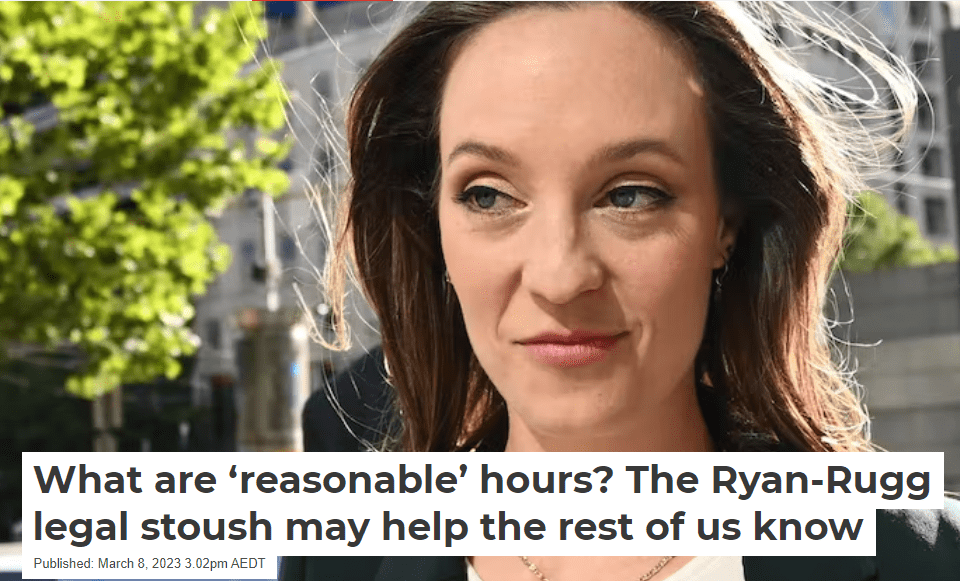
Differing perspectives on working hours
On March 8, 2023, Giuseppe Carabetta, Associate Professor, University of Technology Sydney, wrote about how the current dispute between Politician Monique Ryan and her former Chief of Staff, Sally Rugg, could open the door to lots of legal action through the courts and the Fair Work Commission. Sadly occupational health and safety (OHS) does not feature, but let’s look at the industrial relations context first and consider what is meant by “reasonable”.