
Several readers have raised their eyebrows over recent media reports in South Australia that say that SafeWorkSA is in the process of accepting an Enforceable Undertaking (EU) related to the death of 54-year-old Debra Summers, who was found dead in a freezer at the Echunga police training reserve on October 4, 2016. The use of EUs when a fatality is involved deserves discussion and resolution, especially when the workplace death involves a hazard that was so well-known.
Category: Premium
Family violence at work, looking at trees instead of forest
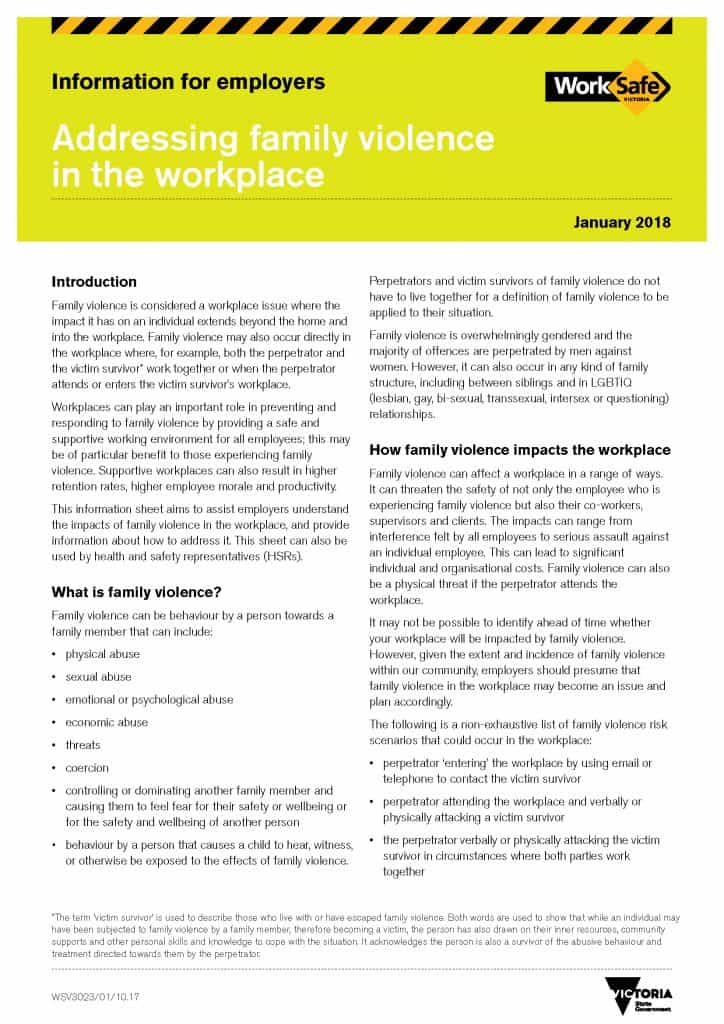
Victoria’s Minister for Workplace Safety, Jill Hennessy, has released a media statement about the occupational health and safety (OHS) context of family violence, referencing a WorkSafe Victoria guidance note from January 2018.
Hennessy is quoted saying:
“Employers have a legal obligation to provide a safe workplace for their employees – and that includes doing whatever they can to support workers experiencing family violence.”
But what level or type of support is expected from employers? Family violence is damaging and insidious but also a crime. It is also a subset, or maybe a special type, of workplace violence as is evident by WorkSafe’s reference to its broader violence publication at the end of the family violence guidance note. The publication, A guide for employers Preventing and responding to work-related violence, outlines the employers duty of care, which includes prevention.
Steady as she goes in Victoria
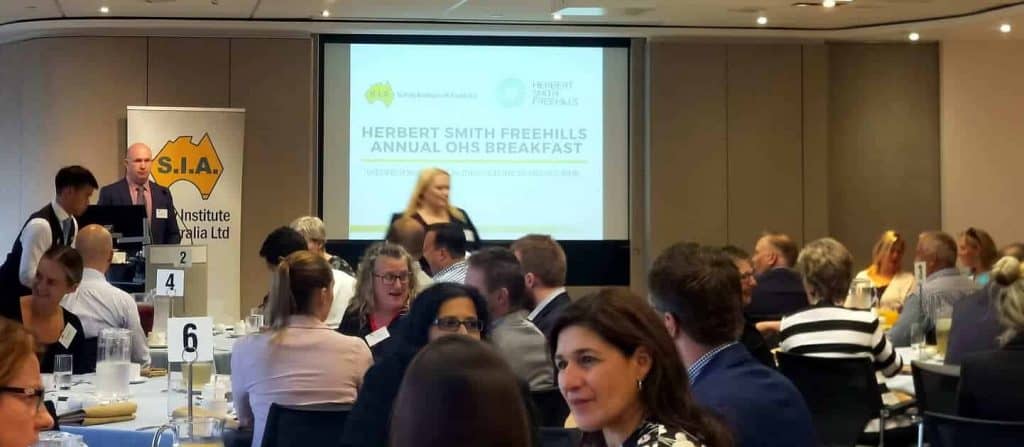
The annual Safety Institute of Australia (SIA) breakfast was held at the Melbourne offices of Herbert Smith Freehills (HSF). As has become a tradition, a spokesperson for WorkSafe Victoria was the feature presenter and this year that was the very recently appointed Executive Director of Health and Safety, Julie Nielsen. HSF’s Steve Bell also provided an update on OHS laws and national Work Health and Safety (WHS) changes.
Business groups miss the target on sexual harassment
Two business associations have released the submissions they provided to Australia’s National Inquiry into Sexual Harassment in Australian Workplaces – the Australian Chamber of Commerce and Industry (ACCI) and the Australian Industry Group (AiG). These submissions have been eagerly anticipated as these two groups are politically influential.
ACCI has based its submission on 13 “principles”:
- Employers oppose sexual harassment
- Sexual harassment is not good business
- More Australians need to be able to recognise sexual harassment
- We need to improve the attitudes Australians bring to work
- The law needs to support employers in turning values into action
- We need to recognise/reward learning and change
- Individuals must be made more accountable for their own behaviour
- Greater effectiveness does not demand more law
- Regulation needs to be smart, simple, clear and balanced to be effective
- Jurisdictional overlap / repetition detracts from effectiveness
- Businesses have differing capacities and cultures
- Sexual harassment can be challenging to manage
- This is a moving target; new sexual harassment risks are emerging
Each one of these sound positive but can be argued over. For instance “sexual harassment can be challenging to manage”. This is less of a principle than a reason, or even an excuse. Sexual harassment is complex to manage as it is not just about poor relationships, it involves a sexual element which involves power and disrespect; power that is sometimes misinterpreted as leadership or part of a manager’s entitlement.
Full audio interview with Marie Boland
Audio of the full interview with Marie Boland is now available to SafetyAtWorkBlog subscribers. Several issues were discussed that were edited from last week’s SafetyAtWorkBlog article.
Exclusive interview with independent WHS reviewer, Marie Boland
SafetyAtWorkBlog had the opportunity to interview Marie Boland earlier this week after the release of her review into Australia’s Work Health and Safety (WHS) laws. Below is an edited version of that interview.
Marie, thanks for talking to me, it’s a terrific report you’ve produced. What was it like to undertake a national investigation of this type, given that it was pretty much you and just a couple of others?
…It was quite daunting at the beginning, but as I said in the introduction and nothing kind of clichéd about it, it was very much a privilege to be able to do it. And the privilege was enhanced by having the opportunity to go travel all around Australia, and some places I’ve never been before like Tamworth and what it really brought home to me was the diversity of people, workplaces, geography and that these laws are covering and the diversity of people who are dealing with the laws on a daily basis. So, it was certainly a once in a lifetime experience for me I suppose, and maybe a point in history for the laws as well.
I was very much aware throughout the process of my privilege and being able to do it and also the waves of expectation I suppose and this being the first review of the national laws and also very much aware of all the work that went into creating the laws in the first place. And certainly, a lot of the people who put so much effort into that work were still obviously very keen on how they were being applied and as I said I was very conscious of respecting all of that as I went around the country.
Another generation of safety thinking
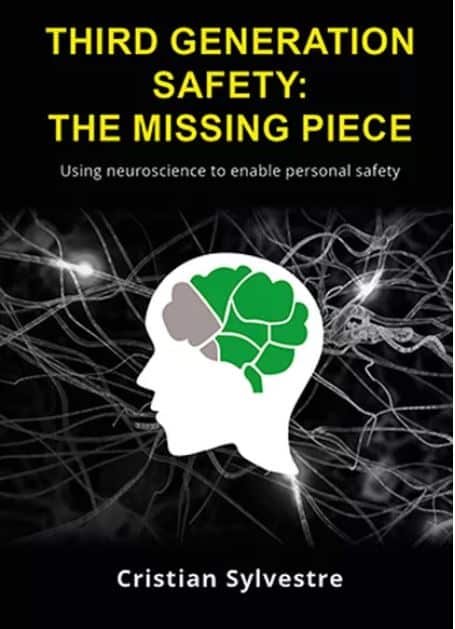
Several years ago I attended an occupational health and safety (OHS) conference at which Cristian Sylvestre was speaking. He was in one of the secondary rooms, it was packed with conference delegates and he was talking about neuroscience and its potential to affect safety. In 2017 he self-published a book called “Third Generation Safety: The Missing Piece“.
OHS has a lot of people talking about new approaches to address the plateauing of safety performance. We are pushed to reassess how we got here and how we look at OHS – Safety II, psychology of risk and others, or we need to have OHS fit with the Fourth Industrial Revolution. Sylvestre advocates a third generation of safety. This is his take on the previous two generations and how we should progress in the future.