 It is difficult to make a book about occupational health and safety (OHS) law interesting. Some try with creative design but the most successful is when laws are interpreted into real world circumstances. Thankfully Breen Creighton and Peter Rozen have written the latter in the 4th edition of Health and Safety Law in Victoria. Independent Australian publishers, Federation Press, recognise the significance of this edition:
“This is an entirely re-written and greatly expanded edition of this standard text on occupational health and safety law in Victoria….[and]
…Critically, the new edition locates the 2004 Victorian Act firmly in the context of the harmonised work health and safety regime…”
This discussion of context lifts this book from an analysis of one State’s OHS laws to an analysis of harmonisation, which may be offer a useful counterpoint to
 In September 2018 Australia commenced
  The
The  Discussions about safety in the mining sector continue with recent debate in the Queensland Parliament but change continues to be at a slow pace and in a manner that reflects “business as usual” rather than being innovative and establishing a sound base for business to grow, and grow safely.
 There have been many inquiries and investigation in Australia and elsewhere about the “future of work” but rarely about the “future of the worker”. Research often looks at how work may be transformed by technology and new labour/employment structures with an assumption that the worker is a passive and static element in this change. Those in occupational health and safety (OHS) and workers’ rehabilitation know that this is not the case.
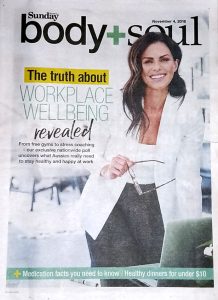 On Sunday November 4 2018, The Herald-Sun newspaper’s regular Body & Soul supplement devoted several pages to an