
Already a member? Log in here
Category: psychiatric
Yoga and yoghurt – corporate wellbeing
Professional organisations need to maintain personal contact between members and stakeholders even when social media allows for almost constant contact. Such events benefit from having thoughts challenged and recently one such event in Melbourne, Australia challenged its audience about psychological health and wellbeing.
A recent NSCA Foundation event heard from Andrew Douglas, one of the few workplace relations lawyers who can bridge the law and the real world. He began by describing wellness or wellbeing in a fresh context.
“Wellbeing is that equilibrium that is achieved between challenge and resources.”
This perspective addresses business operations and personnel management as challenges – situations that arise that need controlling or managing. This is a useful perspective as long as people feel up to the challenge and are not defeatist.
More care needed in discussing workplace mental health and mental illness
Writing about workplace mental health is a tricky task. An article recently posted to Business News Western Australia shows how tricky it can be and how mental health can be misinterpreted as mental illness.
The headline, “Are you one of the 20% of workers that will experience a mental health issue?” clearly refers to workers but the first sentence of the article does not. “Australian adults” are not all “workers”.
Out of the total population of around 24 million Australians, Wikipedia estimates the working-age population of Australia (15 – 64 years) at round 67% (16 million, approximately). If we apply these statistics to the headline, there are 3.2 million workers who “will experience a mental health issue”. But is this annually, over one’s working life or over a lifetime? The article does not say.
Not only are the statistics messy, so is the terminology.
Unfair expectations on the individual
Harvard Business Review (HBR) is a justifiably respected business publication but it often sells occupational health and safety (OHS) short. A new HBR article, “Stress Is Your Brain Trying to Avoid Something“, is a case in point.
Too much of the contemporary approaches to psychosocial hazards at work focus on the individual without addressing the organisational. This often compounds the struggles of individual workers and encourages managers to blame workers instead of analysing the organisational and cultural factors that lead to a hazard or incident.
5 experts in 60 minutes

The Institute for Safety, Compensation and Recovery Research (ISCRR) has tried a new format for its occupational health and safety (OHS) seminars. It is not a lunch with a single presenter and it is not a Three-Minute Thesis. It is five safety researchers in one hour, seven minutes per person and a single question from the floor – and it worked. Continue reading “5 experts in 60 minutes”
Psychologically health workplaces
In some of his research into the operations of WorkSafe Victoria, OHSIntros provided this graph of workers compensation claims for psychosocial issues. Not only does it show the extent of the issue in recent years, it provides a clear historic starting point for the hazard – a hazard that has created an industry of its own and that has complicated the management of workplace safety.
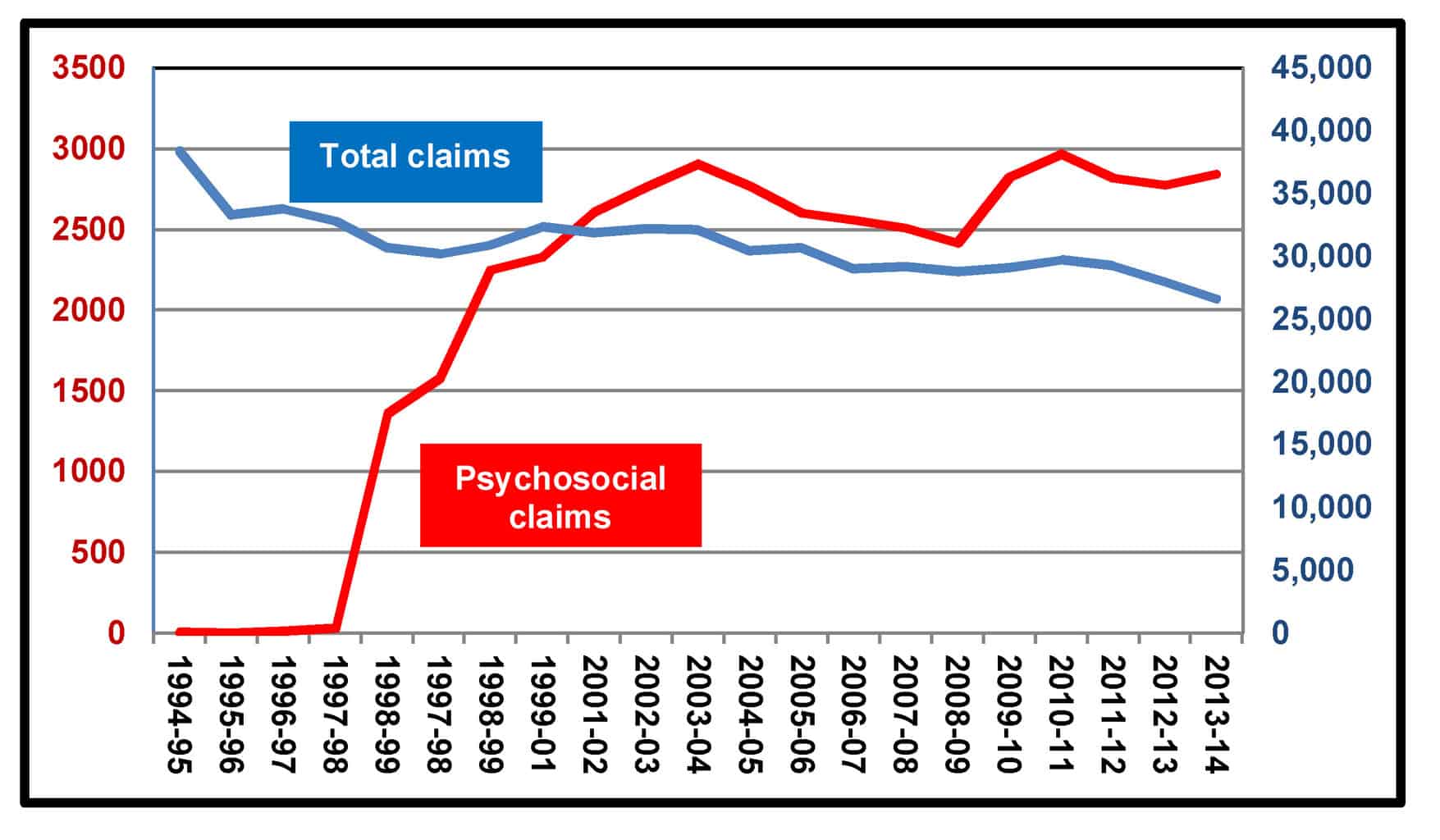
OHSIntros comments on this increase by saying “the conventional rationale in OHS is that when you identify and focus on a risk, the claims flood in…” but significantly states that this logic remains untested. Occupational health and safety (OHS) seems to run on untested logic.
Clearly psychosocial issues in the workplace present a problem. OHSIntros writes that in 2013-14 psychosocial claims overtook manual handling on average cost amounts of A$88,000 to A$67,000, respectively (page 11)
Recently
Penalty rates outweighs workplace bullying
The attention given to the recent draft report of the