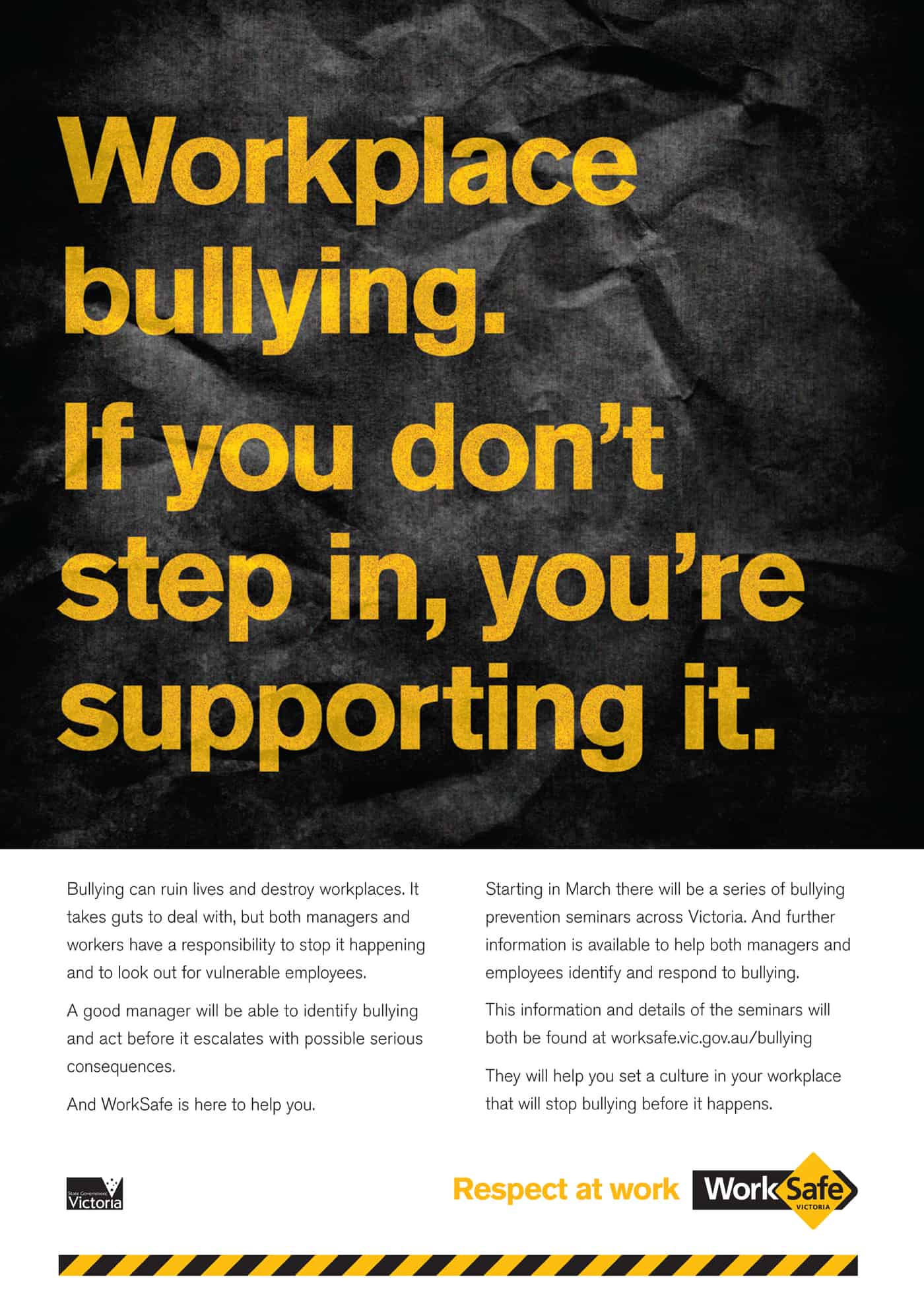
Political ideologies on show over workplace bullying

In Australia, Parliamentary inquiries are usually required to provide the Parliament with a copy of their findings. In the last week of November 2012, the Chair of the Australia’s Parliamentary Inquiry into Workplace Bullying, Amanda Rishworth, presented its report which included a dissenting report from the Conservative (Liberal Party) committee members. On 28 November both Alan Tudge MP, one of the dissenting committee members, and Deborah O’Neill (Labor Party), spoke to the House of Representatives about the report. Their speeches say much on the issue of workplace bullying and the politics of workplace health and safety (WHS) in Australia.

Statistics and Costs

Tudge acknowledges the importance of preventing workplace bullying but provides an important fact to remember when reading the full report. According to Hansard, Tudge says

“The prevalence of workplace bullying is not known – there is no statistical data to assess exactly how prevalent it is. Regardless of the precise number, we know that it is too prevalent.” (emphasis added)

This may sound a little contradictory but it summarises a problem when investigating workplace bullying, there are no useful statistics on it. Continue reading “Political ideologies on show over workplace bullying”

Australia’s workplace bullying report is a missed mental health opportunity

Cover of Workplace Bullying Final ReportThe report, issued last week, from Australia’s Parliamentary Inquiry into Workplace Bullying, is a terrific discussion on workplace bullying but is a major missed opportunity to achieve necessary change, and change in this area equates to the reduction of, principally, psychological harm to workers and their families.

The report starts off shakily by giving prominence to a statement that is clearly wrong. Page 1 of the report quotes Carlo Caponecchia and Anne Wyatt, saying:

“Bullying is the key workplace health and safety issue of our time.”

Caponecchia and Wyatt may believe that, but to open a Parliamentary report with this quote shows poor judgement from the Committee by giving workplace bullying prominence over other workplace health and safety (WHS) hazards and issues. Workplace bullying may indeed be the most difficult workplace health and safety challenge but that is very different from what the quote says. Continue reading “Australia’s workplace bullying report is a missed mental health opportunity”

Zero Harm persists in confusing companies on safety

Zero Harm = Zero Credibility

Australian lawyer, Andrew Douglas is one of the most passionate safety advocates I have met and he is a dogged critic of the Zero Harm branding present in occupational health and safety thinking. In his latest article at Leading Thought, he discusses Zero Harm and states that:

  1. “It is untrue and neither workers or supervisors believe the concept is true. Therefore it is unsustainable.
  2. The structures mean you get a clean out of low risk, low hanging fruit but your high end risk is unaffected.
  3. The safety knowledge of those most at risk, the workers, is not improved nor is their decision making capacity. Without changing mindsets people will continue to make deadly decisions.
  4. The positive studies do not measure Zero Harm against another process – I don’t doubt that any money and focus on safety will impact safety performance. The issue is it the best, does it reduce the risk of serious injury or death?
  5. The language, metrics and rhetoric of Zero Harm is utterly inaccessible to workers. They need a language in safety they own and understand.”

This level of criticism would do for many corporate safety programs as Zero Harm runs counter to the consultative and collaborative safety management process. Curiously one Australia’s OHS regulators, Workplace Health and Safety Queensland (WHSQ), has bought into the Zero Harm concept applying it to leadership. Continue reading “Zero Harm persists in confusing companies on safety”

First look at Australia’s workplace bullying report

Australia’s Parliamentary Inquiry into Workplace Bullying has released its report that includes 23 recommendations and a dissenting report from the Coalition (conservative) committee members.

The first recommendation that most will look forward is the latest workplace bullying definition. The committee suggests:

“repeated, unreasonable behaviour directed towards a worker or group of workers, that creates a risk to health and safety”.

This is no great shake from most of the previous definitions but illustrates further the isolation of Victoria from nationally harmonised work health and safety laws as WorkSafe Victoria’s preferred definition is

“… persistent and repeated negative behaviour directed at an employee that creates a risk to health and safety.”

Regardless of which definition is “better”, Victoria will be further out-of-sync.

The Committee also recommends the Government

“develop a national advisory service that provides practical and operational advice on what does and does not constitute workplace bullying..”

This is sorely needed and will relieve State OHS regulators of the pressure and the resources. No timeline is mentioned but it is likely that the Federal Government will move to establish such a service quickly, as the recommendation is not surprising.

However, the opposition political mantra for any government initiative is how it will be funded. Continue reading “First look at Australia’s workplace bullying report”

Challenges for WorkSafe Victoria at WorkSafe Week

As part of the annual WorkSafe Week, WorkSafe‘s Ian Forsyth presented the organisation’s OHS strategy to a large crowd at the Melbourne Convention Centre on 28 October 2012.

Harmonisation

Clearly Forsyth anticipated questions about the Victorian Government’s decision not to implement the model Work Health and Safety laws that will exist in all but two States and territories from 1 January 2013. He stressed that the government is adamant that the WHS laws will not be introduced “in the foreseeable future” and therefore Victorians need to refocus on compliance with the existing Victorian laws. He effectively shutdown any discussion on those laws before they started. The laws are off the Victorian table so let’s start working with what we have.

His stance has great significance for Victorian businesses and almost projected isolationism as a positive move. Part of his, familiar, justification was that the model WHS laws were based largely on the Victorian occupational health and safety laws and so there is little need to change, particular if the change would increase the regulatory cost burden to Victorian businesses. Continue reading “Challenges for WorkSafe Victoria at WorkSafe Week”

Workplace Bullying Beat-Up

Over the last few weeks the Australian print media has published several articles based on the expressions of concern by some business and employer associations about  Safe Work Australia’s code of practice on workplace bullying.  The latest article was in the Sunday Herald-Sun on 28 October 2012, “Bullying blueprint attacked” (not available in its original form online), which opens with the inflammatory paragraph:

“Workers in cushy jobs will be able to claim compo for being left idle, under national laws drawn up to combat bullying.”

The later online version of the article, by the same writer, Natasha Bita, has a much less aggressive title, “Plan to ban work pranks”, and a revised text.  The “new” opening paragraph says:

“Workers will be able to claim compensation if their boss does not provide them with enough work and office pranks would be banned under national laws to combat bullying.”

This has not stopped Senator Eric Abetz releasing a media statement which states that the workplace bullying code reads

“like something out of the socialist playbook whereby personal  responsibility is thrown out the window and everyone is bound in bubble wrap.”

Senator Abetz is known for these types of colourful statements but the question that should be asked is, why raise these concerns now? Continue reading “Workplace Bullying Beat-Up”

WorkSafe tries a new promotional approach

The increasing prevalence of pictorial social media has generated a surge in organisations generating “infographics” from workplace health and safety statistics Almost always these images are a technique for generating internet traffic through established websites, blogs and other online services. Fundamentally it is stealth advertising for the unwary online user. However, such images have much greater legitimacy when offered by OHS regulators.

In the week prior to its WorkSafe Week 2012, WorkSafe Victoria issued two online infographics as part of a media statement. Both are attractive by their simplicity but the simplicity can also be a problem.

The cost comparison infographic is super general but clearly illustrates that the cost to prevent harm is much less than any fine that may come from prosecution. However, the risk of being prosecuted in Victoria and receiving a monetary penalty seems to be declining as non-pecuniary penalties, such as enforceable undertakings and others, are made available to the Courts.

Fines are only one of the potential costs. An inescapable cost is the cost to the injured worker, the disruption to that worker’s family life, the disruption to the worker’s employer. Continue reading “WorkSafe tries a new promotional approach”

Concatenate Web Development
© Designed and developed by Concatenate Aust Pty Ltd