Workplace mental health deserves more attention

Mental health needs in the workplace has been an evolving area of study and application and has been followed by the SafetyAtWorkBlog since its inception.  Several recent statements and reports in Australia have shown that the subject continues to be discussed but not by those who can make the substantial social change, the Government, partly due to a lack of the type of evidence needed by Government to justify the change.

Mental Health is the core element of almost all the contemporary workplace hazards that are categorised as psychosocial.  This includes stress, bullying, fatigue, suicide, work/life balance, and many more.  Each of these categories are important but most reporting and a lot of the health promotion initiatives in the workplace focus on the manifestation of mental health instead of the source.

On February 21 2014 the chair of the

Subscribe to SafetyAtWorkBlog to continue reading.
Subscribe Help
Already a member? Log in here

New industrial relations book does service to OHS (for a change)

It is common for industrial relations to be written about without any mention or serious analysis of occupational health and safety (OHS). But a new textbook on Australian industrial relations includes a very good chapter of OHS that, significantly, cross-references other chapters in the book to provide a unified approach that reflects both the title and its intent. The book is called “Australian Workplace Relations” and the workplace health and safety chapter is written by Elsa Underhill.

Underhill has written on the OHS effects of precarious employment extensively and this issue is the basis of her chapter.  She sees this as major cause of many of the OHS issues, particularly the growth in psychosocial risks in modern society and provides copious amounts of Australian and international research in support. Continue reading “New industrial relations book does service to OHS (for a change)”

Missed opportunity for making the business case on safety culture

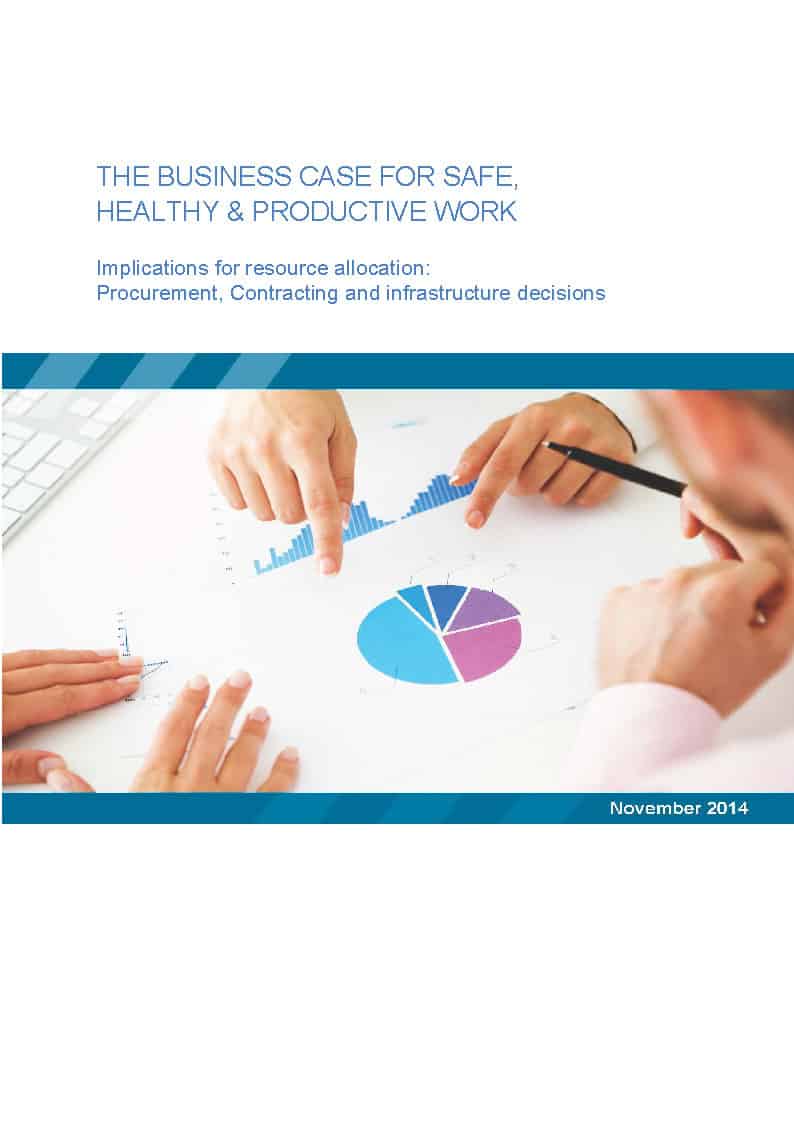
Cover of HSL culture documentRecently the UK’s Health and Safety Laboratory (HSL) released its second white paper on safety culture.  This paper is called “Making the Case for Culture” and outlines the three arguments for a workplace safety culture – legal, moral and financial – from which a safety business case can be built.  Financial seems to get the most attention but this is perhaps because it is the element that is argued the least and the one that can get the greatest attention from company executives.

The document seems a little thin but it could be put that the simplicity of the presentation in a booklet designed to provide safety culture guidance is an advantage.  It could also be argued that it is primarily a promotional pamphlet for the HSL’s very useful safety climate tool .

Continue reading “Missed opportunity for making the business case on safety culture”

Proposed drug testing – a political tool

On 6 February 2014 the Victorian Premier. Denis Napthine, announced the intention to

“…require construction companies to implement comprehensive drug and alcohol screening measures to ensure the safety of workers to be eligible to tender for Victorian Government construction contracts.”

This is to be part of the occupational health and safety (OHS) obligations of companies under the Implementation Guidelines to the Victorian Code of Practice for the Building and Construction Industry.  Understandably the construction union, particularly, is angry and feels as if it is being singled out.  Both organisations have chosen their words very carefully. Premier Napthine is quoted as saying:

“Reports of illicit drug use and distribution on Victorian construction sites are widespread.”

The CFMEU‘s Victorian Secretary John Setka has stated that

“There is no epidemic of drug taking on construction sites…. Our Health and Safety representatives who look out for workers’ health and safety are not reporting a problem.”

It is unlikely there is an epidemic of drug use but the Premier is talking of drugs AND alcohol.  

Subscribe to SafetyAtWorkBlog to continue reading.
Subscribe Help
Already a member? Log in here

Citi Research report provides insight into Australian corporate safety performance

On 29 January 2014 Australia’s Fairfax newspapers published an article called “Safety performances at Australia’s top companies is serious business” written by Adele Ferguson.  The article is based on an analysis by Citi Research of the safety performance of companies listed in Australia’s ASX100 share index.  Citi Research (Citi) has kindly provided SafetyAtWorkBlog with a copy of this report developed for its fund manager and superfund clients.  It is a terrific reference document providing a useful insight to the OHS performance of prominent Australian corporations.  It cannot be definitive but we know of nothing else like it in Australia.

In the Fairfax article Ferguson wrote:

“While safety is a complex issue largely due to the fact that safety records are difficult to measure and difficult to compare across companies and industries, it is an important area to explore. For starters, it is a good proxy for the way a company deals with staff and manages risk more generally.”

Safety does not have to be complex but the measurement of safety performance can be as, even though there is a (dreadfully outdated) Australian Standard for measuring OHS performance, companies tweak the existing measures and the principal measurement, the Lost Time Injury Frequency Rate (LTIFR), has been found to be a flawed indicator.  LTIFR is tolerated as a measurement simply because a better alternative has not been developed or widely accepted.

The Citi Research report lists LTIFRs for most of the 117 companies but it balances this with almost as many Total Recordable Injury Frequency Rates (TRIFR).  

Subscribe to SafetyAtWorkBlog to continue reading.
Subscribe Help
Already a member? Log in here

Serious questions raised about the effectiveness of OHS enforcement strategies

Richard Johnstone is always worth reading as he writes perceptively about occupational health and safety (OHS) and its enforcement.  The new book from Baywood PublishingSafety or Profit” provides a chapter by Johnstone that argues:

“…that despite the rhetoric of stronger enforcement and more robust prosecution, the dominant ideology of work health and safety enforcement – ambivalence about whether work health and safety offenses are “really criminal” and viewing prosecution as a “last resort” in the enforcement armory – still dominates the approach of Australian work health and safety regulators.” (page 113)

The importance of Johnstone’s chapter is that he reminds us that much of the current OHS debate is circular and limited and fails to question the soft enforcement strategy that has existed since the

Subscribe to SafetyAtWorkBlog to continue reading.
Subscribe Help
Already a member? Log in here

The safety features of the new Polaris set a new benchmark

2014.5-SprtsmnAce4x4-White_f3qThe Weekly Times scored an exclusive this week about a new model of Polaris quad bike which incorporates a roll cage or rollover protection structure (ROPS) in its design.  The significance of the Sportsman Ace is, according to the newspaper and the manufacturer, a “game changer” because it seems to counter the arguments of the quad bike manufacturers against such design changes in submissions to government and in public campaigns.  They have stressed that more effective control of a quad bike comes from driver training and behaviour and that ROPs may itself contribute to driver injuries and deaths.  The Polaris Sportsman Ace, to be released in the United States this week and Australia next month, seems to prove that quad bikes can be redesigned to include safety features, an action that manufacturers have been extremely reluctant to do.

A major critic of ROPs on quad bikes in Australia has been the Federal Chamber of Automotive Industries (FCAI). SafetyAtWorkBlog spoke to a spokesman for the FCAI who explained that the Polaris Sportsman Ace is not an All-Terrain Vehicle (ATV) but a UTV (Utility Terrain Vehicle). Continue reading “The safety features of the new Polaris set a new benchmark”

Concatenate Web Development
© Designed and developed by Concatenate Aust Pty Ltd