The world looks to Australia for quad bike safety changes

On 19 October 2012 in a video address to an Australian forum on quad bike safety, the US Consumer Product Safety Commissioner Robert Adler stated

“We at the US CPSC are monitoring your activities closely with the hope that what you learn can help us back here in the United States.”

That places considerable attention on the safety initiatives and negotiations in Australia but also may indicate that the United States is struggling to achieve change in this area.

On October 17 2012, the Weekly Times devoted its front page, a double page spread and its editorial to the safety of quad bikes, or All Terrain Vehicles (ATVs).   The editorial called  on the Government to

“…mandate all ATVs are fitted with roll-over protection ..[and to] provide a rebate to allow retro-fitting of roll-over protection to existing ATVs.”

ABC News provided an excellent summary of the issues associated with quad bike safety in its news report on 17 October 2011 and showed some scary images of young children riding quad bikes.

Following the forum, Australia’s Workplace Relations Minister, Bill Shorten issued a media statement outlining to the outcomes.  It stated:

“The Minister said he has asked Safe Work Australia to report on the key findings of the quad bike issues paper and today’s forum, and that he would direct Comcare*, the Commonwealth workplace safety regulator, to immediately implement the following:

SISA has few problems with SafeWorkSA but where are the other submissions?

In May 2012, the South Australian parliament announced an inquiry into the effectiveness of that State’s workplace safety regulator, SafeWorkSA.  Submissions are being received by the Parliament Committee but, as yet, none are available through the inquiry’s website.

Andrea Madeley of VOID has commented that her organisation has already provided the committee of inquiry with a submission but the only public submission SafetyAtWorkBlog can find is from the Self-Insurers of South Australian Inc (SISA).  Below is the summary of SISA’s submission:

“Should the responsibility for all occupational, health and safety issues remain with SafeWork SA or should some or all of that responsibility be transferred to WorkCover?

SISA members have no fixed views, although if the choice were simply limited to the current separated model and a single massive regulator, we might well opt for the current model as a means to avoid conflicts of interest. If, in the alternate, we are asked ‘Could the quality of OHS regulation and functional delivery be improved?’, we would answer ‘yes, but this cannot be achieved by structural change alone’. We therefore advocate no particular structure (though with a preference against amalgamation) and urge the Committee to concentrate on the quality of what is delivered.

2(a) WorkCover ought to be recognised as having a vital role and interest in improved OHS outcomes.

2(b) Scope exists for improved collaboration between WorkCover and SafeWork SA, especially in the field of data collection, management and use.

2(c) SafeWork SA and WorkCover should look at the self insured employers as resources and force multipliers for their own efforts to reach out to smaller employers.

2(d) Our members have few complaints (and no recent ones we are aware of) about their interactions with SafeWork SA.

2(e) The experience of small and medium size business may be different, however.

3. The OHS profession should have substantial representation on OHS regulatory and advisory bodies.

4(a) The real challenge for SafeWork SA lies in the small and medium size business community.

4(b) The conventional model of the regulator being the initiator of action will always be inadequate for small and medium size business due to the sheer numbers involved compared to the resources available.

4(c) Experience rating of workers compensation premiums has at best limited and delayed effect, and even that is anecdotal and presumptive rather than established as fact.

4(d) South Australia needs to think outside the square of normal regulatory models when considering small business safety. The French CRAM model might offer one such possibility.” [emphasis added]

SISA believes that SafeWorkSA’s performance can be improved but not through structural change.  It would be fascinating to see how SafeWorkSA would change with a new set of work health and safety laws.  From recent comments in the media by SafeWorkSA’s Judith Lovatt it would appear that the organisation is looking forward to them.

SISA clearly understands the separation between the workers compensation and rehabilitation roles of Workcover and the harm prevention and prosecution role of SafeWorkSA.  Too often criticism of the management of workers compensation is aimed at the wrong regulatory agency, a major problem seen recently in the Federal Parliamentary Inquiry into Workplace Bullying. Continue reading “SISA has few problems with SafeWorkSA but where are the other submissions?”

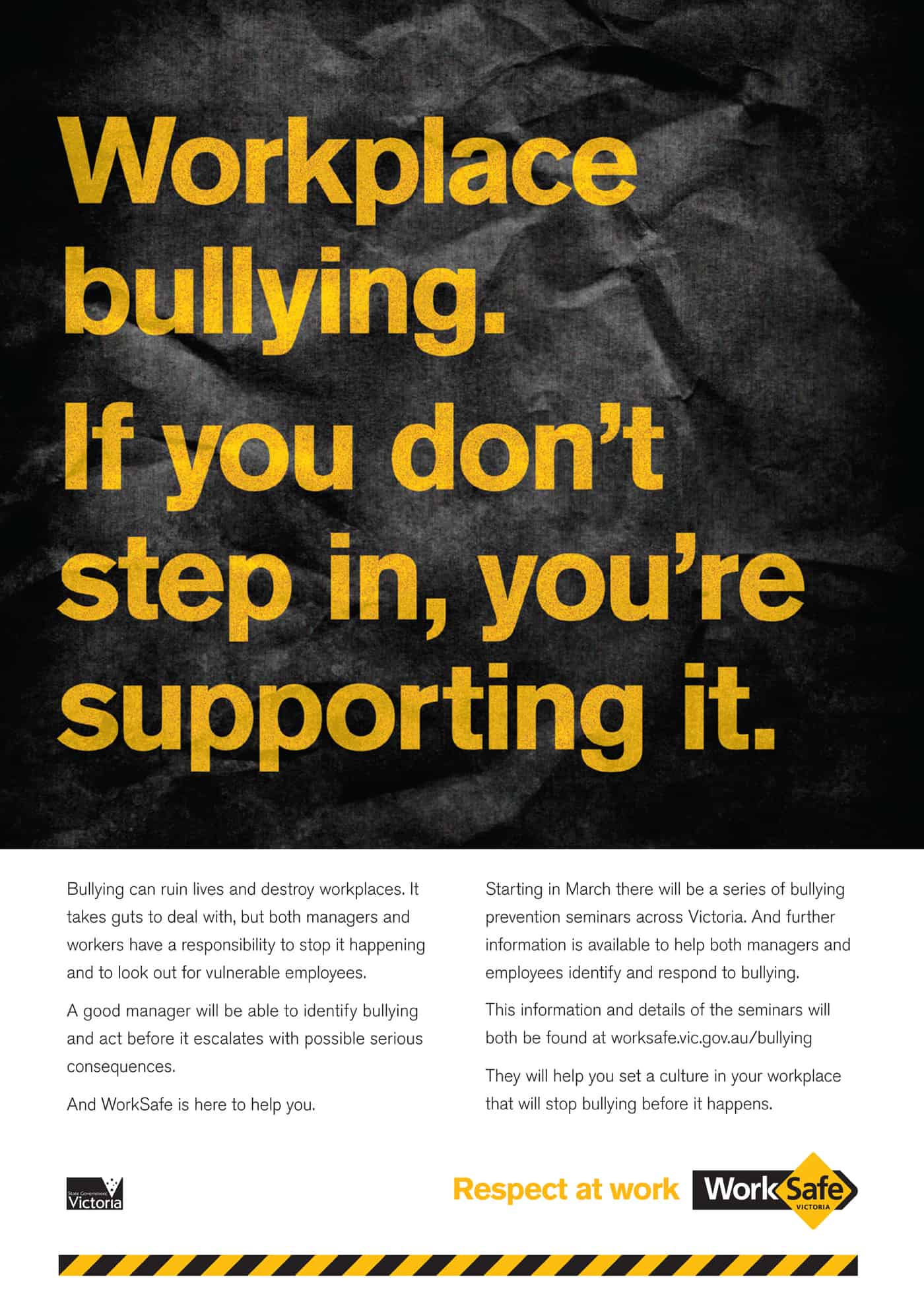
Momentum increases for tangible action on workplace bullying

According to the Canberra Times, a company board has been served with an improvement notice over inadequate attention to workplace bullying claims in a retirement home.  The ABC television program, 7.30, has followed up workplace bullying claims aired earlier this month with a further case on 25 September 2012 with savage criticism of WorkSafe Victoria’s actions in the case.

The Australian Government has completed the public hearings of its Parliamentary Inquiry into workplace bullying.  Bullying is everywhere but little seems to be happening to address the various elements and deficiencies of the regulatory system.

On 21 September 2012 the WorkSafe ACT Commissioner warned about inaction on workplace bullying:

“If bullying has not occurred, then a properly conducted investigation should find that… If, on the other hand, an independent investigation substantiates the allegations, then the employer will be in a position to act to protect their workers from any ongoing threat to their health and safety.” Continue reading “Momentum increases for tangible action on workplace bullying”

Lessons for Australia from UK assault on OHS red tape

The chase for government and corporate effectiveness and productivity increases through cutting “red tape” has, historically, had dubious longterm benefits. The attack on the red tape of occupational health and safety (OHS) has been brutal in the United Kingdom and has occurred with an unforgiving, and misguided, tabloid media.  Some in the UK media have been pointing out the government’s strategic folly, the latest is Russell Lynch in the Evening Standard.

On 20 September 2012, Lynch brutally described the UK situation:

“Safer businesses are more productive, not least because of the management time taken up when some poor sod has to be scraped off the floor. And let’s not forget inspections focus on occupational health as well, meaning employees have more chance of working without developing illnesses.”

The sad part of this statement is that productivity advantage of safer businesses has been known by governments for some time but that the wave of red tape attacks was politically stronger.

Some Australian States are on an extreme austerity drive even though the Australian economy is nowhere near as troubled as that of the United Kingdom.  These strategies usually call for across-the-board percentage reductions in costs.  This generality is a major problem as productivity and cost-effectiveness of specific organisations is not considered.  Untargeted cuts penalise the successful and the inefficient – the current experience of the Health and Safety Executive. Continue reading “Lessons for Australia from UK assault on OHS red tape”

Australia’s mining sector progresses safety but without effective accountability

In 2010 the New South Wales Mines Safety Advisory Council (MSAC) released its important Digging Deeper report, proving this industry sector is at the forefront of safety management innovation in Australia.  This month  MSAC provided an insight into “world-leading” safety with its report “Actions for World-leading Work Health and Safety to 2017“.

The report discusses five strategic areas for attention but of more interest is the elements that MSAC believes represents “world-leading WHS”:

Continue reading “Australia’s mining sector progresses safety but without effective accountability”

Reliance on PPE impedes safety progress

There is an increasing call for the mandatory wearing of high-visibility clothing for motorcycle riders around the world.  The reason is to make motorcyclist more visible to car drivers and other road users.  This sounds logical and sensible and is, in some way, based on the prominence of high-visibility clothing in  the industrial sectors of manufacturing, construction and others.  But is this a matter of policy based on evidence or a broad application of logic or a “common sense”?

As the requirement for high visibility clothing has been in workplaces longer than on motorcyclists it is worth looking for evidence of the effectiveness of high visibility clothing in workplaces.  A brief survey of some of the research literature has been unsuccessful in locating much research into this issue. (We always welcome input from readers on this). Wikipedia traces high-visibility clothing back to Scottish railways in the early 1960s, where

“Train drivers operating in these areas were asked their opinion as to the effectiveness of the jackets.”

It would seem the choice of high visibility clothing has stemmed from assessing a workplace, determining the dominant colour of that workplace or environment and then examining the colour wheel (above) to choose a colour of the greatest contrast, thereby providing a high visibility.   Continue reading “Reliance on PPE impedes safety progress”

The Australian Government looks to apply “above-the-line” safety to quad bikes

At the end of August 2012, Australia’s Minster for Workplace Relations, Bill Shorten, released a discussion paper on quad bike safety. The intention of the discussion paper is a:

“…calls for submissions on potential improvements to quad bike safety to reduce the alarming rate of quad bike fatalities and injuries….

The comments received will be discussed at a one day forum between all levels of government, farming organisations, unions, industry and community groups to be held in October 2012.”

The paper is fairly thin on details and is certainly not like other discussion papers which present a current state of knowledge or present a set of circumstances that comments are wanted on.  But most of the quad bike safety research is readily available on the internet so, perhaps Minister Shorten is acknowledging this reality and the intelligence of those interested in this issue. The paper poses the following questions: Continue reading “The Australian Government looks to apply “above-the-line” safety to quad bikes”

Concatenate Web Development
© Designed and developed by Concatenate Aust Pty Ltd