
Quad bike manufacturers withdraw from the safety campaign

The Weekly Times newspaper can feel justifiably chuffed that it has played a significant role in changing some of the attitudes on the safe operation of quad bikes.

It’s front page article on 23 November 2011 reports on a considerable backdown by quad bike manufacturers in Australia on the issue of rollover protection structures (ROPS) or crush protection devices (CPDs). (The cartoon is very funny also) Motorcycle manufacturers have been supporting a campaign and website through the Federal Chamber of Automotive Industries (FCAI) but even recent media releases (FCAI MOVES TO DE-BUNK ATV ROLL-OVER PROTECTION MYTHS )  have been removed from the FCAI website  and the FCAI spokesperson has been “directed by ATV makers not to discuss the issue” according to the Weekly Times.  FCAI’s 2010 position paper on quad bike safety continues to be accessible.

New CEO

SafetyAtWorkBlog has been told that there is industry speculation that the sudden change in policy direction is due to the September 2011 appointment of a new CEO, Ian Chalmers. Continue reading “Quad bike manufacturers withdraw from the safety campaign”
Workplace Bullying is a significant challenge even if the reality is smaller than expected

An article in the Weekend Australian newspaper and magazine (not available fully online) provides some statistics that raise serious questions about the level of bullying in workplaces in Australia, with particular focus on Victoria.  Of the 2,080 complaints lodged with WorkSafe Victoria in 2010-11

“only eight were deemed serious enough to warrant possible prosecution.”

Yet the OHS regulator received 7,050 inquiries about bullying.  There is clearly a problem in Victorian workplaces but it is not always bullying, as defined under OHS law.  Something else is happening and it has been happening for some time.

As reported previously in SafetyAtWorkBlog, the issue of workplace relationships is broader than can be handled by one regulator under one law.  There are human rights issues, mental health issues, harassment  and potential suicides – a range of social issues that should have taken the prevention of “workplace bullying” out of the workplace sometime ago.

The newspaper article, by Richard Guilliatt, draws on several significant cases of proven workplace bullying beyond the more familiar case of Brodie Panlock.  Christine Hodder’s suicide in 2005 following bullying in the New South Wales Ambulance Service generated a review of the organisation that found systemic bullying.  Sixteen year old Alex Meikle committed suicide in 2008 after many workplace “pranks” that included being set on fire. Continue reading “Workplace Bullying is a significant challenge even if the reality is smaller than expected”

OHS Strategy to nowhere

Throughout 2011, Safe Work Australia (SWA) has been conducting consultative workshops in the development of the next ten-year National OHS Strategy.  SafetyAtWorkBlog reported previously on the Melbourne meeting.  SWA has released their report into that Melbourne meeting.

The meeting had a set of criteria for the stakeholders to consider.  Sadly, there was no forewarning of the issues to be discussed so the workshop took some time to gain traction.  With only one day of consultation, it would have been more productive to release the agenda topics a day or two earlier.  These topics, each of which could have generated at least a half-day’s debate, are listed below

“Social/Economic/Emerging Issues in the Workforce, Business and Technology…

Hazards – Enhancing the capacity of workplaces to respond to:

  • Disease-Causing Hazards …
  • Injury-Causing Hazards …
  • Psychological Injury-Causing Hazards …

Work Health and Safety Systems – Challenges and Solutions in Safe Design and Work Systems, Skills and Training, and in Safety Leadership and Organisational Culture…..”

The report has responses to each of these topics but many of the suggestions are already known.  The lack of creativity in the suggestions is largely disappointing.  The responses to “what will success looks like in ten years” are mostly extensions of programs that are already in place or a perpetuation of the “way things are done now”.  Innovation was largely missing, perhaps due to the participants not being able to lose their own agendas.  The earlier SafetyAtWorkBlog article discussed the negative impact of the shadow of harmonisation, a term found only once in SWA’s report. Continue reading “OHS Strategy to nowhere”

Work-related suicide gains some fresh media recognition

On 4 November 2011, Victoria’s 7.30 program broadcast a heart-rending story about the suicide of a woman who, her mother believes, took this action after suffering chronic pain due a work-related incident and being given insufficient support from her employer and workers’ compensation bodies.  The story of Rebecca Wallis (spelling uncertain) apparently generated sufficient communication to the Australian Broadcast Corporation for 7.30 to undertake a follow-up and more broad look at the relationship between workers compensation and suicide.

One of the people interviewed in the 11 November 2011 program was John Bottomley of the Creative Ministries Network.  Bottomley has published several research reports on work-related deaths and suicides.  The figures he mentions in the report, that around 30% of the work-related suicides identified in his research had a “work injury or work-related mental illness” as a contributory factor, are included in the online publication from 2002, “Work Factors in Suicide“.  What is not mentioned is another statistic in his report:

“Nine people (8%) were on workers’ compensation when they committed suicide.” (page iii) Continue reading “Work-related suicide gains some fresh media recognition”

Australia releases official statistics into work-related injuries

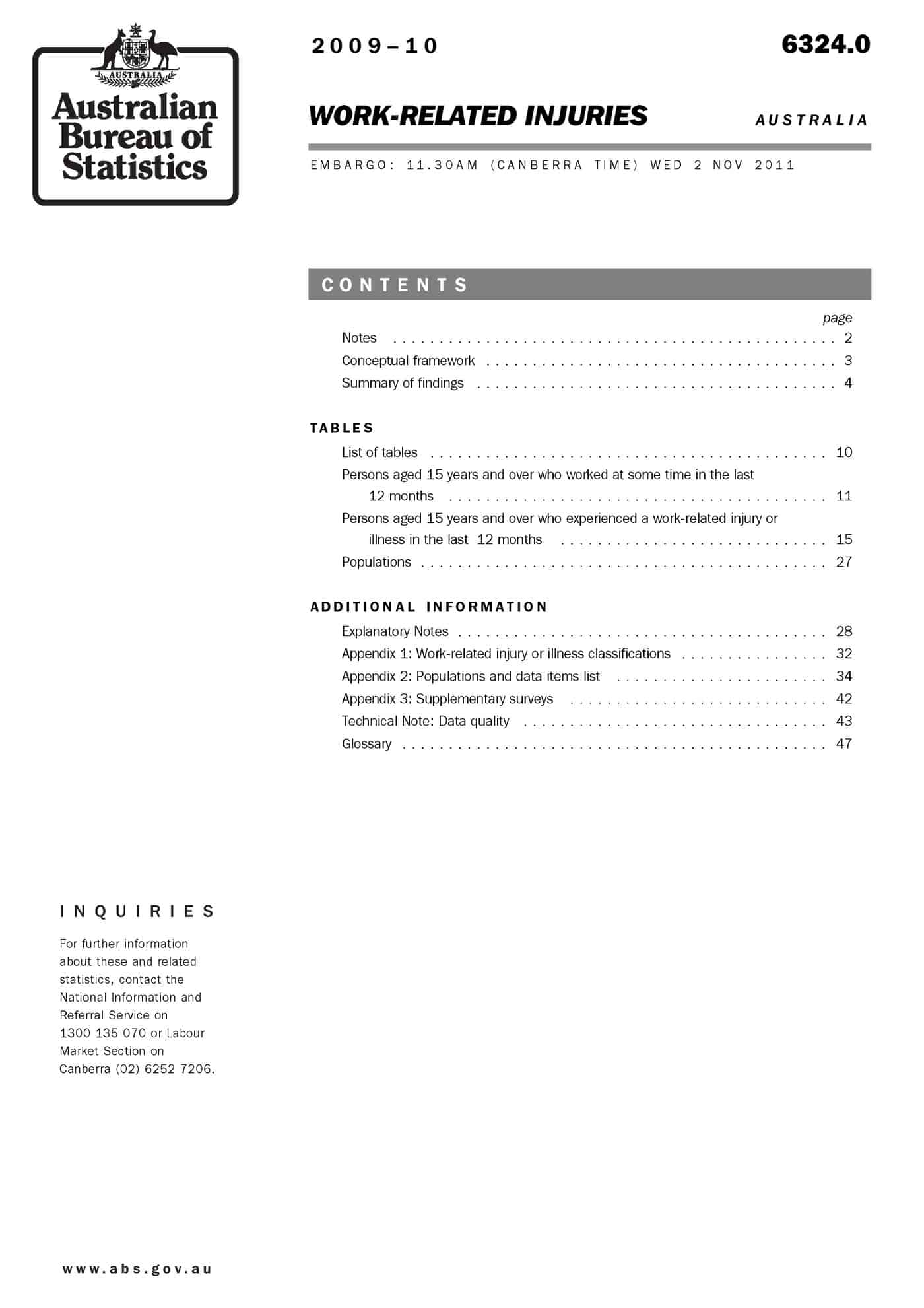
Data released by the Australian Bureau of Statistics (ABS) in early November 2011 has revealed that 18.5% of people injured at work in 2009-10 received no OHS training prior to the incident.

The basic findings of the 2009-10 data are not all new as a December 2010 media release shows but the new report, “6324.0 – Work-Related Injuries, Australia, 2009-10” does include new data on OHS training.

Most of the OHS training data is included in table 13 but other tables should not be overlooked.  Table 3 shows that of those injured in 2009-10:

“82% (522,400) had received occupational health and safety training in the job prior to their work-related injury or illness occurring…”

and that 18.5% did not.

A legitimate question is “what is meant by occupational health and safety training?”   Continue reading “Australia releases official statistics into work-related injuries”

Australia inactive on environmental tobacco smoke

Safe Work Australia has released a couple of packages of draft codes of practice in line with the Australian Government’s OHS harmonisation strategy but where is the code that addresses the established risk of environmental tobacco smoke (ETS) or second-hand smoke?  This is a question that was asked during the recent Safe Work Australia week by Smoke Free Australia, an alliance of employee and health groups.

Smoke Free’s media release stated that

“….thousands of Australians are working in areas contaminated by highly toxic, carcinogenic tobacco smoke – and Safe Work Australia has done nothing to prevent it”

Stafford Sanders, the coordinator for Smoke Free Australia, was struggling to understand why ETS had not been given prominence in the new draft codes of practice given that second-hand smoke is a known killer. Continue reading “Australia inactive on environmental tobacco smoke”

Workplaces are under-prepared for first aid incidents

The Australian Medical Association (AMA) has reported that

“Less than 10% of people are aware they need to cool burn wounds for 20 minutes in cool water as a first aid measure.”

Research* published in the AMA’s Medical Journal of Australia, in October 2011, found that

“Unprompted, 82% of (7320) respondents said they knew to cool the burn with cool or cold water but 41.5% said they didn’t know for how long cold running water should be applied.”

SafetyAtWorkBlog has followed the issue of first aid treatment for burns and the evidence for burn creams.

The application of the recommended treatment for burns continues to be a contentious issue in practice in Australian workplaces.  Part of the reason could be that first aid treatment in many workplaces is seen as little more than a “bandaid treatment” because this is the first aid treatment most seen and most received.  But this perception does not site well with the evidence for burn treatments.

The first aid (band aid) treatments in most workplace is quick and usually does not interrupt work.  To properly treat a burn, a worker must stop work for twenty minutes.  Most workplaces where burns are likely to occur, for instance, construction sites, manufacturing, food preparation, are unlikely to welcome a stoppage of one worker for twenty minutes.  Can one imagine a burger flipper at a fast food restaurant standing with a hand under a running tap for twenty minutes?  It would be unlikely that this absence could be covered. Continue reading “Workplaces are under-prepared for first aid incidents”

Concatenate Web Development
© Designed and developed by Concatenate Aust Pty Ltd