
Australian IR Minister mentions international OHS conventions action

Chris Evans, the Australian Minister for Workplace Relations issued a media statement on 28 April 2011 concerning the World Day for Safety and Health at Work.  As well as some generalities about OHS harmonisation and government commitment, he said

“The Australian Government is also in the process of ratifying the ILO Asbestos Convention 1986 (convention 162) and the ILO Protocol of 2002 to the Occupational Health and Safety Convention 1981 (Protocol 155).

These ILO instruments will give Australians a world class OHS regime, by entrenching best practice in protecting our community from the harmful effects of asbestos and enhancing data collection and publication to support policy making and research.

“Australia has long been a member and supporter of the ILO in its efforts to promote safe work environments and raise the quality of labour and social standards throughout the world,” said Senator Evans.” [links added]

This seems a positive move but it is significant that no deadline for ratification is identified by Minister Evans.  There are also a couple of obvious limitations or problems with these conventions and protocols. Continue reading “Australian IR Minister mentions international OHS conventions action”

Online media slams Workcover SA report

Online newspaper, Indaily, has released a report by DeakinPrime which summarises a November 2010 summit conference on workers compensation.  DeakinPrime facilitated the summit

InDaily focuses on the following criticisms, amongst others, from the report:

  • a silo approach by Workcover
  • the lack of feedback
  • injured workers were not the prime consideration of Workcover
  • politicisation was leading to instability
  • a disassociated claims management process.

These criticisms are present in the full report  but the presence of criticisms should not surprise as the nature of these summits are usually twofold – the creation of innovative solutions and an avenue for complaint.  Continue reading “Online media slams Workcover SA report”

Industry action confuses quad bike sellers

Last week, Honda quad bike dealers were supplied with the safety code provided by the Federated Chamber of Automotive Industries. This code outlines research that shows some roll over protection (ROPS) devices may increase the risk of injury.  A major ROPS identified in recent reports is the QuadBar, a device that may be “set to become an industry standard” for quad bike safety according to one media report.

Last week, SafetyAtWorkBlog heard that some Honda quad bike dealers, who also stock the QuadBar, feared that the distribution of the FCAI Industry paper was an indication that the continued stocking of the QuadBar may threaten the retention of their Honda dealership. Continue reading “Industry action confuses quad bike sellers”

Beware OHS statistics quoted in media releases

On 6 April 2011, at the Safety In Action conference in Melbourne, the Safety Institute of Australia and the Australian Institute of Management released the findings of their 2011 Business Survey.  The 2010 survey was discussed in an earlier blog article.

SafetyAtWorkBlog was allowed to see a version of the survey results prior to their public release next week but according to the media release of 6 April:
“More than 40 per cent (41%) of the occupational health and safety (OHS) personnel surveyed did not believe their organisation had a ‘well entrenched OHS culture.’ That view was shared by a quarter of human resources (HR) personnel and senior managers involved in the survey. In contrast, just 11 per cent of CEOs and Board members held that view.

Furthermore, almost half of OHS personnel (49%) who participated in the survey believed that efforts to minimise Continue reading “Beware OHS statistics quoted in media releases”

Useful safety information from the US

One always has to be careful about information released on April Fools’ Day but in 2011 an important pieces of safety information from the United States was released – a video message from the Chemical Safety Board (CSB).  A reader also pointed to a set of OHS case studies from the University of Massachusetts Lowell (UMASS) released in January.

Twelve months after the Tesoro Refinery fire in Washington in which seven people died, CSB is continuing its investigation but has released a video message, by Chairperson Rafael Moure-Eraso, that is confronting and displays the exasperation of  safety regulators.

Continue reading “Useful safety information from the US”

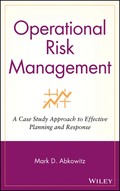
Operational Risk Management – a timeless book, sadly

For several years now Mark Abkowitz’s book “Operational Risk Management” has been sitting on my “to-read” shelf.  Given my recent wish for a case study approach to leadership and given the Fukushima nuclear issues, the book caught my attention.

Books that analyse disasters are far superior to watching real-time disasters because the distress is minimised, the analysis can be dispassionate and time can provide a more detailed context.  (The quickness of production of some of the books about the BP/Gulf of Mexico suffered from the curse of topicality)  Books provide a distance that the constant exposure to “disaster porn” does not.

Operational Risk Management looks at many at many disasters from the last 30 years but the disasters are not only industrial and process disasters, although Chernobyl and Bhopal are covered. Continue reading “Operational Risk Management – a timeless book, sadly”

Managerial OHS walk-arounds and D&O liabilities

The latest edition of The National Research Centre for Occupational Health and Safety Regulation’s newsletter lists two new working papers, one from Andrew Hopkins and one from Neil Foster.  Both should be obligatory reading.

Hopkins discusses how to increase the value of the “management walk-arounds” an increasingly common key performance indicator for senior executives.  Hopkins, naturally, uses the Deep Water Horizon case as an illustration of the flaws in the process but walk-arounds should not only be for large projects.

Hopkins shows that the VIPs had an inadequate understanding of safety.  They identified the slips, trips and falls hazards rather than asking questions about the potential major hazards of the facility.  This is a common trap for managers and safety professionals, for those with suitable OHS skills, and one that needs to be actively countered.  Continue reading “Managerial OHS walk-arounds and D&O liabilities”

Concatenate Web Development
© Designed and developed by Concatenate Aust Pty Ltd