

Occupational health and safety (OHS) is rife with ideas that refuse to die even though they are not supported by evidence. OHS management is dominated by a belief that Executive Leadership is either the answer or the first place to start change. Leadership and OHS are dangerously intertwined. Perhaps an assessment of Zombie Leadership is required. Some recent Australian research will help.
Category: research

Economics, OHS and Alchemy
In many Australian businesses, “program is king”. Deadlines must be met, whatever the circumstances. Occupational health and safety (OHS) advisers often bristle at this reality because they know that health and safety will be sacrificed to meet those deadlines. If this reality is to be changed, it is necessary to pay more attention to economics and its influence on the decision-making of business owners, and not just on the OHS effects of those decisions.
In Sociology: A Very Short Introduction Steve Bruce says:
“Most disciplines can be described by the focus of their attention or by their basic assumptions: we could say that economists study the economy or that they assume that a fundamental principle of human behaviour is the desire to “maximise utility”. If we can buy an identical product in two shops at two different prices, we will buy the cheaper one. From that simple assumption an increasingly complex web is spun.”
page 18
What makes Victoria think it is so special?
The Victorian government has released the final report of the Legislative Council Economy and Infrastructure Committee’s inquiry into the Workplace Injury Rehabilitation and Compensation Amendment (WorkCover Scheme Modernisation) Bill. Many readers will already be asleep after that sentence. Forgive me, it is accurate, but is the report of any use? It certainly progresses the debate on psychosocial regulations.

The sleeper IR issue of the Right-to-Disconnect wakes up
This week, the Australian Parliament debates further workplace relations legislative system changes. These will have occupational health and safety (OHS) impacts, usually indirectly; however, one clear OHS element in the proposed legislation is the Right-to-Disconnect.
This change has been a long time coming and has clear and proven mental health and social benefits for workers, but you won’t hear much of the OHS justification in the media. Most of the business opposition has been alarmist noise claiming the world will end. According to the Australian Financial Review (AFR) editorial on February 1 2024. Workplace Relations Minister Tony Burke:

Predatory Capitalism and OHS
A fundamental aim of occupational health and safety (OHS) is the prevention of harm. To determine the most effective ways of preventing work-related harm, OHS professionals must investigate the source of harm. This requires them to look beyond their own workplaces to socioeconomic factors. Greed is the source of almost all of the world’s economic woes.
Greed manifests in the OHS context by employers not allocating sufficient resources for people to work safely and healthily. This greed, this seeking of maximum profits and excessive wealth, is supported by legislative, financial and social institutions. A new book by Ingrid Robeyns – “Limitarianism, – The Case Against Extreme Wealth” – offers several examples of how greed creates unsafe work.
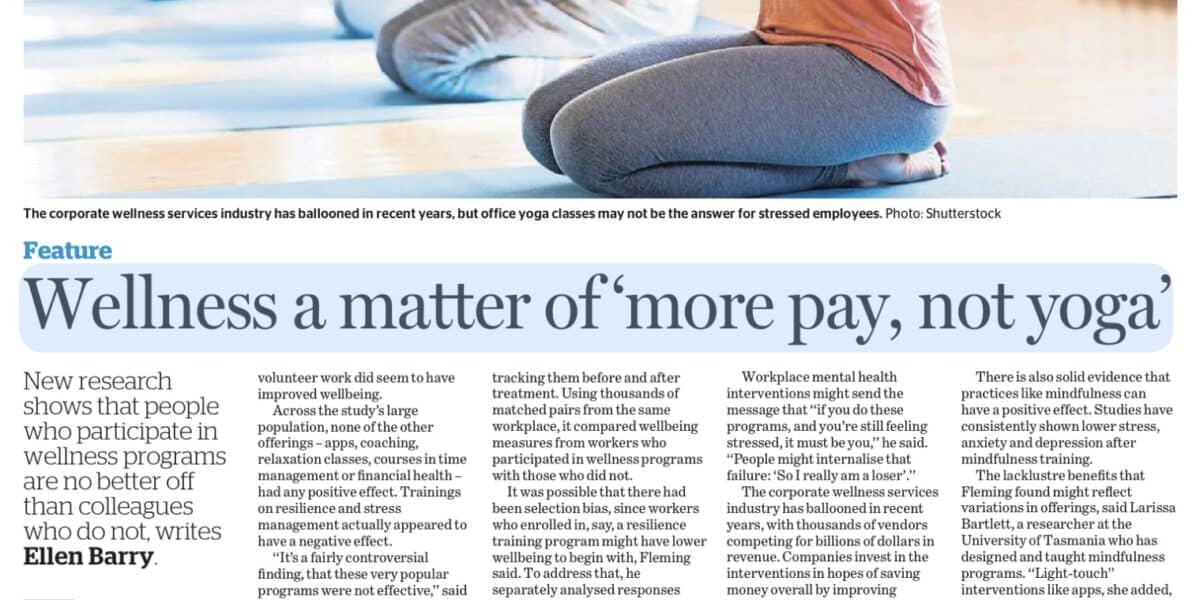
A curious omission from NY Times well-being article in The Age
Another article reporting on Dr William Fleming’s workplace wellness research appeared recently in the New York Times, reproduced in some Australian newspapers like The Age (not available online). Newspapers are entitled to edit other newspaper’s articles for many reasons. Most tweaks are legitimate, but, in this case, The Age dropped an entire paragraph, which does not reflect the balance of the full NYTimes article.

Are wellbeing programs “safe washing” their OHS performance?
First, there was brainwashing, then greenwashing and safewashing. Could the well-being industry be accused of safewashing? Has well-being had its day in the sun?
The first use of safewash to describe presenting occupational health and safety (OHS) information in a diffused truth was in the 2016 research paper by Sharron O’Neill, Jack Flanagan and Kevin Clarke, called “Safewash! Risk attenuation and the (Mis)reporting of corporate safety performance to investors” (abstract/summary available). It has turned up elsewhere since.