
 Below is the list of occupational health and safety (OHS) issues for the next three years, put to the Australian Council of Trade Unions and passed, at its Congress on 18 July 2018. Some were expected but others will cause concern, primarily, for business owners. Perhaps the major concern is that these commitments are to be rolled out nationally.
Category: research
Does using the Big Stick work?
 Governments use legislation and the threat of punishment as a deterrent for dangerous actions and poor decision-making. Imposing harsh consequences is hoped to change the behaviour of companies and individuals. Occupational health and safety (OHS) laws are no different with deterrence being used to justify the introduction and enforcement of Industrial Manslaughter laws, for instance.
The Australian Senate’s current inquiry
Independent analysis of WorkSafe activities and strategies
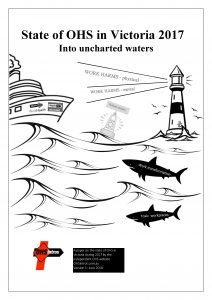 Barry Naismith of OHSIntros has released his latest independent research report into the status of occupational health and safety (OHS) in Victoria. (Given the inquiry into SafeWorkSA currently occurring in South Australia, I wish that State had an equivalent researcher, for context.) Naismith focusses on WorkSafe Victoria’s aim to address the issue of workplace wellness and asks how such an approach can be enforced?
It is a positive that an OHS regulator is looking at workplace wellness which encapsulates work-related psychological hazards.
Objections, support and deterrence
 Several of the articles in the Safety At Work special edition on Industrial Manslaughter mentioned in a previous post were from a July 2004 Building Trades Unions Conference at which Reverend Fred Nile, Katy Gallagher and John Della Bosca spoke. Below are some of the interesting quotes raised but before we reach them, in August 2004, the Federal Government, through its then Minister for Employment and Workplace Relations, Kevin Andrews, issued a media release saying:
“This is in stark contrast to the ACT’s punitive industrial manslaughter law which simply places employers and employees in an adversarial workplace setting. Industrial manslaughter laws are unnecessary and can only create uncertainty for employers and employees.”
Industrial Manslaughter and the Big Picture (2004)
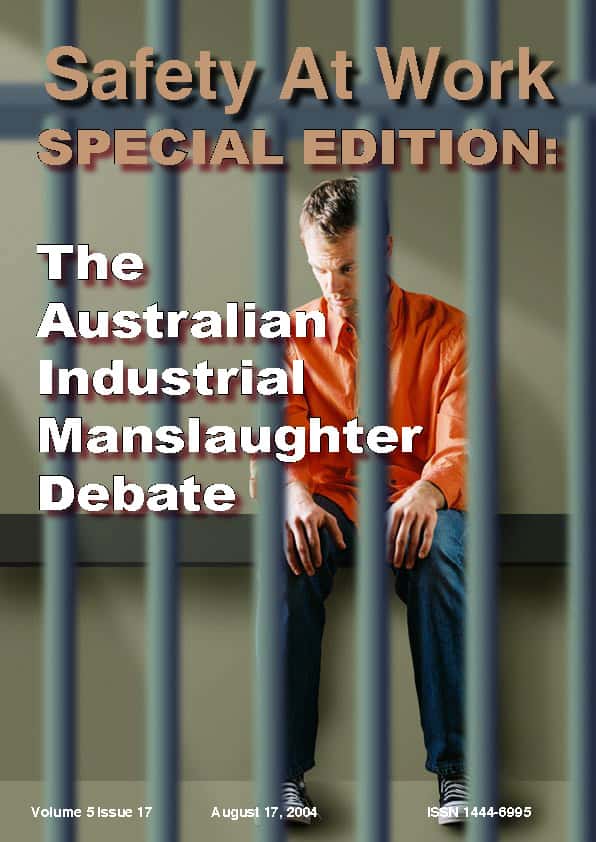 In 2004, the hottest occupational health and safety (OHS) topic was industrial manslaughter. In Melbourne, there were seminars on the topic that easily topped 200 participants. However it was also a year of confusion and fear, which may have accounted for the good seminar attendance figures.
At that time I was producing an online PDF Magazine and I devoted a whole edition to the topic. Now it is a time capsule of the issues and objections raised at the time which provide a useful context to the current debates. Here is my article on the issue from August 2004, slightly edited with links included, where possible.
WA research project on work-related mental health
Western Australia’s Parliament heard more about the State’s investigation into work-related mental health on June 26 2018.
Talking about OHS could remove the need for Industrial Manslaughter laws
Gaby Grammeno has been writing about workplace health and safety (WHS) issues for longer than I have. Her work for Workplace OHS, a subscription OHS news service, includes an “ask an expert” service and her latest is a comparison between the OHS/WHS laws involving “reckless endangerment” and “industrial manslaughter”.
The article is of interest to OHS people and reinforces some of the legal opinions on the proposed introduction of industrial manslaughter laws in Victoria. There is disparity in sentencing and financial penalties in Queensland laws compared to potential Victorian ones and one includes “serious injuries” where the other addresses deaths. But the issue of penalty sizes is a sideshow to the intended purpose of these types of laws – deterrence.
Will a penalty of A$3.8 million have a greater deterrent effect than A$3.1 million?