Prescient research on OHS, values and sustainability

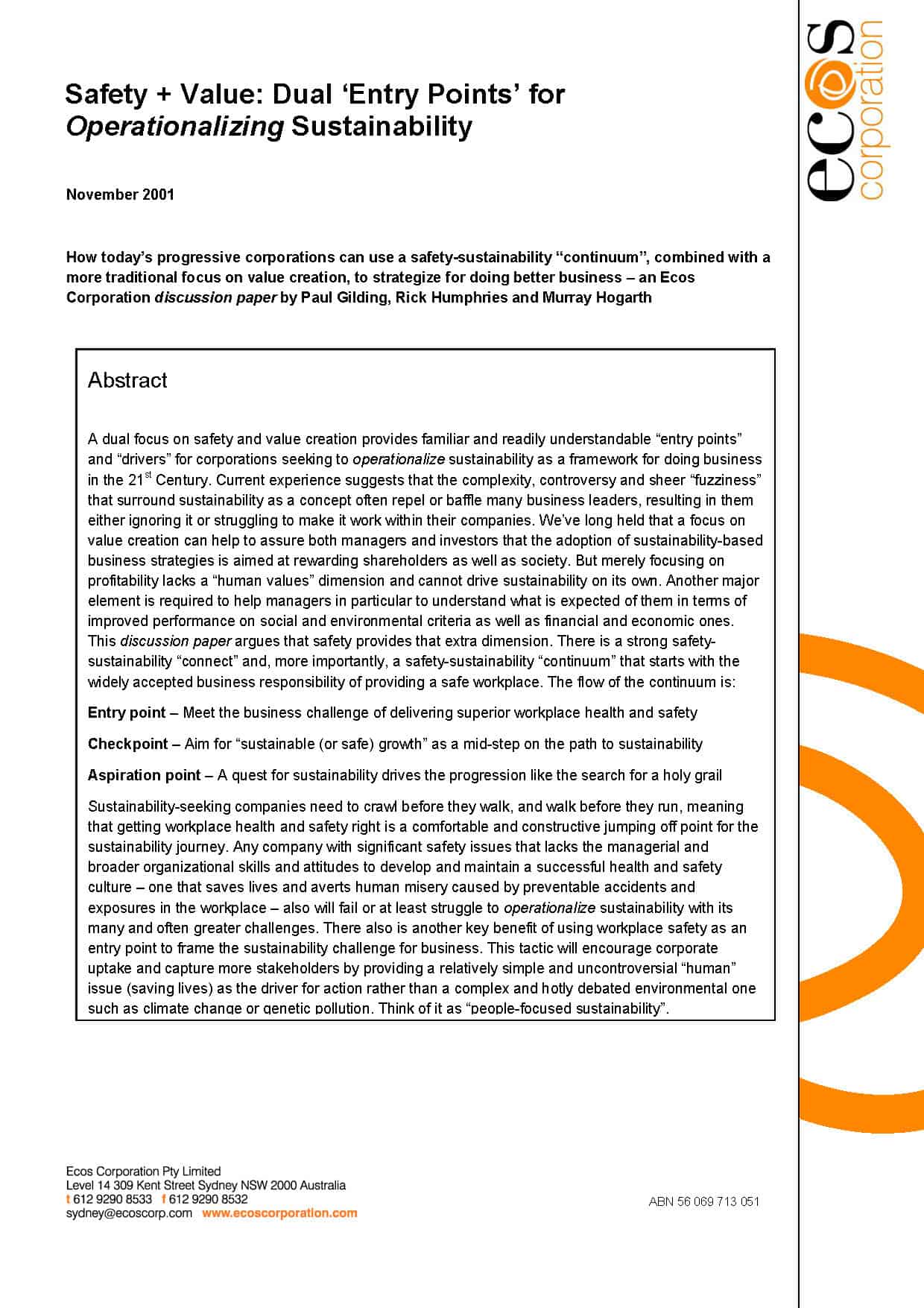
Cover of Ecos+Corporation+The+Safety+Sustainability+Connect+Paper (1)It has become fashionable to place occupational health and safety (OHS) in the organisational context of business sustainability.  But this is not a new phenomenon in Australia.  In 2001 the Ecos Corporation published a discussion paper called “Safety + Value: Entry Points for Operationalizing Sustainability.”* It states

“A dual focus on safety and value creation provides familiar and readily understandable “entry points” and “drivers” for corporations seeking to operationalize sustainability as a framework for doing business in the 21st Century.”

Subscribe to SafetyAtWorkBlog to continue reading.
Subscribe Help
Already a member? Log in here

Quiet Outrage inspires

Last year Professor Andrew Hopkins‘ contribution to occupational health and safety (OHS) was celebrated in Australia.  At the event, a publisher was promoting Hopkins’ upcoming autobiography.  The book is not an autobiography, it is better.

The book is called “Quiet Outrage – The Way of a Sociologist” and was released in March 2016.  Don’t be surprised if you have not heard of this new release.  The publisher, Wolters Kluwer, seems to have done next to nothing to promote this book even though Hopkins’ works have been a major seller for the company.  Hopkins writes that 90,000 copies of his books have been sold around the world – an extraordinary achievement for an Australian sociologist. Continue reading “Quiet Outrage inspires”

Safety footwear needs more safety research

Safety footwear is a standard item of personal protective equipment (PPE) in many workplaces but it can be contentious.

safety boots

The need for safety footwear

Some years ago I was asked to assess the need for safety footwear in a large manufacturing site.  The need was obvious, there was a lot of manual handling of cumbersome objects and the factory was old so the design and layout was based on the lifting and moving of objects rather than a flow of production.

The company wanted this need verified as one of the office staff, clearly of some influence, would enter the factory in high heels and refused to wear safety footwear.  This was a clear breach of the company’s safety policies and was causing unrest in the factory.  The safety solution was clear

Subscribe to SafetyAtWorkBlog to continue reading.
Subscribe Help
Already a member? Log in here

Trade unions temper language on ABCC safety role

The politics of industrial relations will be a crucial element of Australia’s Federal election due later this year.  The Federal Government has already used workplace safety as a reason for the reintroduction of the Australian Building and Construction Commission (ABCC).  The trade union movement’s latest response is a campaign launched on April 10, 2016 accompanied by an online video. Continue reading “Trade unions temper language on ABCC safety role”

What does the Prime Minister’s criticism of banking culture mean for OHS?

Some of Australia’s mainstream media reported on Prime Minister Malcolm Turnbull‘s admonishment of the banking sector on April 6 2016.  He accused them of having an unhealthy culture, reflecting a general and growing public dissatisfaction with large financial institutions, insurance companies and other corporations.

Given that the dominant perspective on occupational health and safety (OHS), at the moment, is the importance of an organisational culture that values workplace safety, it is worth looking at Prime Minister Turnbull’s words and those of prominent executives and financial regulators recently reported in the mainstream press.

Continue reading “What does the Prime Minister’s criticism of banking culture mean for OHS?”

A new option for avoiding OHS obligations

cover of Deferred-Prosecution-Agreements-Discussion-PaperA major motivation for occupational health and safety (OHS) improvements in many businesses is the potential damage to a company’s reputation if someone is injured or killed from the company’s operations.  Usually such an event would result in a prosecution by an OHS regulator but prosecution rates are variable and there are an increasing range of options and mechanisms, such as enforceable undertakings, available to companies in order to avoid a prosecution or financial penalty.

A new prosecution option has recently gained the attention of the Australian Government and one with which OHS professionals should become familiar as it could spread into their field of operations.

Subscribe to SafetyAtWorkBlog to continue reading.
Subscribe Help
Already a member? Log in here
Concatenate Web Development
© Designed and developed by Concatenate Aust Pty Ltd