
Can Broken Windows Theory help OHS?

There are very few innovations that originate from within the occupational health and safety (OHS) profession.  Most of the change seems to come from the application of external concepts to workplace activities and approaches.  Recently a colleague was discussing how some of the current OHS initiatives mirror the “broken windows” concept which originated in criminology in the United States.  In some ways Broken Windows Theory mirrors OHS positives but it may also reflect some of the negatives or OHS dead-ends.

Ostensibly Broken Windows Theory discusses how attention to small improvements may generate cultural change.  However the improvements introduced seem to have different levels of success depending on the context in which they are applied.  For instance in OHS, a construction site may mandate that protective gloves are worn for all manual activity but if there is a variable level of manual handling risk, the wearing of gloves will be an accepted practice in one area but haphazard in another.  The intention of a mandated safety requirement is to change the risk and safety culture of a workplace but the different levels of risk mean that the requirement can be seen as “common sense” in one area but unnecessary “red tape” in another.

The criminological application of the theory reached its peak in New York City in the 1980s and 1990s.
Subscribe to SafetyAtWorkBlog to continue reading.
Subscribe Help
Already a member? Log in here

Royal Commission and risk registers

Most of the Australian media is waiting for the former politicians to appear at the Royal Commission into the Home Insulation Program later this month but the Commission has not been quiet in its many public hearings recently.  One of the hearings heard evidence that is particularly significant and relates to risk registers.

According to 

Subscribe to SafetyAtWorkBlog to continue reading.
Subscribe Help
Already a member? Log in here

Well-being programs have their place

Many Australian newspapers include articles about workplace health in their job ad or professionals sections.  On May 3 2014 the Weekend Australia included an article called “Working harder for health“.  The article touches on most of the usual elements of such articles

  • individual responsibility;
  • increased productivity;
  • medical screenings; and
  • vaccinations and fruit bowls.

But (finally) the interviewee acknowledges the importance of looking beyond corporate well-being programs to  larger organisational issues.

Subscribe to SafetyAtWorkBlog to continue reading.
Subscribe Help
Already a member? Log in here

“It’s easier but it isn’t easy” – OHS leadership tips from IOSH

The Institute of Occupational Safety and Health (IOSH) recently uploaded a swag of videos to YouTube, ostensibly, to promote its upcoming conference.  One video asks if it is harder or easier to inspire leadership on OHS matters.  Most speakers believe it is easier because:

  • there is a stronger social expectation of higher safety standards,
  • managing people is more inclusive,
  • technology allows more effective communication,
  • leaders are coaches,
  • people have a greater awareness of how to be safe.

Some believe it is harder because:

  • it is more difficult to have faith in corporate leaders,
  • companies have a more complex structure of accountability and responsibility,
  • there is greater cynicism of corporate leaders due to the GFC in 2007.

One speaker at IOSH’s upcoming conference says “It’s easier but it isn’t easy” acknowledging past improvements and future challenges.

The IOSH videos are promoting the conference but there is food for thought in all of them.  Conferences in Australia have tried similar teaser ads (some including the author) for conferences but not to the extent that IOSH has through YouTube.  As safety conferences seem to be fading in both length and influence in Australia, such videos will become rarer but, as with rarity, the content may become more valuable.

Kevin Jones

Analysis needed on new workplace bullying data

In December 2013 I wrote:

“The Age is correct in saying that claims of workplace bullying are “set to soar”. This has been predicted for some time, even privately by members of the Fair Work Commission, but the number of claims does not always indicate the level of a problem.” (link added)

Recently the Fair Work Commission (FWC) released its

Subscribe to SafetyAtWorkBlog to continue reading.
Subscribe Help
Already a member? Log in here

Red tape (again) and Obama’s support – Melbourne’s Workers’ Memorial Day 2014

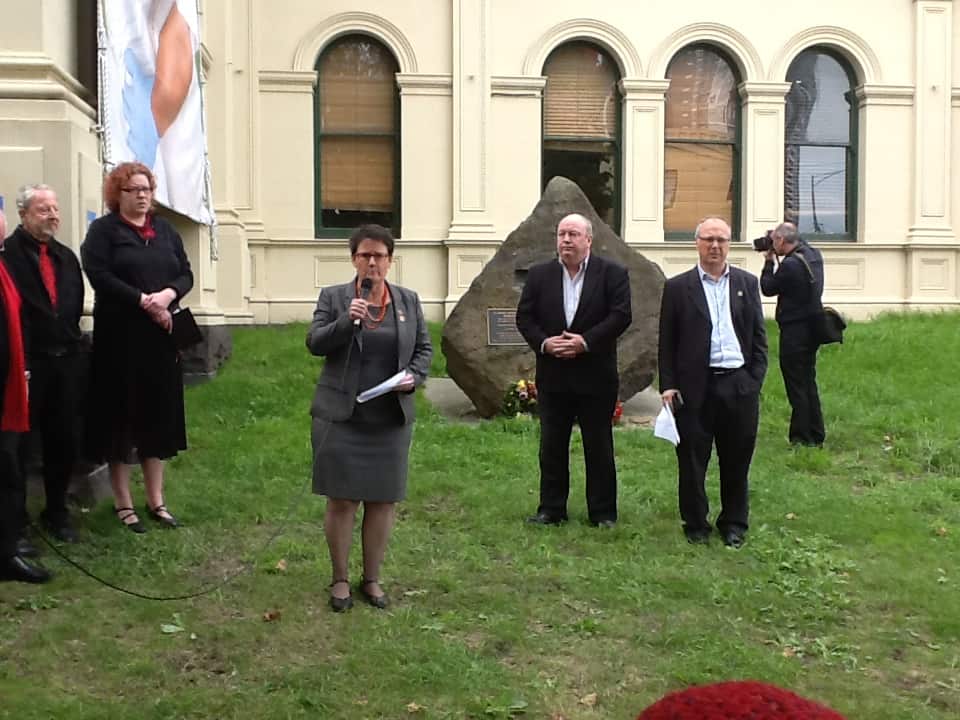
IWMD 2014 01A short time ago the International Workers Memorial Day commemoration in Melbourne, Victoria, concluded. The ceremony was less sombre than in previous years with, it seemed, fewer families and relatives of deceased workers.  Certainly there was no speech from a family member, nothing from workplace safety advocates other than the three trade union speakers, Meredith PeaceBrian Boyd and Michael Borowick (all pictured right), however there were tears for some in the crowd and wreaths were laid prior to a minute silence.

The politics was reduced this year as there were no noisy protests from the back of a tray truck and no march on Parliament afterward, however politics is never far from the surface of this type of event. Michael Borowick, Assistant Secretary of the Australian Council of Trade Unions  was the more effective of today’s three speakers.  Continue reading “Red tape (again) and Obama’s support – Melbourne’s Workers’ Memorial Day 2014”

Self-employment should not be seen as a work/life solution

Work/life balance is a close cousin to occupational health and safety (OHS), particularly health.  It is often the gateway people use to reduce occupational health risks such as stress and other psychosocial issues.  Moving to self-employment can be a successful strategy but it is not as easy as simply relocating one’s individual workplace or teleworking, the expected control on work hours may not eventuate and it may be very difficult to maintain a livable wage.  In The Saturday Age on April 26 2014 (not locatable on-line), Dr Natalie Skinner of the Australian Centre for Work + Life, provided a useful perspective.

Skinner writes that her annual surveys over the last six years have indicated that:

“self-employment is neither better nor worse for work-life conflict than being an employee.”

Skinner acknowledges that this seems odd because there has been so much debate about the win-win of workplace flexibility.

Subscribe to SafetyAtWorkBlog to continue reading.
Subscribe Help
Already a member? Log in here
Concatenate Web Development
© Designed and developed by Concatenate Aust Pty Ltd