Is capitalism anti-safety? Systemic failures in oil industry

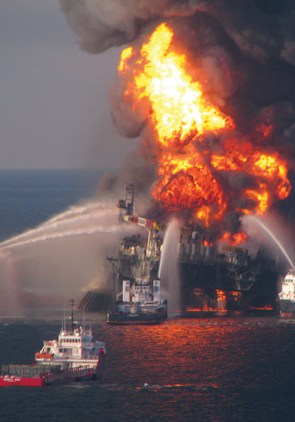
The Wall Street Journal and other media around the world have reported on systemic failures of the global oil industry and government regulators identified by the National Commission on the BP Deepwater Horizon Oil Spill and Offshore Drilling.  These articles are based on the release of a single chapter, Chapter 4, of the final report due for release on 11 January 2011.

A media release from the Commission includes the following findings from Chapter 4

“The well blew out because a number of separate risk factors, oversights, and outright mistakes combined to overwhelm the safeguards meant to prevent just such an event from happening.  But most of the mistakes and oversights at Macondo can be traced back to a single overarching failure—a failure of management.  Better management by BP, Halliburton, and Transocean would almost certainly have prevented the blowout by improving the ability of individuals involved to identify the risks they faced, and to properly evaluate, communicate, and address them.”

“. . .the Macondo blowout was the product of several individual missteps and oversights by BP, Halliburton, and Transocean, which government regulators lacked the authority, the necessary resources, and the technical expertise to prevent.”

“The blowout was not the product of a series of aberrational decisions made by rogue industry or government officials that could not have been anticipated or expected to occur again. Rather, the root causes are systemic and, absent significant reform in both industry practices and government policies, might well recur.”

“What we. . .know is considerable and significant:

  1. each of the mistakes made on the rig and onshore by industry and government increased the risk of a well blowout;
  2. the cumulative risk that resulted from these decisions and actions was both unreasonably large and avoidable; and
  3. the risk of a catastrophic blowout was ultimately realized on April 20 and several of the mistakes were contributing causes of the blowout.”
The significance of these quotes is that the Commission is critical of an industry and not just a single company.   Continue reading “Is capitalism anti-safety? Systemic failures in oil industry”

The evidence on first aid treatment of burns

The treatment of burns in a workplace setting has always been a contentious matter between first aid trainers and equipment suppliers.  First aid says that initial treatment of burns should be the application of cold running water but equipment suppliers often include burn treatment creams.  What’s the evidence for burn creams?

In December 2010, the Cochrane Library produced a collection of reviews concerning the treatment of burns.  Some of the information in the collection  should be of great use and interest to workplace first aiders.

One report states:

“In the early management of minor burn injury,do silver based products improve burn infection control and healing?

There is not enough evidence to decide whether silver based products improve healing, infection control, pain or other outcomes in people with minor burns.” Continue reading “The evidence on first aid treatment of burns”

New public sector bullying guideline

In late-December 2010, the State Services Authority issued a new OHS/HR publication entitled “Tackling Bullying“.  The guide is aimed squarely at the public sector but should be of interest for any organisation that has a large number of office-based staff.

This guide is a good example of how the OHS guidelines can be tailored to specific industries and circumstances.  The “further resources” section also includes a considerable number of hyperlinks to current bullying documents.

Public servants often have a very different approach to psycho-social issues of bullying and stress because the public service is a unique work environment where considerable resources have been traditionally devoted to staff welfare.  In some ways, this uniqueness can provide a level of sensitivity to OHS issues that is not reflected in other industry sectors.   Continue reading “New public sector bullying guideline”

Rainbow windmill deaths continue to affect the local community

In March 2010, SafetyAtWorkBlog reported on the deaths of two farmers in the rural town of Rainbow in Victoria.  They died when a windmill they were transporting on a property made contact with overhead power lines.  The deaths continue to be a difficult topic of discussion throughout the Wimmera-Mallee, as I found out over the Christmas holiday season.

The coronial inquest into the deaths of John and Michael Helyar began in Horsham in November 2010 and will continue in April 2011.  Some of the inquest reports in the local newspaper make for harrowing reading but also provide an important insight into the decision-making process that occurs at the site of a workplace fatality and one that involves close friends.

The two articles are

Coronial inquest into tragedy at Rainbow, and

Inquest hears of agonising drama at Rainbow

Kevin Jones

Quad bike safety issues continue with no end in sight

SafetyAtWorkBlog has been following the discussions about safety of all-terrain vehicles and quad bikes for some time.  This is because the use of these vehicles encapsulate so many of the issues that workplace safety needs to deal with:

  • Safe design
  • Personal protective equipment
  • Hierarchy of controls
  • The line between private activity and work activity
  • Personal responsibility
  • The “nanny state”
  • Regulatory safety guidance
  • Industry-based codes of practice

On 19 December 2010, the New Zealand Sunday Star Times ran a feature article on quad bikes, written by Amanda Cropp (I can’t find the article online but please send a link if you can) entitled “Risky Business”.  The article is a fair summation of many of the perspectives and attitudes to quad bike safety.

For those readers who like statistics, Cropp writes that

“The annual ACC [Accident Compensation Corporation] bill for quad bike-related injuries is around $7 million, and Hobbs’ claim was among 2533 in 2009, a sizeable increase on the 457 new claims accepted in 2000.” [link added] Continue reading “Quad bike safety issues continue with no end in sight”

Undercover Boss is an example of executive alienation

Undercover Boss” has become a popular television program in many countries over the last few years.  The format is fresh and the results revealing.  The eyes of each boss are opened to the deficiencies of a business and to the value of the workforce.  Each episode ends with the reward of acknowledgement to the workers and new wisdom to the boss.

But the show is also an indictment of the attitudes of, and the management training provided, to senior executives.  Why were the employees not being valued by the executives already?  How did the executives lose touch?

If business management, corporate structures, and management training was rooted in the reality of work rather than profit, a series like Undercover Boss would never have been possible.

The concept of an executive maintaining a perspective of frontline customer contact is not new.   Continue reading “Undercover Boss is an example of executive alienation”

How much significant information do workplace fatalities provide?

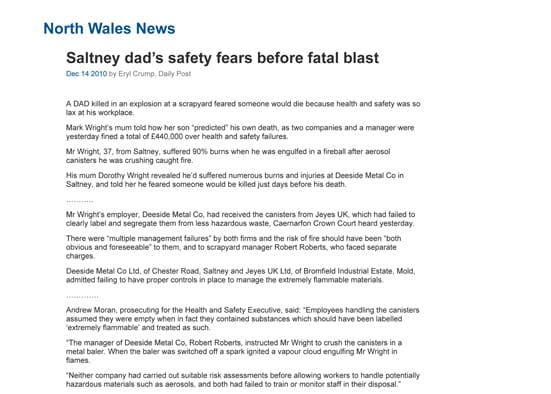
Workplace fatalities are terrible, lingering tragedies that generally don’t teach anything new about OHS failures.  I couldn’t find anything new in the frightening detail in the article below (dated 14th December 2010) or in scores of Google searches of industrial/occupational fatalities; though disease fatality epidemiology can be  informative.

If all workplace fatalities in Australia were stopped overnight, most workers wouldn’t notice a single improvement in their own workplace.  They’d still be working in the same cluster of hazards, useless risk assessments and a regular sprinkling of near misses and daily shortcuts.  Despite regulators’ and politicians’ shrieks of dismay at workplace deaths, such fatalities don’t represent the main OHS problem at work.

If any regulator was informed in advance – in some detail – that in a particular industry there would be three fatalities in the next three months (or even intolerable risk) they wouldn’t know how to prevent them.  Example?  Think of the insulation program, which still has some way to go and a few more surprises in store.  Example?  Over the next six months there are likely to be 3-6 quad bike-related fatalities in Australia, mostly as a result of rollovers.

Or think of the value of risk assessments:  example?  Consider the 60,000-80,000 barrels (10,000 tons) of the most dangerous hexachlorobenzene (HCB) waste stockpiled and being repackaged (ultimately, drum to drum) by workers in a primitive work process at Botany Bay Industrial Park, Sydney.  One of the world’s largest stockpiles of such dangerous wastes that no one around the world is prepared to handle.   This is the only place I’ve ever had to wear two layers of protection to inspect. What has the regulator done? Continue reading “How much significant information do workplace fatalities provide?”

Concatenate Web Development
© Designed and developed by Concatenate Aust Pty Ltd