EY report shows a business model that generates serious job stress

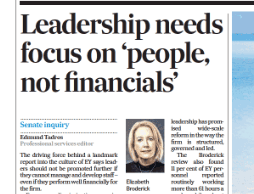
In 2022 a young employee of EY died by suicide after a work function. EY announced an independent review of EY Oceania’s workplace culture and that the report would be publicly available. That report was released on 27 July 2023. EY’s response was good crisis management, but the public release is beyond what many companies would do, so EY’s transparency in this case should be acknowledged.

The report written by Elizabeth Broderick‘s company offers good news for EY. There is a high level of satisfaction, but results in the 80 percentages or some 90 percentages still allow for a significant number of personnel who are dissatisfied, harassed, bullied, and/or mentally stressed. It is not unreasonable to accept the EY report as being indicative of the workplace cultures of hundreds or thousands of similar businesses.

This report needs to be read widely and thoroughly by any Human Resources (HR), Executive and occupational health and safety (OHS) professional. The following article scratches the surface of this significant investigation.

Subscribe to SafetyAtWorkBlog to continue reading.
Subscribe Help
Already a member? Log in here

Do you fix the fish or the aquarium?

Guest post from Jason van Schie

We can all (hopefully!) agree that looking after workers makes sound business sense. Look after your workers, and they will look after you.

So what is the best way to care for employees? By responding to their symptoms of distress through provision of reactive services like EAP [Employee Assistance Program] and resilience apps (fixing the fish), or by improving the design, management and social interactions at work (the aquarium)?

Let’s park that question for a minute and consider two questions:
1) What happens when we fix the worker but not the work? and
2) If population health is the goal, which approach is more likely to achieve the desired result?

Continue reading “Do you fix the fish or the aquarium?”

Reflect on failures before jumping into change

Gabrielle Carlton, Director & Principal Consultant at Resylience, recently published an interesting article about her experience with a former Australian soldier who was struggling with work-related mental ill-health. The mental health of defence personnel is a hugely important and complex situation that questions the core function of defence and our expectations of defence personnel. However, some of her comments on psychosocial health in the article’s conclusion caught most of my attention.

Subscribe to SafetyAtWorkBlog to continue reading.
Subscribe Help
Already a member? Log in here

Business Leaders Breakfast seminar

The WorkSafe Victoria Business Leaders Breakfast earlier this week offered a chance for interested parties to hear from WorkSafe and its guest Rod Maule, the General Manager of Safety and Wellbeing at Australia Post. WorkSafe’s Colin Radford offered a “stump speech” that, although familiar, was important. Maule was a colourful speaker who, on reflection, wasn’t as informative as he seemed at the time.

Subscribe to SafetyAtWorkBlog to continue reading.
Subscribe Help
Already a member? Log in here

Learning of ourselves from others

Adam Goodes will be a featured speaker at the 23rd World Congress of Health and Safety At Work in Sydney, Australia, in November 2023. My initial response was, “What does he know about workplace health and safety?” This question is perhaps more indicative of my limited perspective of occupational health and safety (OHS). I have discussed my question with several people over the last week and have a partial answer to my question, but, as is often the case in OHS, more questions arose.

Subscribe to SafetyAtWorkBlog to continue reading.
Subscribe Help
Already a member? Log in here

Psychosocial risks may need a new type of activism

Excessive working hours are a known occupational health and safety (OHS) hazard, both physically and psychologically. But when the excessive, excessive? When do these excessive hours start to create harm?

A recent article by the Centre for Work Health and Safety clarifies, confuses and may startle.

Subscribe to SafetyAtWorkBlog to continue reading.
Subscribe Help
Already a member? Log in here

From mindful back to careful

It seems that being “mindful” is now more commonly advocated than being careful. “Mindful” has become the equivalent of “careful”, but these words have different meanings and are not interchangeable. Occupational health and safety (OHS) laws impose a Duty of Care, not a Duty of Mind.

Much of the social media discussion on Mindful vs Careful seems to originate from parental sites or well-being advocates. One example can be found here in a discussion of a child’s reaction to each of these words.

Continue reading “From mindful back to careful”
Concatenate Web Development
© Designed and developed by Concatenate Aust Pty Ltd