An OHS-based investigation of suicides should identify new control options

Melbourne, Australia – December 28, 2016: Melbourne Metro Train at Ringwood Station

Why is rail-related suicide an occupational health and safety (OHS) issue?

I looked into the issue of rail-related suicide when writing an OHS chapter for the Metro Trains Melbourne’s (MTM) bid for a franchise renewal for running trains on the metropolitan network. Each rail-related suicide, MTM describes these as trespasser suicides, creates major work-related psychological trauma for the train drivers as well as grief for the families of the deceased.  These incidents have secondary impacts on the rail workers who need to clean the trains which are taken out of service after each incident and driven to the nearest biowash, as well as those MTM staff, and emergency service workers, who were required to attend the scene.

There is also massive harm, pain and cost to those whose suicide attempts fail to result in death, and those who will care for those who are now disabled.

Addressing the hazard of rail-related suicides needs a new and broader discussion; one which must involve a broad, enlightened occupational health and safety approach.

Subscribe to SafetyAtWorkBlog to continue reading.
Subscribe Help
Already a member? Log in here

Front page OHS article gives half the story

Years ago I was advised how to read a newspaper article – the first two paragraphs and the last.  The exclusive front page article in The Australian ($ paywalled) on August 15 2018 about occupational health and safety (OHS) management at Sydney’s light rail construction project is a good example of what journalists choose to write and what they are obliged to write.

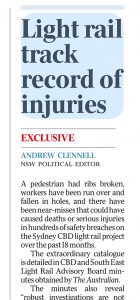
“A pedestrian had ribs broken, workers have been run over and fallen in holes, and there have been near-misses that could have caused deaths or serious injuries in hundreds of safety breaches on the Sydney CBD light rail project over the past 18 months.

The extraordinary catalogue is detailed in CBD and South East Light Rail Advisory Board minutes obtained by The Australian.”

and

Subscribe to SafetyAtWorkBlog to continue reading.
Subscribe Help
Already a member? Log in here

OHS outcomes of ACTU Congress 2018

Below is the list of occupational health and safety (OHS) issues for the next three years, put to the Australian Council of Trade Unions and passed, at its Congress on 18 July 2018.  Some were expected but others will cause concern, primarily, for business owners.  Perhaps the major concern is that these commitments are to be rolled out nationally.

Subscribe to SafetyAtWorkBlog to continue reading.
Subscribe Help
Already a member? Log in here

Trade unions need to look for change beyond legislation

Danny Glover addressing the ACTU Congress on July 16 2018

The 2018 Congress of the Australian Council of Trade Unions (ACT) is happening in the middle of a campaign to “Change the Rules”.  These “Rules” are largely concerning with industrial relations, of which Occupational Health and Safety (OHS) is a subset, or complementary, element. Legislation constantly needs challenging and review; much legislation, like Australian Standards, misses their expiry dates and persists too long,  becoming increasingly seen as irrelevant.

OHS has the “luxury” of having been reviewed nationally within the last decade.  For some Australian States this change was progressive but for most it was a catch up to contemporary standards and expectations.  OHS laws have not progressed since and a lot of hope is placed on the current Independent Review of Work Health and Safety (WHS) laws to enliven the discussions, yet that report is not due until 2019.

Trade unions have a great deal of faith in legislation to achieve change.  

Subscribe to SafetyAtWorkBlog to continue reading.
Subscribe Help
Already a member? Log in here

Duty of Care to the safety and health of “others”.

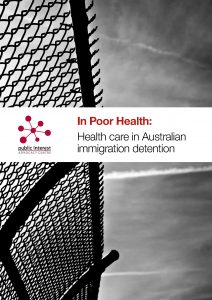
The Public Interest Advocacy Centre (PIAC) has released a very good report about Australia’s immigration detention centres which includes a long discussion on duty of care to detainees under Common Law. The report, “In Poor Health: Health care in Australian immigration detention” does not include any discussion on the duty of care under work health and safety (WHS) legislation however it can be argued that the Australian Government, through its supply chain, chain of responsibility and contract management, also has a duty of care to detainees under health and safety laws.

Several recent legal actions and workplace safety guidance indicates that clarification about the duty of care on physical and psychological risks to “others” is overdue.

Subscribe to SafetyAtWorkBlog to continue reading.
Subscribe Help
Already a member? Log in here

ACCC slaps down the FCAI on quad bike safety

On June 5 2018, Sharon O’Keeffe of the North Queensland Register newspaper aired the response of the Deputy Commissioner of the Australian Competition and Consumer Commission (ACCC) Mick Keogh to claims from the Federated Chamber of Automotive Industries (FCAI) on the safety of quad bikes and crush protection devices (CPDs). O’Keeffe says “the gloves are off”.

In March 2018, the ACCC announced its intention for a mandatory safety standard for quad bikes, or All Terrain Vehicles (ATV,) that included CPDs. 

Subscribe to SafetyAtWorkBlog to continue reading.
Subscribe Help
Already a member? Log in here

Why are we arguing about Industrial Manslaughter laws?

From left: Dave Brownlee, Janine Brownlee & Lana Cormie

On the issue of Industrial Manslaughter laws, Lana Cormie (pictured far right) said:

“Employers need to have motivation to do the right thing, ’cause clearly they don’t do it off their own back.  So, if that means, if this’ll be the difference between them making OH&S a high priority and not, then it needs to be done.  And I think all the other benefits for the men on the ground, and the women on the ground, will filter down from that.  “

Her comments on International Workers Memorial Day emphasises that the introduction of these laws is not so much about new laws but the failure of the existing ones and of their application.  Over time, the general commitment to implementing occupational health and safety (OHS) has declined in many workplaces or, at least, has not progressed in the way expected by the safety law makers of the 1970s and 1980s.

Government has relied on the increase of financial penalties as the major deterrent Continue reading “Why are we arguing about Industrial Manslaughter laws?”

Concatenate Web Development
© Designed and developed by Concatenate Aust Pty Ltd