Australian IR Minister mentions international OHS conventions action

Chris Evans, the Australian Minister for Workplace Relations issued a media statement on 28 April 2011 concerning the World Day for Safety and Health at Work.  As well as some generalities about OHS harmonisation and government commitment, he said

“The Australian Government is also in the process of ratifying the ILO Asbestos Convention 1986 (convention 162) and the ILO Protocol of 2002 to the Occupational Health and Safety Convention 1981 (Protocol 155).

These ILO instruments will give Australians a world class OHS regime, by entrenching best practice in protecting our community from the harmful effects of asbestos and enhancing data collection and publication to support policy making and research.

“Australia has long been a member and supporter of the ILO in its efforts to promote safe work environments and raise the quality of labour and social standards throughout the world,” said Senator Evans.” [links added]

This seems a positive move but it is significant that no deadline for ratification is identified by Minister Evans.  There are also a couple of obvious limitations or problems with these conventions and protocols. Continue reading “Australian IR Minister mentions international OHS conventions action”
Industry action confuses quad bike sellers

Last week, Honda quad bike dealers were supplied with the safety code provided by the Federated Chamber of Automotive Industries. This code outlines research that shows some roll over protection (ROPS) devices may increase the risk of injury.  A major ROPS identified in recent reports is the QuadBar, a device that may be “set to become an industry standard” for quad bike safety according to one media report.

Last week, SafetyAtWorkBlog heard that some Honda quad bike dealers, who also stock the QuadBar, feared that the distribution of the FCAI Industry paper was an indication that the continued stocking of the QuadBar may threaten the retention of their Honda dealership. Continue reading “Industry action confuses quad bike sellers”

Operational Risk Management – a timeless book, sadly

For several years now Mark Abkowitz’s book “Operational Risk Management” has been sitting on my “to-read” shelf.  Given my recent wish for a case study approach to leadership and given the Fukushima nuclear issues, the book caught my attention.

Books that analyse disasters are far superior to watching real-time disasters because the distress is minimised, the analysis can be dispassionate and time can provide a more detailed context.  (The quickness of production of some of the books about the BP/Gulf of Mexico suffered from the curse of topicality)  Books provide a distance that the constant exposure to “disaster porn” does not.

Operational Risk Management looks at many at many disasters from the last 30 years but the disasters are not only industrial and process disasters, although Chernobyl and Bhopal are covered. Continue reading “Operational Risk Management – a timeless book, sadly”

People enter the quad bike ROPS debate

A week on from Australia’s The Weekly Times using its front page to open a debate about roll over protection structures (ROPS), the debate has continued in the letters and op-ed pages of The Weekly Times.

Dr Yossi Berger of the Australian Workers Union asks the valid question in his opinion piece – should all the responsibility for quad bike incidents be placed on riders or can manufacturers do better?  If injuries and deaths on quad bikes continue to occur after rider-focused control measures have been advocated and encouraged for many years, isn’t it time to look at more than PPE and administrative controls?  As Albert Einstein is alleged to have said:

“The definition of insanity is doing the same thing over and over and expecting different results.”

Rhys Griffiths of the Federal Chamber of Automotive Industries says in his piece that the quad bike manufacturers are frustrated that low-cost, in safety-speak, administrative controls are not being applied by riders or endorsed by safety regulators.  The control measures recommended are likely to have positive safety impacts but these could be improved further by the integration of a ROPS.  However Griffiths says that :

“Roll Over Protection Systems are not the answer”.

I agree but safety is rarely about “the” answer.  Better outcomes are mostly achieved by a combination of controls that can accommodate the varying work characteristics. Continue reading “People enter the quad bike ROPS debate”

New quad bike research and practical safety guidance

A major Australian rural newspaper, The Weekly Times, has devoted its front page to an article on rollover protective devices on quad bikes.   It has taken as the base new information released by the Australian Centre for Agricultural Health and Safety (ACAHS) through a media release. The new policy paper and the supporting Practical Management Guide acknowledge new research from independent engineers that has finally questioned the established knowledge base on the safety of quad bikes.

ACAHS has come to a position where it states:

“Farmers and other owners of quad bikes should be encouraged to fit suitably tested protective devices to reduce death and serious injury from rollovers.” Continue reading “New quad bike research and practical safety guidance”

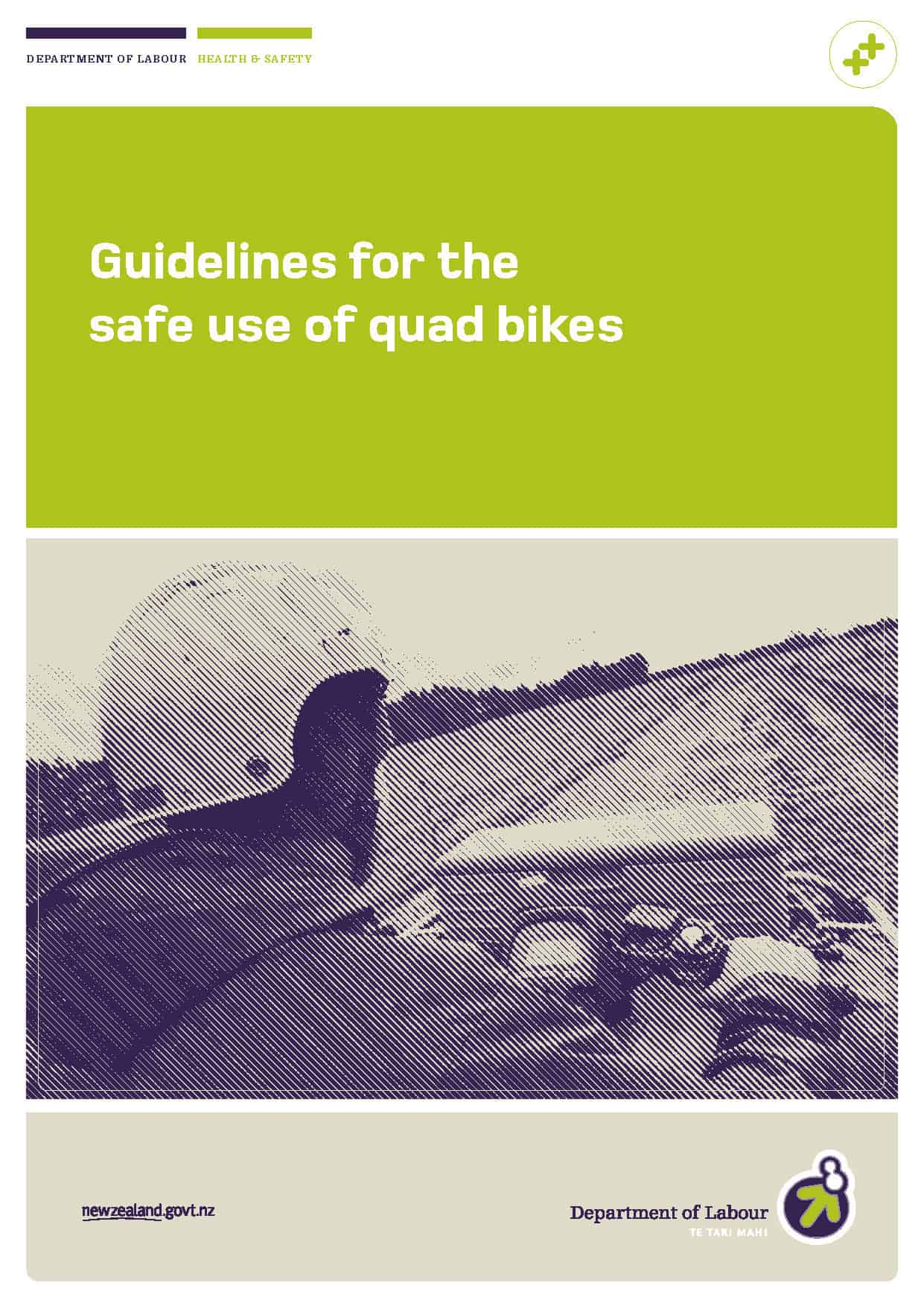
NZ releases new guidelines on quad bike safety

Any new OHS guidelines from regulators important to read and consider when implementing safety interventions.   New Zealand’s Department of Labour (DoL) has released new guidelines for the use of quad bikes in workplaces, predominantly, farms.

Quad bike manufacturers are strong advocates of “active riding” techniques as an important safety practice. The new guidelines support this position.

Regular readers will be aware that there are engineering controls for rollovers of quad bikes where “active riding” is an administrative control of rollovers. The engineering control is primarily a rollover protective structure (ROPS). The difference between the two control measures is significant as the engineering controls are considered to be a higher order, or more effective, control in the hierarchy of controls advocated by OHS regulators and professionals around the world.

The NZ DoL guidelines make reference to ROPS but only as a text box because the evidence on ROPS remains contentious. Continue reading “NZ releases new guidelines on quad bike safety”

Quad bike fatality costs over $80k in penalties

A Western Australian company has been fined $A50,000 over the death of one of its workers in November 2008  The worker rode a quad bike into a wire gate and died.  The recent WorkSafe WA media release focuses, understandably on the fine imposed in the Perth Magistrates’ Court on Jenara P/L but a clearer picture of the incident is available from an earlier WorkSafe report into the incident.  The accused, in this instance, was Seatown Holdings, a labour hire firm who was fined $A30,000 :

“The accused was a labour hire company which employed a worker for remuneration and arranged for said worker to work for Jenara Pty Ltd who was one of its clients.

The client ran a grain growing farm near Miling.

During the afternoon on Sunday 16 November 2008 the worker was working alone and riding an All Terrain Vehicle (ATV) on a road on the client’s farm when he rode into a wire gate known as a ‘cockies gate’. Continue reading “Quad bike fatality costs over $80k in penalties”

Concatenate Web Development
© Designed and developed by Concatenate Aust Pty Ltd