Quirky safety cards

Conferences usually provide delegates with goodie bags of promotional material from sponsors and speakers. Most of it is dross but the bags often include quirky items such as drink bottles, stress balls, baseball hats, sunscreen, which can also be silly, but occasionally there are some that are useful and notable.

SafeWorkNSW produced a deck of playing cards where safety statements or aphorisms replaced the pictures of two-headed royalty and card symbols. This is the type of item that may be left in a glovebox of a car for times of imposed idleness, but I have only seen playing cards used once on a worksite (exempting the playing of Uno by tax office employees in the early 1980s at the morning break after the tea ladies brought chocolate and cream buns). A construction site I was working at was “rained off” one day and the cards came out.

The use of such safety playing cards is intended to be a useful subliminal way of reminding workers of the importance of safety. Given that the longevity and success fo safety posters is very limited, the card strategy may be worth considering by other organisations.

If you have an example of a useful OHS promotional item, please send through an image and/or a description via this email link.

Kevin Jones

Some OHS webinars are much better than others

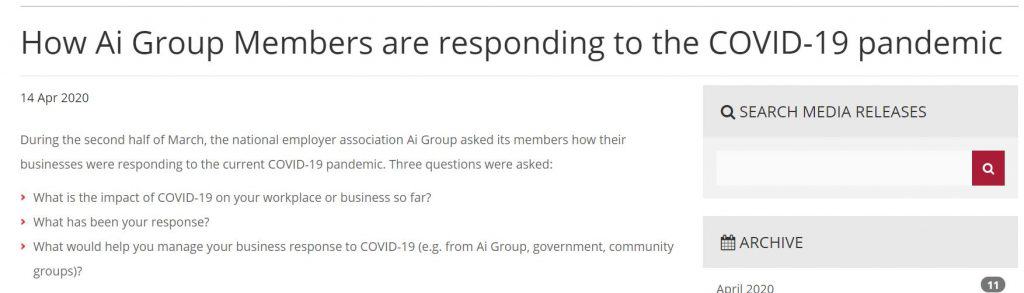
The Ballarat Regional Occupational Safety and Health (BROSH) group conducted an online seminar on March 31, 2002 at which Tracey Browne of the Australian Industry Group (AIGroup) spoke. The content was very good, and the format worked even though many people are still trying to acclimatise to online meetings and the muting of microphones.

Browne provided a general update on managing occupational health and safety (OHS) during the COVID19 pandemic disruption but there were a couple of notable contributions.

Subscribe to SafetyAtWorkBlog to continue reading.
Subscribe Help
Already a member? Log in here

Safe Work Australia’s COVID19 guidance

In mid-March, pandemic advice from occupational health and safety (OHS) regulators was assessed with the generic guidance from WorkSafe Victoria being praised. Many changes to workplaces have occurred since then and Safe Work Australia (SWA) has caught up with the demand for industry-specific guidance on managing work in this pandemic. SWA’s advice is very good and is discussed below.

Subscribe to SafetyAtWorkBlog to continue reading.
Subscribe Help
Already a member? Log in here

Safety opportunity from calamity

Australia is starting to settle into a state of stability as the various restrictions on life and work become more consistent. This has also allowed for some to start thinking about the recovery phase – the “bridge”, the awakening, whatever one wants to call it – to reconsider what we think of work and workplaces and our expectations are for the future. Do we resurrect the BC (Before COVID19) employment and economic models or work differently? There is an opportunity to steer work and business into a more sustainable direction that reduces physical and psychosocial harm and regains productivity and profitability. The structures, models and criteria already exist.

And, perhaps, we should incorporate the values recommended by actor, Matthew McConaughey.

Subscribe to SafetyAtWorkBlog to continue reading.
Subscribe Help
Already a member? Log in here

The challenge of preventing harm beyond just “primary prevention”

Fay Calderone’s article in HRDaily on workplace sexual harassment and her responses to some questions from SafetyAtWorkBlog illustrate several points of difference between the usual Legal/HR approach to the management and prevention of workplace risks and the application of the occupational health and safety (OHS) approach. These points of difference are discussed below.

Leadership discussion, policies and training

The prevention of harm is a core principle of occupational health and safety. OHS professionals strive to eliminate hazards at the earliest opportunity and apply the precautionary principle as often as possible. Prevention is aimed at detecting early indications or precursors of hazards, such as those occurring in a Near Miss.

Subscribe to SafetyAtWorkBlog to continue reading.
Subscribe Help
Already a member? Log in here

OHS, sexual harassment, HR and the pursuit of prevention

HRDaily unlocked an article concerning workplace sexual harassment on March 6 2020. The article was written by lawyer Fay Calderone and SafetyAtWorkBlog sought clarification from her on a number of points.

Some of the issues raised in the original article and Calderone’s responses will be discussed in a secondary article.

Subscribe to SafetyAtWorkBlog to continue reading.
Subscribe Help
Already a member? Log in here

The concept of “Coercive Control” should be applied to workplace violence

“Coercive control” is getting attention in New South Wales in relation to domestic violence but there are similarities to workplace behaviours such as sexual harassment and bullying.

The Chief Psychiatrist of Victoria’s “guideline and practice resource: family violence” says

“Family violence is understood as a pattern of repeated and
coercive control, aiming to control another person’s thoughts, feelings and actions.”

page 5
Subscribe to SafetyAtWorkBlog to continue reading.
Subscribe Help
Already a member? Log in here
Concatenate Web Development
© Designed and developed by Concatenate Aust Pty Ltd