Froth and bubble replaced with sensible discussion

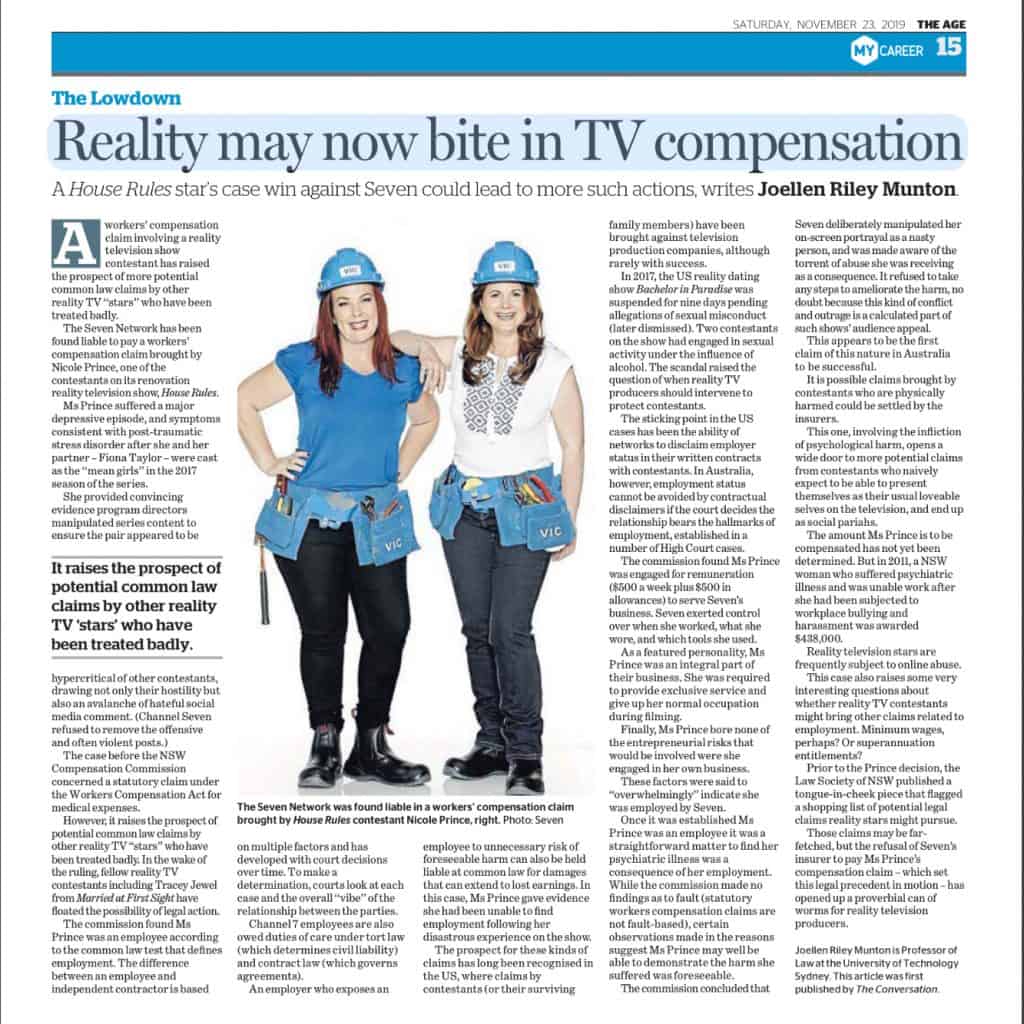
A recent court case over workers’ compensation gained a great deal of media attention in Australia because the case related to the employment status of a contestant on a reality television show. (Outside of workplace deaths the last media occupational health and safety (OHS) frenzy concerns a public servant being injured during sex.) Commentators left and right were both chuckling at the latest court decision and being alarmist about it setting a precedent. Finally a newspaper and online article has spoken of the case sensibly.

Nicole Prince, an OHS professional, competed in a reality program about house renovations. She and her partner were portrayed on the show as the nasty couple, a role that most reality TV shows look for and/or create. After leaving the show, Prince argued that she could be considered an employee of the broadcaster, Channel 7, and so was entitled to workers compensation for the psychological distress that resulted from her treatment by Channel 7, and especially on social media.
Subscribe to SafetyAtWorkBlog to continue reading.
Subscribe Help
Already a member? Log in here

Paper provides historical context to OHS laws

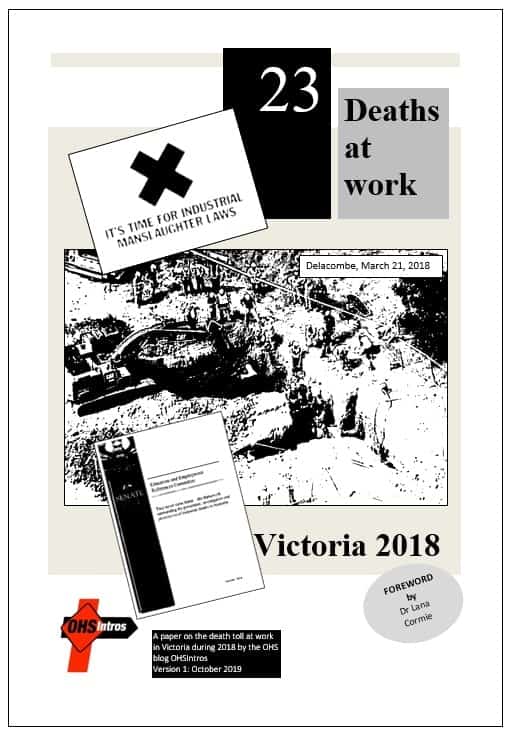
Barry Naismith of OHSIntros has provided excellent independent analysis of Victoria’s occupational health and safety (OHS) data for many years. His latest “Deaths at Work” report (available publicly for a limited time) includes a detailed discussion on the social context of Victoria’s proposed Industrial Manslaughter (IM) laws.

But of more immediate interest is Naismith’s longitudinal analysis. One of his graphs showing death statistics back to the commencement of Victoria’s modern-era OHS laws in 1985 supports the statement popular with politicians that the rate of work-related deaths is declining over that time but Naismith points out that the five-year trend to 2018 is reversed and that this is part of the justification for the IM Laws.

Subscribe to SafetyAtWorkBlog to continue reading.
Subscribe Help
Already a member? Log in here

Cocky on Industrial Manslaughter and confident on OHS of vehicles

Even before the Victorian Parliament (maybe) passes the Industrial Manslaughter amendments to the Occupational Health and Safety Act, Premier Daniel Andrews is promising new, targeted investigative resources. Even though Andrews acknowledged that the laws may not pass, he seems super-confident and we know that politics is littered with cases of over-confidence.

If the opposition Liberal/National Party coalition wanted to seriously embarrass the Premier and this Labor Government, it could nobble the changes in the Legislative Council in a move that would be popular with the major business organisations, agricultural industry groups and farmers.

Many of the issues Andrews’ raised at the Victorian Labor Party conference on 16 November 2019 make a lot of sense, but why jeopardise a crucial vote on the Industrial Manslaughter laws? And how will he bring commercial vehicles into the occupational health and safety statistics, as he has promised?

Subscribe to SafetyAtWorkBlog to continue reading.
Subscribe Help
Already a member? Log in here

Industrial Manslaughter Laws are treading water

On November 13 2019 the Victorian Parliament heard detailed debate (page 93) about Industrial Manslaughter laws but without resolution. Many of the points raised were familiar and along political party lines but of particular interest was the insights provided into how that State’s political leaders perceive occupational health and safety (OHS).

Each of the speakers reiterated the importance of OHS and how all workers deserve to go home at the end of the shift – you know the cliches and the debate held plenty of them. There was also a fundamental misunderstanding by many speakers though.

Subscribe to SafetyAtWorkBlog to continue reading.
Subscribe Help
Already a member? Log in here

Farm suicides and prevention

In a submission to the Australian Government’s inquiry into the future of work, the McKell Institute dips into Safe Work Australia’s latest statistical data and reveals a few occupational health and safety (OHS) and workers compensation surprises in the area of agriculture. These surprises are substantiated by other occupational health and safety (OHS) data sources.

Recently, SafetyAtWorkBlog chastised Australian government agencies, and politicians, from relying on workers compensation claims data as measurements of OHS rather than having established supplementary and robust sources of data on work-related injuries and illnesses. Such reliable sources would have helped anticipate some of the hazards from new employment structures and re-emerging occupational hazards. The McKell Institute wrote:

Subscribe to SafetyAtWorkBlog to continue reading.
Subscribe Help
Already a member? Log in here

Don’t be a fish; be a frog.

“Don’t be a fish; be a frog. Swim in the water and jump when you hit ground.”

Kim Young-ha

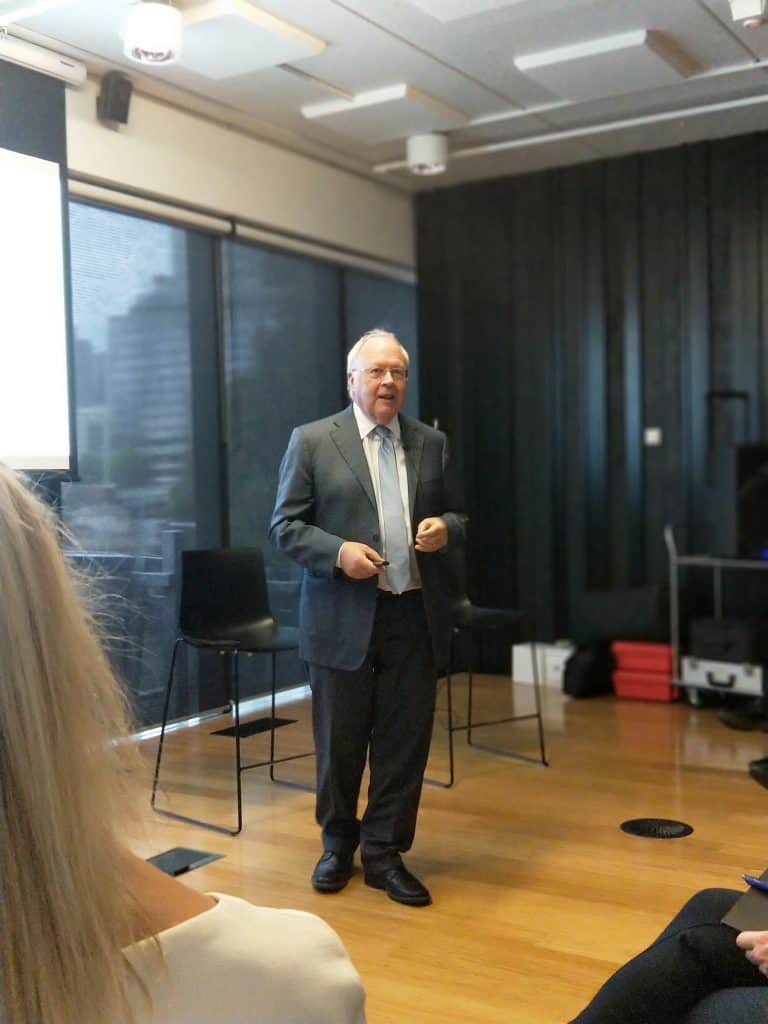
This aphorism seems apt for the safety culture journey that is occurring at Melbourne Water under the tutelage of Professor Patrick Hudson (pictured right). Melbourne Water is attempting to become a “generative organisation” in line with Hudson’s Safety Culture Maturity model and hosted a public event with Hudson in early November 2019. This provided an opportunity to hear how the model has evolved, particularly in its applications.

Subscribe to SafetyAtWorkBlog to continue reading.
Subscribe Help
Already a member? Log in here

Political Science (finally) comes to OHS

Improvement in occupational health and safety (OHS) standards has always been the intention of OHS laws. Parallel to this is the intention of the OHS, and allied, professions to continuously improve health and safety through the prevention of harm. However, political leadership on OHS has been scarce over the last few years, especially in the national governments of the United Kingdom, the United States and Australia. So, it is necessary to look beyond the party politics to other sources of change.

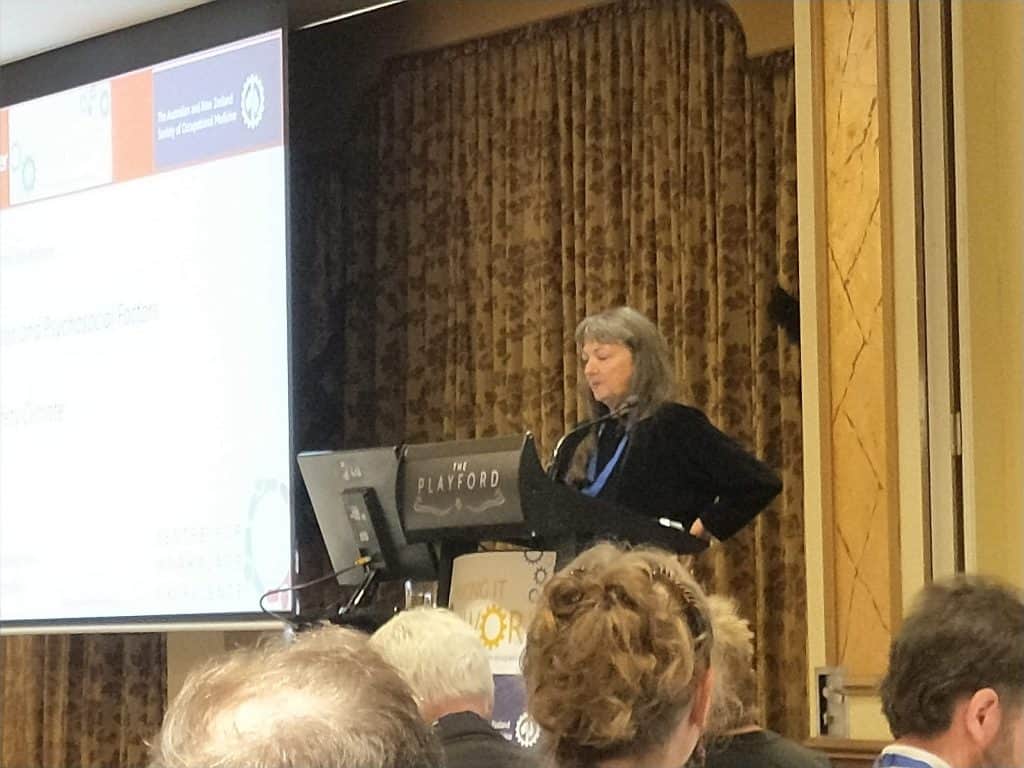
Professor Maureen Dollard speaking at the 2019 ANZSOM Scientific Meeting in Adelaide

At the recent scientific meeting of the Australia and New Zealand Society of Occupational Medicine in Adelaide, prominent academic, Professor Maureen Dollard, introduced a much- needed element of political science into her presentation which was titled “Work Organisation and Psychosocial Factors”. SafetyAtWorkBlog was able to ask Dollard, and fellow presenter Professor Sally Ferguson, about this political context.

Subscribe to SafetyAtWorkBlog to continue reading.
Subscribe Help
Already a member? Log in here
Concatenate Web Development
© Designed and developed by Concatenate Aust Pty Ltd