
Australian Governments’ flawed strategy on new OHS laws

Lawyer Andrew Douglas’ latest article for SmartCompany illustrates the conflicting approach to the enforcement of alcohol and drug policies in workplaces.  Douglas illustrates the constant struggle for business operators between employment law and safety law, workplace relations and human resources.  Case law has progressed the management of human capital more quickly than has safety management over the same workplace issue of alcohol and drug use leading to a difficulty in determining the best managerial approach to the hazard.

Douglas’ discussion of the role of case law in changing managerial approaches also has relevance in the OHS harmonisation process currently occurring in Australia.  In the early days of this process, the legal fraternity believed, and often publicly stated, that the operation of the law will be “ironed out” only after several years of prosecutions and case law.  These statements seem to forget that behind almost all OHS prosecutions are one or more injured workers and the reality is often forgotten when part of a lawyer’s motivation is also to seek a precedent or a clarification of the law. Continue reading “Australian Governments’ flawed strategy on new OHS laws”
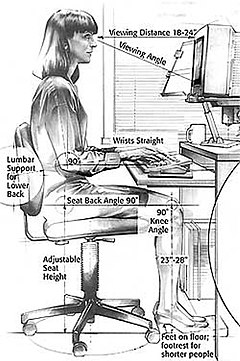
Ergonomics advice does not always reflect the reality

It is common for companies to invest in expensive office furniture in the belief that the furniture will encourage the worker to undertake tasks more safely.  In most circumstances, this is a waste of money and a major distraction from managing safety throughout workplaces.

The safety message is also being confused by some OHS regulators.  It is well-established that injured backs and other musculoskeletal injuries improve with movement rather than the traditional bed-rest.  However this encouragement to move is not reflected in most of the advice for configuring workstations.  Continue reading “Ergonomics advice does not always reflect the reality”

OHS compliance checklists

For several months some Australian OHS regulators have been providing “Compliance at a glance” checklists. These are not intended to establish compliance, particularly in the small business sector as listed on one regulator’s website , but are more brief indicators of areas for greater improvement.

Nevertheless the items listed in the “red zone” of the checklists establish a benchmark of NON-compliance. These items are listed below:

Australian Government moves to a national workers’ memorial

Earlier this week, the Australian Treasurer, Wayne Swan, delivered the budget statements for the next 12 months.  There were several issues that may have an impact on industrial relations and workplace safety over the next few years but the most obvious and tangible commitment was on the issue of a national worker’s memorial.

According to Budget Paper Number 2 (page 167):

“The Government will provide $3.6 million over four years for the establishment of a National Workers’ Memorial and an interactive website. The National Workers’ Memorial will honour Australian workers who have lost their lives due to work related accidents, incidents or disease, and serve as a reminder of the importance of workplace safety.”

The project will be coordinated by the Department of Education, Employment and Workplace Relations who, it is understood, has  already been discussing this concept.

Additional detail is required about the project as there is a major opportunity to build a dignified memorial and website but there is also a risk of producing something that alienates those worker support groups.  Any issues related to a memorial about worker deaths requires careful consideration and coordination.

Kevin Jones

Queensland’s Work Health Safety Bill in Parliament

Several submissions to Australia’s OHS harmonisation process were very critical of the lack of attention provided to the occupational diving industry.  It seems that the Queensland Government has been listening as it has introduced into Parliament a Safety in Recreational Water Activities Bill 2011 alongside its State-version of the model Work Health and Safety Bill (WHS).  The safe diving bill is an example of the additional State-level OHS legislation that the harmonisation process has always allowed for, and may pave the way for “specialist” OHS laws in other States.  The Queensland process is slightly different from how the New South Wales government has approached its OHS legislation.

The bill, as outlined in Hansard, uses model WHS bill language:

“Now I turn to some of the specifics. The Safety in Recreational Water Activities Bill includes the following key elements:

Farm deaths require radical approach

WorkSafe Victoria has reported  that of seven recent work-related fatalities, three have occurred in regional areas on farms.  The most recent death was misreported as involving a quad bike.

In a media release issued on 10 May 2011, WorkSafe’s Ian Forsythe said,

“Safety’s not just about what WorkSafe does. It’s about employers, workers and the wider community taking ownership of it not just for themselves, but the wider community.

It is imperative that regional Victorians, whether they are employers, self-employed or workers to stop and think about what is ultimately important to them and what they can do to prevent more tragedies affecting them and their communities.”

Over the last 20 years WorkSafe has tried a wide variety of safety campaigns in rural farming communities.  Some have Continue reading “Farm deaths require radical approach”

OHS news and content suggestions welcome

Recently, readers have been providing tip-offs to OHS issues that are not being covered by the traditional media.  SafetyAtWorkBlog has always inhabited this niche but is looking to expand its story source options.

I am encouraging readers to provide not only news tip-offs but to also suggest safety issues that could form the basis of a SafetyAtWorkBlog article.  For instance, do you know of an extraordinary safety person whose story requires a broader audience?  Is there a design fault with a safety product that the manufacturer is not attending to?  Is the application of a safety law having an unexpected effect at a workplace?

Tip-offs and suggestions can be anonymous but I reserve the right to reject any suggestions that I feel are not suitable for the SafetyAtWorkBlog.  The more specific and detailed your information for the article (contact details, photos, reference documents etc.), the higher the priority given.

But don’t forget that if you have the writing bug, you are welcome to send through articles for consideration.

Kevin Jones

Concatenate Web Development
© Designed and developed by Concatenate Aust Pty Ltd