Brodie Panlock – the catalyst for new bullying/stalking laws

Brodie’s Law” is gaining considerable attention in the Victorian newspapers in anticipation of the introduction of the Crimes Amendment (Bullying) Bill 2011 in Parliament but it may be unreasonable to label these changes “Brodie’s Law” as, although Brodie Panlock’s suicide and the related court actions were the catalyst for the Bill, the proposed Bill is much broader than workplace bullying and, in many ways, focuses more on stalking than bullying, if there can be a differentiation.

The draft bill will broaden the existing offence of stalking in the Crimes Act to capture types of bullying behaviour and are likely to expand the types of  environments in which such bullying can occur. Continue reading “Brodie Panlock – the catalyst for new bullying/stalking laws”

Is this how safety should be promoted?

One of the first OHS trade exhibitions for 2011 in Australia starts today.  Exhibitions like Safety In Action are the best opportunities for many health and safety professionals, representatives and students to update their product knowledge.  It is usually here where one finds out about non-steel capped safety footwear, new fall harnesses or the latest interlock devices.  But do these innovative products needs to be promoted by scantily clad women as in the picture on the right?

This has been a constant annoyance at trade exhibitions for some time and, in fact, some exhibitions in Australia in 2010 received complaints about this type of promotional strategy.  Scantily clad women do attract the attention of potential clients, particularly in male-dominated industries, but there is considerable debate about whether the strategy promotes the product or the breasts. Continue reading “Is this how safety should be promoted?”

Success from enlightenment not compliance

An article in the InDaily online newspaper for 4 April 2011 provides several safety management issues that are worth pondering. (Thanks to the readers who brought the article to my attention)

Keith Brown was the CEO of South Australia’s Workcover Corporation earlier this century.  He has told InDaily that he lost his position due to a change in the politics of the state and has not been welcome since. (A more personal perspective on Brown was provided by Rosemary McKenzie-Ferguson in a January 2011 blog comment.)

Brown says that the most effective way of reducing the unfunded liabilities of workers compensation is to communicate with all stakeholders in the injury management process.  He believes that

“WorkCover now operates more to service the needs of the bureaucracy compared to the operation he ran for six years in favour of the clients.” Continue reading “Success from enlightenment not compliance”

Transocean executives gain safety bonuses

News that Transocean are awarding their executives substantial safety bonuses has the internet aflame with outrage.  Certainly it seems hard to justify the bonuses given after the death of 11 workers and the damage to the local environment, economy and community but the action will also affect safety management.

 Safety management is increasingly relying on statistics to identify performance levels.  Transocean’s actions illustrate that some statistics bear little relation to reality or, at least, the real-world context of its operations.

AFP  quotes Transocean as reporting to the US Securities and Exchange Commission that:

“Notwithstanding the tragic loss of life in the Gulf of Mexico, we achieved an exemplary statistical safety record as measured by our total recordable incident rate and total potential severity rate” Continue reading “Transocean executives gain safety bonuses”

Useful safety information from the US

One always has to be careful about information released on April Fools’ Day but in 2011 an important pieces of safety information from the United States was released – a video message from the Chemical Safety Board (CSB).  A reader also pointed to a set of OHS case studies from the University of Massachusetts Lowell (UMASS) released in January.

Twelve months after the Tesoro Refinery fire in Washington in which seven people died, CSB is continuing its investigation but has released a video message, by Chairperson Rafael Moure-Eraso, that is confronting and displays the exasperation of  safety regulators.

Continue reading “Useful safety information from the US”

Workplace safety challenges for the Coffice

What is a workplace?  In Australia, the easy answer is “wherever work takes place”.  This seems sensible and logical but think about it and the impact on businesses and community will be large.  The Sunday Age newspaper reports on one business that is setting down some ground rules for those who are running businesses from their cafe or, what the article describes as “coffices“. Continue reading “Workplace safety challenges for the Coffice”

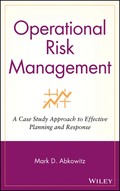
Operational Risk Management – a timeless book, sadly

For several years now Mark Abkowitz’s book “Operational Risk Management” has been sitting on my “to-read” shelf.  Given my recent wish for a case study approach to leadership and given the Fukushima nuclear issues, the book caught my attention.

Books that analyse disasters are far superior to watching real-time disasters because the distress is minimised, the analysis can be dispassionate and time can provide a more detailed context.  (The quickness of production of some of the books about the BP/Gulf of Mexico suffered from the curse of topicality)  Books provide a distance that the constant exposure to “disaster porn” does not.

Operational Risk Management looks at many at many disasters from the last 30 years but the disasters are not only industrial and process disasters, although Chernobyl and Bhopal are covered. Continue reading “Operational Risk Management – a timeless book, sadly”

Concatenate Web Development
© Designed and developed by Concatenate Aust Pty Ltd